
As hospitals accelerate investments in AI diagnostics, precision medicine, and digital health, healthcare experts say continuous physician education will determine whether these technologies deliver better patient outcomes.
Artificial intelligence has rapidly become one of healthcare’s most transformative technologies. From assisting radiologists in detecting cancers to helping clinicians prioritize critical cases and supporting precision medicine, AI is reshaping how diseases are diagnosed and managed. South Korea has emerged as one of the global leaders in this transformation, driven by a thriving ecosystem of medical AI companies including Lunit, VUNO, Deepnoid, Coreline Soft, and JLK, alongside government initiatives to expand digital healthcare and smart hospitals.
Yet healthcare leaders increasingly argue that technological innovation alone is not enough. Sophisticated diagnostic equipment, AI-powered imaging platforms, and precision medicine tools only achieve their full clinical potential when healthcare professionals possess the skills to use them accurately, confidently, and consistently.
As hospitals worldwide continue digitizing clinical workflows, attention is gradually shifting toward an equally important question: how should physicians be trained for an era where artificial intelligence and advanced imaging technologies become routine components of patient care?
The discussion extends well beyond software development or medical devices. Increasingly, healthcare systems are investing in continuous professional education, simulation-based learning, and competency-based training programs designed to help clinicians adapt to rapidly evolving technologies throughout their careers.
During an exclusive conversation with KoreaTechToday, experts from the Center for Diagnostics and Telemedicine of the Moscow Health Department (MHD) said that ongoing physician education has become a critical complement to advances in medical technology.
Technology is evolving faster than traditional medical education
Medical innovation no longer occurs over decades. New imaging systems, AI algorithms, robotic procedures, and precision medicine approaches are entering hospitals at an unprecedented pace. While these technologies promise faster diagnoses and more personalized treatments, they also require physicians to continually develop new competencies. Experts argue that this represents one of healthcare’s biggest challenges. Investments in AI must be matched by investments in the professionals expected to use those tools in real clinical environments.
“Modern technologies create vast opportunities in medicine, but their clinical impact depends critically on the competence of the clinicians who deploy them. Consequently, advances in diagnostic hardware, imaging platforms, and AI-powered tools must be matched by ongoing enhancement of physicians’ professional skills,” the organization told KoreaTechToday.
“Continuing medical education enables practitioners to adopt new diagnostic and therapeutic approaches rapidly, appreciate the capabilities and limitations of new technologies, and apply them safely and effectively in patient care.
“This imperative is particularly acute in oncology, where earlier detection materially improves prognosis. The integration of highly qualified physicians, modern imaging techniques, and AI solutions forms the foundation for more accurate diagnostics, informed clinical decision-making, and enhanced quality of care.”
The message reflects an increasingly common perspective across global healthcare systems. AI is not replacing physicians. Instead, it is changing the skills physicians must master.
Standardized training is becoming a strategic priority
As healthcare technologies become more sophisticated, consistency in physician training is attracting greater attention. Hospitals often operate with different equipment, workflows, and educational resources, creating variations in procedural competency. Standardized simulation platforms seek to address this challenge by allowing clinicians to repeatedly practice procedures under realistic conditions while ensuring comparable educational outcomes.
According to the Moscow Health Department, reusable simulation technologies represent one practical solution.
“Despite rapid development in digital technologies and personalized medicine, the quality of oncological care remains highly dependent on the practical skills of physicians. Consequently, the standardization of specialist training continues to be a key challenge for healthcare systems worldwide.
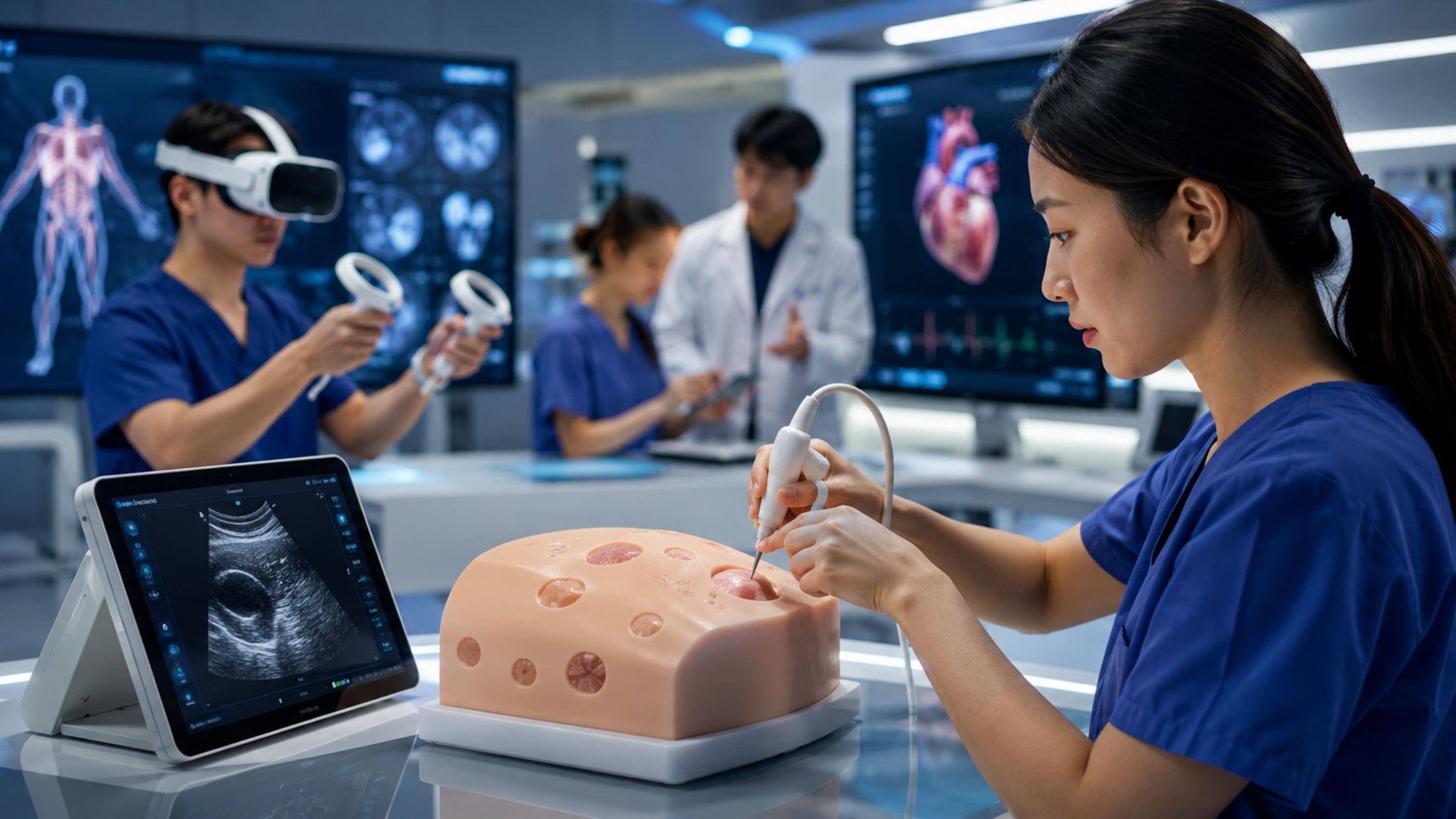
“Reusable phantoms enable the replication of realistic clinical scenarios and support a standardized approach to training, irrespective of the medical institution or country. Physicians are afforded the opportunity to repeatedly practice the full cycle of diagnostic procedures, from lesion detection and differential diagnosis to ultrasound-guided biopsy. This training format facilitates the development of practical competencies and allows for objective assessment of specialist proficiency.”
Unlike traditional single-use training models, reusable simulators also improve cost efficiency while enabling repeated practice, making advanced procedural education more accessible across larger healthcare systems.
South Korea’s digital healthcare ambitions depend on workforce readiness
South Korea has invested heavily in becoming a global leader in digital healthcare. Hospitals across the country are increasingly deploying AI-assisted diagnostic software, robotic surgery platforms, cloud-based medical imaging systems, and precision medicine programs. Government initiatives continue encouraging digital transformation across hospitals while supporting the commercialization of medical AI developed by domestic startups.
However, healthcare experts increasingly recognize that digital transformation extends beyond technology procurement. Successfully integrating AI into everyday clinical practice requires physicians who understand not only how to interpret AI-generated results but also when algorithms should be questioned, how new technologies fit into clinical workflows, and how digital tools can complement rather than replace medical judgment.
Continuous education therefore becomes essential for maintaining clinical quality while ensuring patient safety. For South Korea, where population aging and growing healthcare demand continue placing pressure on hospitals, structured professional development may also help clinicians adapt more efficiently as medical technologies evolve.
Simulation is becoming part of lifelong medical learning
One emerging trend supporting this transition is simulation-based education. Modern medical simulators have advanced significantly beyond traditional anatomical models. Today’s technologies increasingly combine realistic materials, digital imaging, artificial intelligence, and data-driven performance assessment, allowing physicians to repeatedly practice complex procedures without risk to patients.
Beyond improving technical proficiency, simulation also supports competency-based education by enabling objective evaluation of procedural skills before physicians perform interventions in clinical settings.
For healthcare systems seeking greater consistency across hospitals, simulation provides a practical framework for standardizing education while reducing dependence on variable clinical case exposure. As these technologies continue improving, simulation is expected to become an increasingly routine component of continuing medical education rather than simply an optional training exercise.
Healthcare innovation requires investment in both technology and people
Much of the global discussion surrounding healthcare innovation focuses on artificial intelligence, medical devices, and digital platforms. These technologies undoubtedly represent important advances. Yet their effectiveness ultimately depends on the professionals responsible for integrating them into patient care. For healthcare organizations, that means balancing investments across both technological infrastructure and workforce development.
Key priorities increasingly include:
- Expanding continuous professional education alongside AI adoption.
- Standardizing simulation-based training to improve procedural competency.
- Preparing clinicians to safely integrate emerging digital technologies into routine practice.
- Strengthening collaboration between technology developers, hospitals, and medical educators.
Healthcare’s digital transformation is entering a new stage. During the past decade, innovation has largely focused on developing more accurate AI algorithms, improving medical imaging, and expanding precision medicine. These advances will continue shaping healthcare systems worldwide. Increasingly, however, the conversation is expanding beyond technology itself.
The next competitive advantage may lie in how effectively healthcare systems prepare physicians to use these innovations. Continuous professional education, competency-based learning, and realistic simulation are becoming essential components of modern healthcare infrastructure rather than supplementary educational tools.
For South Korea, which continues investing aggressively in AI-driven healthcare and digital hospitals, this shift carries particular significance. Building world-class healthcare will depend not only on adopting the most advanced technologies, but also on ensuring physicians continuously develop the expertise required to apply them safely, confidently, and effectively. As AI becomes embedded across clinical practice, continuous physician training may prove just as important as the technologies transforming medicine itself.