
As video becomes central to digital platforms, advertising and online communication, AI systems are being developed to interpret more than images and generate captions. South Korean startup PYLER is applying multimodal video understanding to identify context, assess content suitability and support decisions across digital video environments.
The rapid expansion of generative AI has made it possible to create text, images and videos with increasing sophistication. Yet as the volume of digital content grows, another challenge is becoming more pressing: understanding what that content actually contains. For businesses, recognising objects or generating descriptions is often insufficient. They need systems that can interpret events, identify context and determine whether content meets specific requirements.
This is particularly relevant to video, where meaning can depend on the relationship between images, dialogue, background sounds and events unfolding over time. A July 2026 research survey on multimodal video understanding identifies cross-modal alignment, semantic interpretation and multimodal reasoning as key capabilities, while highlighting persistent challenges involving long videos, noisy information and the reliability of AI-generated interpretations.
South Korean startup PYLER is developing technology in this emerging field, applying video understanding to brand safety, contextual advertising and content assessment. Its work reflects a broader shift towards AI systems designed not only to generate information, but also to interpret it for practical business decisions.
Why Video Understanding Requires More Than Recognition
Conventional video-analysis systems typically identify objects, people, activities or scenes. More advanced systems can generate captions and summaries. However, understanding a video’s context requires connecting several layers of information.
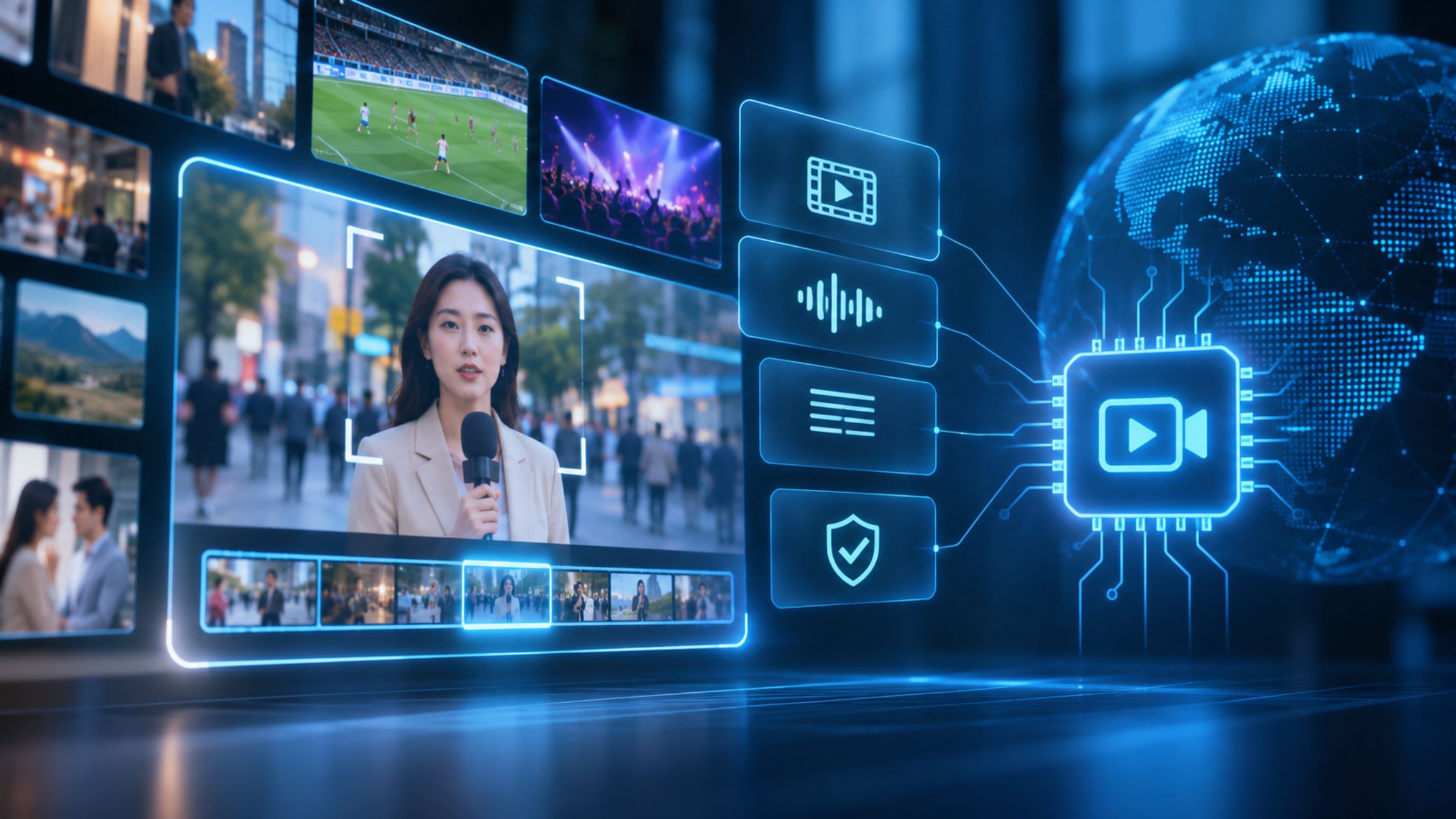
Visual analysis identifies what appears on screen, while audio processing interprets dialogue, music and background sounds. Temporal understanding establishes how events develop and relate to one another. Contextual reasoning brings these elements together to determine what is happening and why it matters.
The distinction is important for applications such as advertising and content moderation. A system may recognise a person, an object or an activity without understanding whether the surrounding scene is appropriate for a particular advertiser or violates a platform’s content standards.
Research in multimodal video understanding is increasingly focused on this challenge. Models must identify relevant moments, connect information across different modalities and produce reliable conclusions without processing every frame at excessive computational cost.
Turning Video Context into Business Decisions
For advertisers and digital platforms, the commercial value of video understanding lies in its ability to support decisions at scale. Brand safety systems, for example, need to identify content that could expose advertisers to reputational risks. Contextual advertising requires a more nuanced assessment of whether a scene aligns with a campaign, while trust and safety applications need to identify potentially harmful or policy-violating material.
PYLER addresses these requirements through its Antares video-understanding technology. Its platform combines visual, audio and textual information to analyse video at the level of individual moments and apply specific content-assessment criteria.
The company has developed applications including AiD, focused on brand safety, and AiM, which supports brand suitability and contextual targeting. Its approach moves beyond keyword-based filtering by assessing the meaning and context of video content.
A case study published by NVIDIA reports that PYLER’s system processes approximately two million videos daily and has reduced unsafe content exposure by 76.7% for major advertisers. NVIDIA also describes the company’s use of time-aware video representations to support contextual search and content validation. These figures are company-reported results presented in the partner case study, rather than independently established industry benchmarks.
Extending Video Analysis to Live Broadcasting
One of the more significant challenges for video-understanding technology is analysing live content. Unlike video-on-demand material, which can be processed before distribution, live broadcasts contain unpredictable scenes and require decisions to be made in real time.
PYLER demonstrated an application addressing this challenge after being named among the Top 10 finalists of the NVIDIA Inception Grand Challenge 2026 in Singapore. The company presented technology developed with a global free ad-supported streaming television (FAST) operator to analyse connected TV (CTV) live broadcasts scene by scene.
The system examines dialogue, visuals and audio to determine whether individual scenes are suitable for advertising. This is particularly relevant to live news and other broadcasts, where unexpected footage can make it difficult to assess advertising suitability in advance. The development extends PYLER’s video-analysis capabilities from video-on-demand content to live streaming environments.
The application illustrates how contextual analysis could help streaming providers identify advertising opportunities within live content while applying more granular suitability standards.
Specialised AI and the Importance of Domain Expertise
The development also reflects a wider question facing the AI industry: how can specialised companies compete as large technology providers continue to advance general-purpose models?
Jaeho Oh, CEO of PYLER, believes the next phase of AI competition will extend beyond building increasingly large models. While conversing with KoreaTechToday, he said:
“We believe the future of AI will involve more than competition to build increasingly large foundation models. General-purpose models have made remarkable progress, but real-world applications often require capabilities that go beyond what a broad model can provide out of the box.
“Video understanding is one example. Videos contain enormous amounts of visual, audio, and temporal information. Interpreting them accurately at scale requires more than recognizing objects or generating descriptions. It also requires understanding context, managing computational costs, and adapting to specific customer needs.”
For PYLER, this means developing technology around the requirements of particular applications rather than treating video analysis as a single, general-purpose task. Oh emphasised that even accurate descriptions have limited commercial value if they do not support a meaningful decision. Different industries require different levels of detail and different standards for assessing safety, suitability and relevance.
The company’s research direction also reflects the importance of audio and data quality. In October 2026, PYLER announced that two research papers had been accepted at NeurIPS 2026. One explores how AI can interpret non-verbal speech information, including emotion and intonation, while the other addresses model training with erroneous or uncertain data. Both areas are relevant to improving how AI systems interpret information that may otherwise be lost or misrepresented.
Oh believes that combining technical capabilities with industry knowledge will determine which specialised AI companies can establish a competitive position.
“We believe the real competitive advantage lies in combining strong AI capabilities with deep domain knowledge and turning that understanding into practical solutions. This is where specialized AI companies can compete globally: not merely by building larger models, but by making AI genuinely useful in specific industries.”
As video distribution expands across social platforms, streaming services and connected television, the ability to interpret content accurately is becoming an increasingly important part of the digital ecosystem. However, scaling this capability requires more than sophisticated models. Systems must deliver consistent results, manage processing costs and adapt to the different standards applied by businesses and platforms.
For South Korean AI startups, this creates an opportunity to build specialised capabilities around specific industry problems rather than competing solely on foundation-model scale. PYLER’s work in video understanding demonstrates one possible direction, combining multimodal analysis with commercial applications in advertising and content assessment.
The broader challenge will be turning technical advances into reliable infrastructure that businesses can deploy across platforms and markets. As generative AI increases the volume of digital content, the ability to understand and evaluate that content could become as important as the ability to create it.