
As cyberattacks increasingly exploit software supply chains, digital identities, cloud infrastructure and interconnected services, South Korea faces the challenge of protecting an economy in which vulnerabilities can extend far beyond individual systems.
South Korea’s digital economy is among the most connected in Asia, with technology deeply embedded in telecommunications, financial services, manufacturing, healthcare and everyday consumer activity. But this interconnectedness also creates a complex cybersecurity challenge. A vulnerability in one organisation, software supplier or digital service can expose systems that depend on it, extending the consequences of an attack beyond its initial target.
The scale of the challenge is reflected in South Korea’s cybersecurity statistics. The country recorded 2,383 reported cybersecurity incidents in 2025, a 26.3% increase from 1,887 in 2024. The pressure continued into 2026, with 1,236 incidents reported to the Korea Internet and Security Agency (KISA) during the first half of the year, up 19.5% from the same period in 2025.
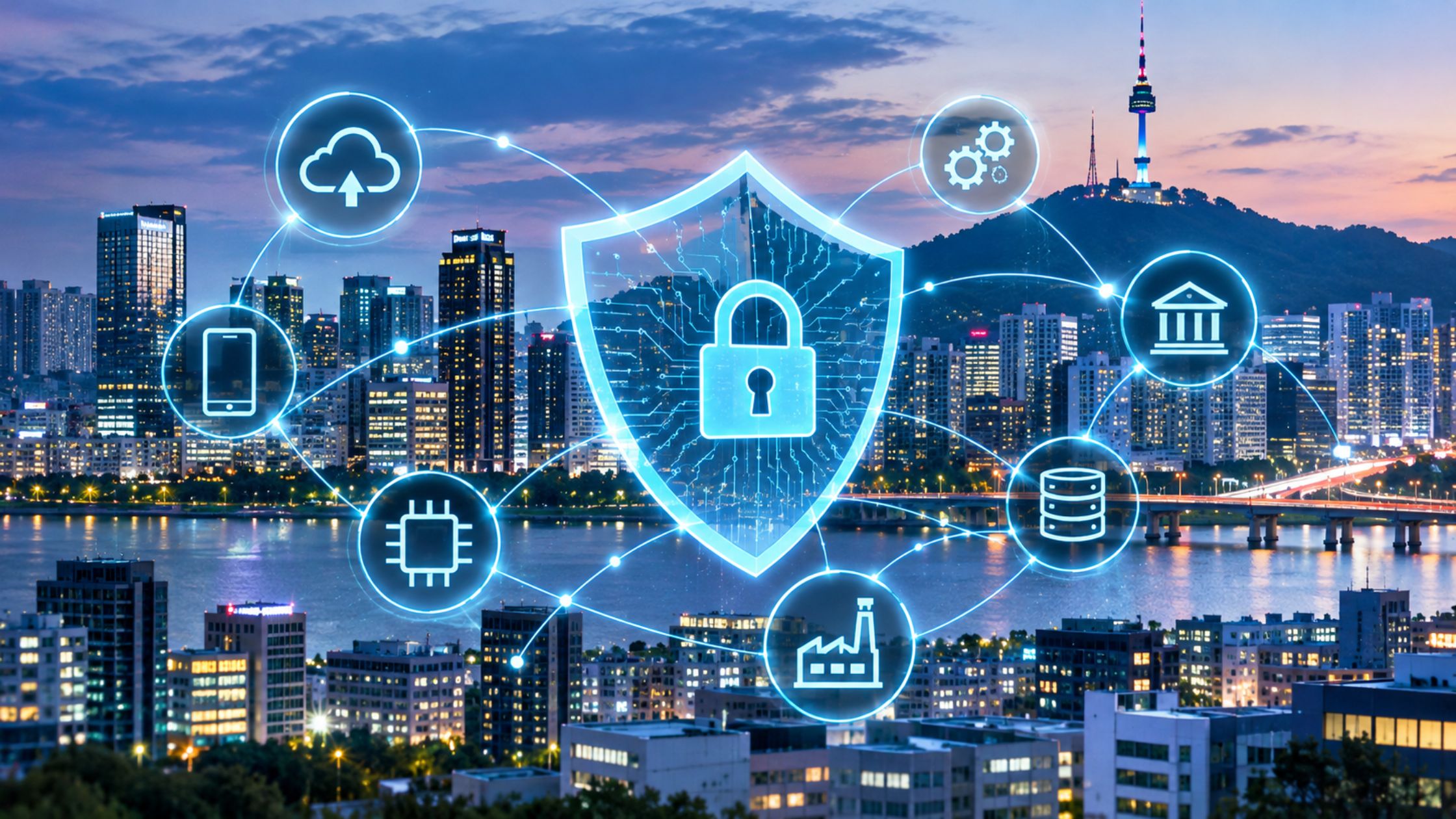
For a technology-intensive economy, the concern is not simply the growing number of incidents, but the potential for security failures to spread across connected systems. This is pushing cybersecurity beyond conventional network protection towards a more coordinated approach involving devices, identities, software suppliers, cloud infrastructure and critical services.
South Korea’s expanding attack surface
The composition of reported incidents in 2025 illustrates the range of threats facing South Korean organisations. Server intrusions accounted for 44.2% of incidents, followed by distributed denial-of-service (DDoS) attacks at 24.7% and malicious code, including ransomware, at 14.9%.
More recent data points to continued pressure from DDoS attacks, ransomware, API vulnerabilities and account compromise. The Ministry of Science and ICT also identified software supply-chain attacks and the growing use of generative AI in cyber threats as important concerns.
Gokul Landge, Chief Business Analyst at cybersecurity company Xproguard, believes South Korea’s digital environment creates a distinct risk profile, even though many of the threats are shared across Asia.
“Yes. South Korea’s advanced digital infrastructure creates a distinct risk profile, although many of these threats are shared across Asia. The country’s high connectivity, technology-intensive industries, and geopolitical environment increase the potential impact of cyberattacks.”
His observation highlights an important distinction. Digital connectivity does not necessarily introduce entirely new categories of cyber threats. Instead, it increases the number of connected systems that may be exposed and the potential consequences when one of them is compromised.
Why security must extend beyond organisational boundaries
Software supply chains have become a particularly important vulnerability. Businesses increasingly depend on third-party applications, open-source components, cloud providers and external development environments. A weakness in one component can potentially affect multiple organisations using the same software.
South Korea’s government is responding to this challenge through its Software Supply Chain Security Roadmap, announced in June 2026 by the Ministry of Science and ICT and the National Intelligence Service.
The roadmap promotes security throughout software development and distribution, including wider use of Software Bills of Materials (SBOMs), vulnerability discovery, AI-assisted security automation and stronger cooperation between public and private organisations. Its underlying objective is to identify risks earlier and reduce the possibility of attacks spreading through interconnected supply chains.
The importance of this approach is also evident in South Korea’s experience with major data breaches. The 2025 Coupang incident, for example, exposed weaknesses in authentication and access controls. A February 2026 government investigation found that a former employee had exploited an internal signing key to generate fraudulent login tokens, potentially exposing information belonging to approximately 33.7 million customers.
The incident demonstrated that cybersecurity failures do not always require sophisticated attacks against infrastructure. Weak access management, insufficient oversight and failures to revoke credentials can create substantial exposure even within established digital businesses.
AI is changing the nature of cybersecurity threats
The growing use of artificial intelligence adds another layer of complexity. Attackers can use AI to accelerate vulnerability discovery, develop convincing phishing messages and create deepfake voices or videos for impersonation. Meanwhile, organisations face risks involving compromised identities, malicious software and vulnerabilities in cloud-connected applications.
Landge identifies several areas requiring particular attention in South Korea:
- AI-generated deepfakes and social engineering.
- Mobile security, identity theft, phishing and malicious URLs.
- Cloud and software supply-chain vulnerabilities.
- Attacks targeting critical infrastructure.
These threats affect different parts of the digital ecosystem but can intersect. A stolen identity could provide access to cloud services, while a compromised software component could expose enterprise systems. Deepfake-enabled impersonation could also undermine trust in digital communications and business transactions.
Consequently, cybersecurity strategies need to account for both technical vulnerabilities and the human interactions that attackers increasingly exploit.
Moving towards layered cybersecurity
South Korea is already moving towards a more coordinated security model. Its May 2026 cybersecurity measures included plans for AI-assisted vulnerability detection, a dedicated vulnerability management centre under KISA and stronger monitoring of major companies in critical industries. The government also outlined support for smaller businesses, recognising that weaknesses among less-resourced suppliers can create risks for larger organisations.
For security providers, this shift creates demand for approaches that combine proactive testing, endpoint protection, identity security and continuous threat monitoring.
Xprobyte, the company behind Xproguard, positions its broader security ecosystem around three offerings: Xproguard for consumer protection, Xproshield for enterprise security and XproAI for AI-driven threat detection and digital trust capabilities.
Landge argues that these areas need to work together rather than operate as isolated security functions.
“The priority is to combine proactive security testing, device and data protection, and AI-powered threat detection to reduce risks before they escalate.”
However, the effectiveness of an integrated strategy depends on more than the availability of security products. Organisations need visibility across their technology environments, clear accountability for third-party risks, timely vulnerability patching and coordinated incident response.
Cybersecurity must evolve with digitalisation
South Korea’s experience reflects a wider challenge facing digitally advanced economies. As businesses connect more services, applications and infrastructure, cybersecurity can no longer be treated as a collection of separate protections managed within individual organisations.
The country’s software supply-chain roadmap and AI-assisted defence initiatives indicate a growing recognition that security must extend across the systems on which its economy depends. For businesses, this means moving from reactive responses towards continuous risk assessment, stronger supplier oversight and shared threat intelligence.
Landge’s assessment captures the underlying principle: “However, these challenges are not exclusive to South Korea; what matters is how interconnected systems can amplify their impact.”
He added that Xprobyte aims to address these risks through a proactive, layered approach that protects users, secures organisations and strengthens digital trust. As South Korea continues expanding its AI, cloud, mobile and industrial technology capabilities, the resilience of its digital economy will depend not only on how securely individual systems are built, but also on how effectively they are protected together.