
As connected TV and ad-supported streaming expand, AI companies are developing tools to analyse live video scene by scene, helping advertisers assess brand suitability and platforms unlock advertising opportunities that conventional systems struggle to identify.
South Korea’s streaming market is creating new opportunities for advertisers, but it is also exposing a challenge in how live video content is evaluated for commercial use. A Q3 2026 study by advertising technology company Magnite, surveying 905 South Korean adults who watch ad-supported streaming video, found that 67% used ad-supported services, 69% watched streaming content through connected TV (CTV) or IPTV, and 72% watched live streams at least once a month. The study also found that 46% were more likely to remember brands advertised during live streams than during on-demand content.
As audiences move between streaming platforms, broadcasters and connected television services, advertisers need more precise ways to determine where their messages appear. This becomes particularly difficult during live broadcasts, where scenes cannot always be assessed in advance and unexpected footage can create brand-safety concerns.
South Korean AI startup PYLER is addressing this challenge with video-understanding technology that analyses live broadcasts at the scene level. The company was selected among the final Top 10 participants in the NVIDIA Inception Grand Challenge 2026, held in Singapore on September 22, after presenting its approach to identifying advertising opportunities within CTV live streams.
Live Streaming Creates a New Advertising Challenge
Unlike Video-on-Demand (VOD), which can generally be analysed before distribution, live broadcasts require content to be assessed as it unfolds. News programmes, sports coverage and other real-time formats can move between scenes with very different commercial implications.
Advertising systems also rely on signals that distinguish programme content from advertising breaks. When these signals are incomplete or lost during streaming, platforms can struggle to identify suitable advertising placements. A broadcaster may consequently restrict advertising across an entire programme rather than risk placing an advertisement alongside inappropriate footage.
This creates both a brand-safety concern and a monetisation problem. Content that could contain commercially suitable scenes may remain underutilised because platforms cannot reliably distinguish those moments from potentially sensitive material.
The opportunity is becoming increasingly relevant as South Korea’s free ad-supported streaming television (FAST) market expands. According to Omdia, the market is projected to grow from US$23 million in 2024 to US$48 million by 2030. Services such as Samsung TV Plus, LG Channels and Wavve are contributing to the country’s growing ad-supported streaming ecosystem.
Moving From Object Recognition to Scene-Level Understanding
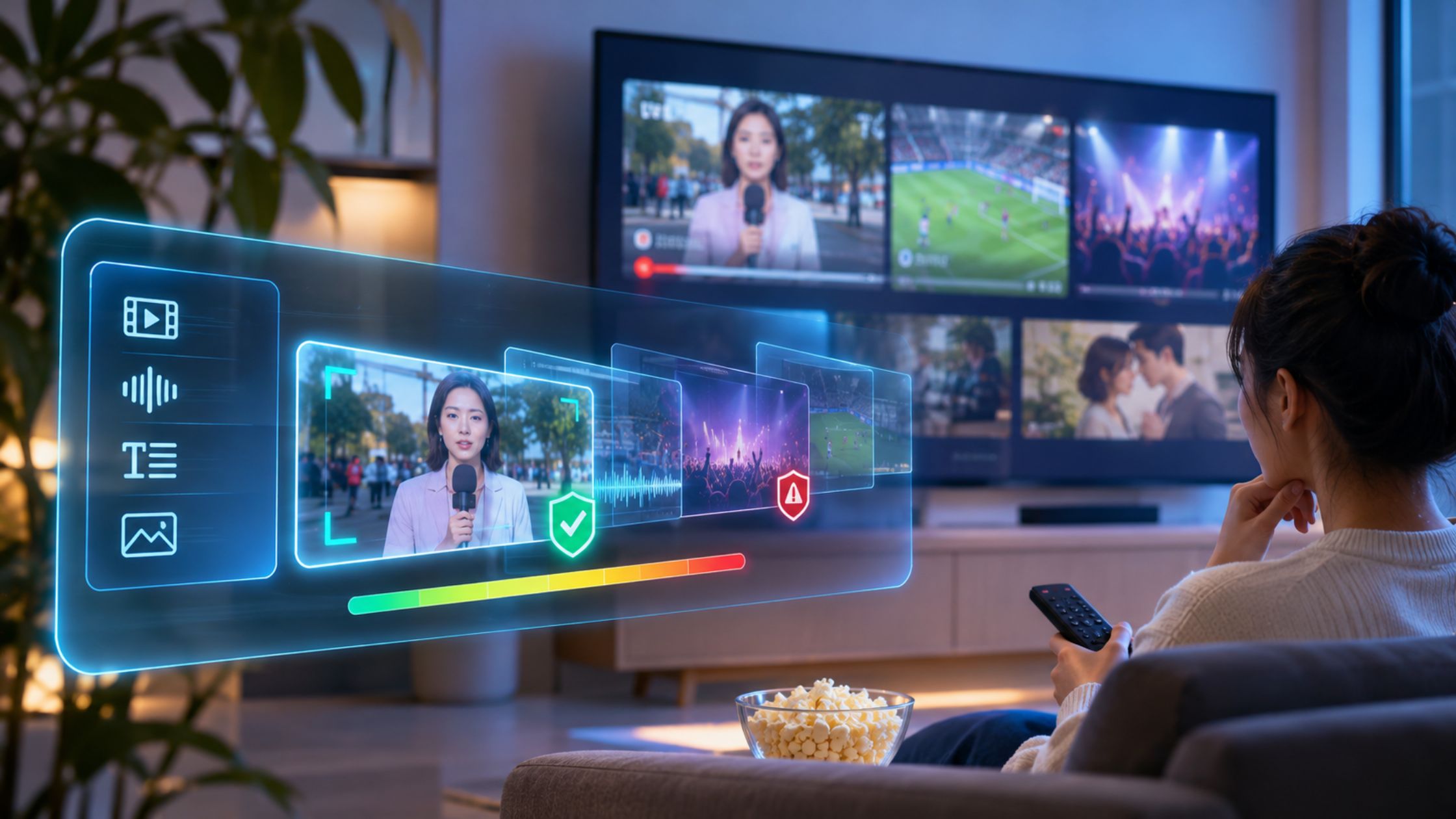
PYLER’s approach involves analysing multiple signals within a video rather than relying solely on individual objects or keywords. Its proprietary video-understanding engine examines dialogue, on-screen text, sound, brands, locations and actions to interpret the context of each scene.
The system then assigns safety status and ratings to individual sections, helping identify where advertisements can be placed. This allows live broadcasts, which might otherwise be assessed as a single block of content, to be divided into more granular advertising inventory.
The distinction is important. Identifying a particular object or word does not necessarily establish whether a scene is suitable for a brand. Contextual analysis can provide additional information about what is happening and how different elements relate to one another.
PYLER has previously applied its video-understanding technology to VOD and digital platforms. Its presentation at the NVIDIA competition extended that approach to CTV live broadcasting, drawing on advertising-related work conducted with a global FAST provider.
NVIDIA Recognition Highlights Commercial Potential
PYLER, led by CEO Jaeho Oh, progressed to the Top 20 before advancing to the final presentation round and securing a place among the Top 10 companies. The company’s announcement said more than 500 AI startups from the Asia-Pacific region participated. No separate rankings were assigned among the final 10.
The recognition follows PYLER’s victory at AI Day Seoul, a competition for Korean startups held in 2025, marking its second consecutive year of recognition in an NVIDIA programme.
The NVIDIA Inception Grand Challenge expanded the earlier Korean programme into the wider Asia-Pacific market, connecting AI startups with business challenges from major companies. The evaluation considered technology validation, potential pilots and opportunities for commercial collaboration. The selected Top 10 companies were offered participation in NVIDIA global events, technical support and follow-up demonstration opportunities with partner companies.
The development reflects a broader industry interest in applying AI to practical media and advertising challenges, rather than evaluating technology solely through model capabilities.
From Brand Safety to Trust & Safety
While live advertising is the immediate application highlighted by PYLER, the company is also expanding its video-understanding technology towards Trust & Safety (T&S).
The growing volume of video content, including material generated using AI, is making it increasingly difficult for platforms to assess content risks through conventional moderation methods. Analysing visual, audio and textual signals together could help platforms identify potentially harmful material and understand the context in which it appears.
The wider technology category is attracting investment and development from established industry players as well. NVIDIA’s published PYLER case study describes its work on contextual brand safety at scale, while AWS announced its Elemental Inference service in September 2026 to generate contextual metadata from live video for applications including advertising suitability. These developments indicate that real-time video understanding is becoming an increasingly important part of the media technology landscape. However, identifying potentially harmful content and making final moderation decisions are not the same task. Platforms still need to apply their own policies, account for context and address the possibility of incorrect classifications.
PYLER Looks Beyond YouTube for Commercial Expansion
PYLER’s initial focus was YouTube, where it developed and commercialised two capabilities: contextual targeting, which helps brands identify relevant content for campaigns, and safety filtering, which helps them avoid potentially harmful or inappropriate placements.
While conversing with KoreaTechToday, Oh explained how this experience shaped the company’s expansion strategy.
“We built capabilities in two areas: contextual targeting, which helps brands find suitable content for their campaigns, and safety filtering, which helps them avoid potentially harmful or inappropriate placements. This experience gave us more than a working AI model. It allowed us to build practical expertise in processing large volumes of video, interpreting complex context, and applying different standards across customers.”
The company now sees opportunities across connected TV and FAST streaming services, broadcasters, content producers and intellectual property owners.
Oh said the NVIDIA recognition had created opportunities to engage with international technology and industry partners, but converting those connections into practical applications would be the next priority.
“Over the next 12 to 18 months, our priority is to deepen partnerships, validate additional use cases, and develop repeatable commercial models. We want to expand where our technology can create measurable value rather than enter new markets simply for the sake of expansion.”
He added that the company’s ambition was to extend the technology validated on YouTube into CTV, live broadcasting and international markets.
For South Korea’s streaming industry, the larger question is whether scene-level video understanding can become a practical layer of infrastructure for advertising and content assessment. As live and ad-supported streaming gain importance, the ability to understand what is happening within a video, rather than simply identify what it contains, could become increasingly valuable to broadcasters, platforms and advertisers.