
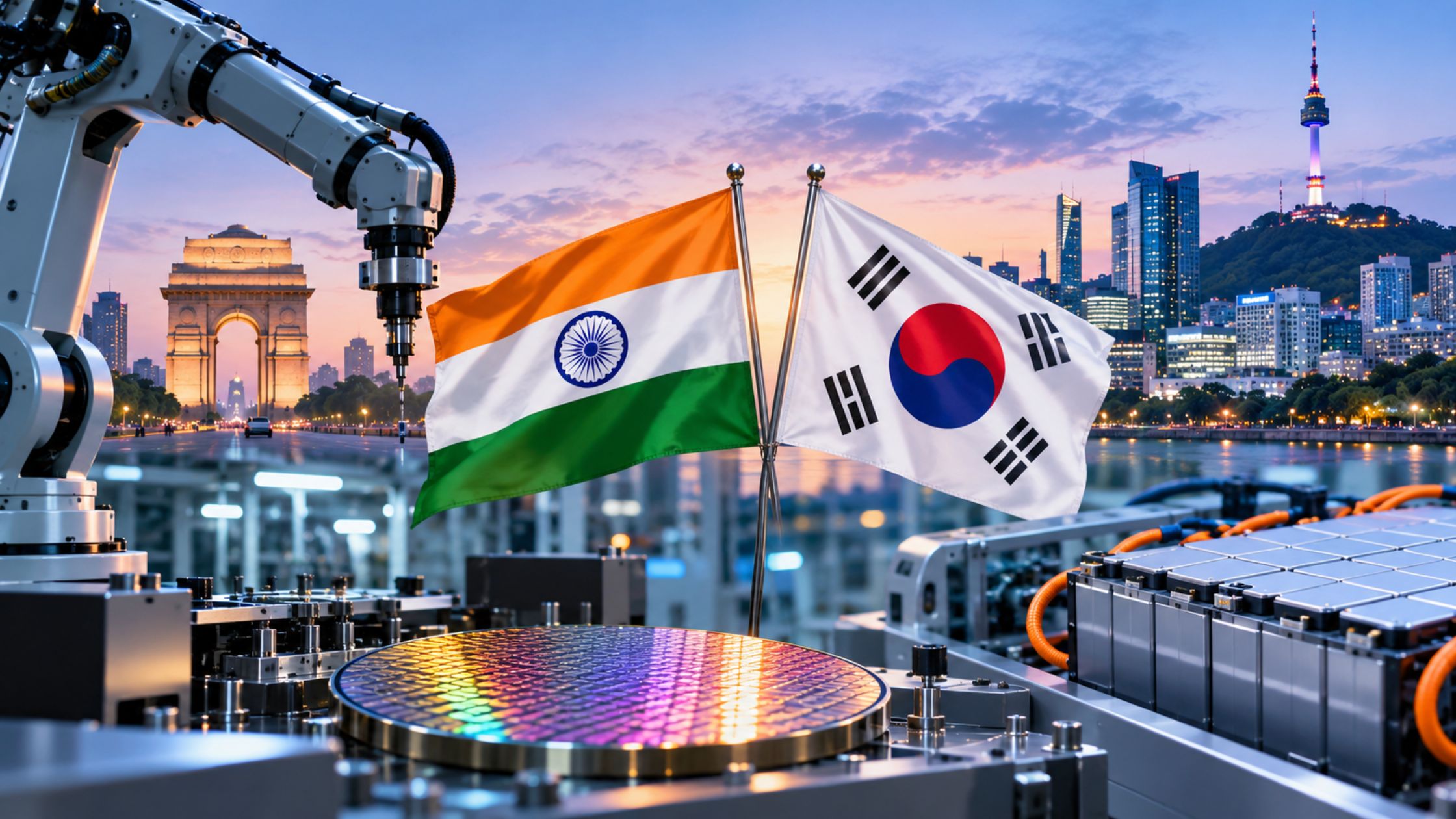
As both countries deepen cooperation in semiconductors, electric vehicle batteries and industrial AI, startups could connect South Korea’s manufacturing expertise with India’s expanding technology and production ecosystem.
India and South Korea are looking to double bilateral trade to US$50 billion by 2030, with a renewed focus on semiconductors, electric vehicle batteries, advanced manufacturing and emerging technologies. It is changing the conventional trade and investment towards deeper industrial cooperation between the two countries. As South Korea looks to strengthen its global manufacturing and technology partnerships, India’s expanding production capabilities, engineering talent and domestic market offer opportunities for collaboration. For startups, this convergence could open access to industrial supply chains, technology partnerships and cross-border investment beyond the traditional dominance of large corporations.
The opportunity is rooted in complementary strengths. South Korea has established expertise in hardware, electronics, automotive manufacturing and industrial technology, while India offers a large domestic market, engineering talent, software capabilities and an expanding manufacturing base. Connecting these capabilities could create a more integrated industrial relationship, with startups contributing specialised technologies, products and services.
Gaurav Pant, an Asian angel investor and industry expert, believes the strongest opportunities will emerge where each country’s capabilities address the other’s requirements. While conversing with KoreaTechToday, he said:
“The most credible opportunities sit where each country’s strength fills the other’s gap. Korea has deep manufacturing know-how and globally competitive hardware, but a small, ageing home market. India has scale, software talent and demand and is quickly building manufacturing depth.”
The April 2026 summit between Indian Prime Minister Narendra Modi and South Korean President Lee Jae Myung provided a policy framework for expanding cooperation. The two governments agreed to establish the India-Korea Industrial Cooperation Committee, a ministerial-level platform intended to strengthen economic engagement. They also committed to accelerating negotiations to upgrade the Comprehensive Economic Partnership Agreement (CEPA), with the aim of concluding the process in the first half of 2027.
The summit identified semiconductors, electronics, advanced manufacturing, electric mobility, critical minerals and clean energy as areas for deeper collaboration. Around 600 companies from both countries participated in the accompanying business forum, where private-sector agreements covered areas including shipbuilding, digital technology and energy.
For startups, these priorities translate into opportunities across several parts of the industrial value chain.
EV batteries and semiconductors could lead collaboration
Electric mobility is one area where the two countries’ capabilities could align. India’s expanding electric two- and three-wheeler market requires affordable and reliable battery systems, battery management technology, materials and recycling infrastructure. South Korean companies bring experience in battery technology and manufacturing, while Indian startups can contribute software, vehicle integration, local product development and solutions adapted to domestic operating conditions.
Pant identified this as one of the most credible areas for collaboration.
“Some clear synergies are visible here. First, EV components, batteries and battery recycling: India’s two- and three-wheeler electrification needs exactly the cell, battery-management and materials expertise Korean firms have at their disposal.”
Semiconductors offer another opportunity, particularly as India works to develop capabilities beyond chip design and assembly. Its ambitions include semiconductor fabrication, outsourced semiconductor assembly and testing (OSAT), advanced packaging and supporting supply chains.
A developing partnership between India’s Advanced System in Package Technologies (ASIP) and South Korea’s APACT illustrates how this cooperation could take shape. APACT, a Korean semiconductor packaging company, is providing technology expertise for ASIP’s planned semiconductor packaging facility in Andhra Pradesh. The project is expected to strengthen India’s domestic packaging capabilities while creating a direct channel for Korean technical expertise to enter the market.
Pant also pointed to electronics and semiconductor supply chains as areas where Indian assembly and design capabilities could complement Korean technology. Beyond hardware, he sees potential in applying artificial intelligence to manufacturing and logistics, combining Korean factory expertise with Indian engineering talent.
These opportunities could extend to predictive maintenance, quality control, warehouse automation and supply-chain optimisation. Rather than developing entirely separate products, startups could build specialised solutions for manufacturers operating across both markets.
Building an ecosystem beyond large corporations
A stronger industrial relationship will require more than agreements between governments and large companies. Smaller businesses and startups need access to investors, customers, technical partners and local market networks.
The April summit included an agreement on cooperation between the two countries’ small and medium-sized enterprise sectors. The framework is intended to facilitate information exchange, business connections and technical collaboration, creating more opportunities for companies beyond the established conglomerates.
Investor engagement is also increasing. In June 2026, South Korea’s Ministry of SMEs and Startups, Korea Venture Investment and the Korea Venture Capital Association organised a Korea-India Venture Investment Meetup in Bengaluru. The event included an MoU between the Korea Venture Capital Association and the Indian Venture Capital Association to encourage investment cooperation, information exchange and connections between the two venture ecosystems.
Such initiatives could help startups access the capital and corporate relationships required to develop cross-border businesses. Venture investors and industry networks will be important in identifying companies whose technologies can address specific manufacturing or market needs.
The challenge is turning opportunity into execution
Despite the growing policy momentum, building a functioning startup corridor will require companies to navigate differences in market conditions, business practices and customer requirements. India’s manufacturing ecosystem is expanding, but infrastructure, supplier capabilities and regulatory processes can vary across regions. Korean companies entering the market will need to adapt their products and commercial strategies rather than assume that solutions developed for South Korea can be transferred directly.
Pant, who has served as a returning judge at the Korean Startup Expo, cautioned against treating India as a single market.
“Korean founders often treat India as a single market. It isn’t. Pick one state, one customer segment and one Indian partner who knows the ground and earn the right to expand from there.”
This is equally relevant to technology partnerships. Semiconductor and battery supply chains involve demanding technical standards, lengthy qualification processes and significant capital requirements. Startups will need credible industrial partners and clearly defined commercial objectives to move from initial discussions to sustained business relationships.
India and South Korea have established the policy frameworks, corporate relationships and technical capabilities needed to deepen industrial cooperation. The next step is to make startups a more active part of that relationship.
The opportunity extends beyond Korean companies investing in India or Indian startups seeking access to Korean technology. It lies in developing businesses that can jointly design products, strengthen supply chains, improve manufacturing processes and serve customers across both markets.
The success of this emerging corridor will ultimately depend on commercial outcomes rather than the number of agreements signed. If Korean industrial expertise can be combined with India’s engineering talent, manufacturing ambitions and market scale, the partnership could create a new route for technology-led businesses to grow across Asia.