
From memory semiconductors and AI devices to advanced wireless infrastructure, South Korea is well positioned as artificial intelligence shifts from centralized data centers to everyday consumer experiences, according to Ookla.
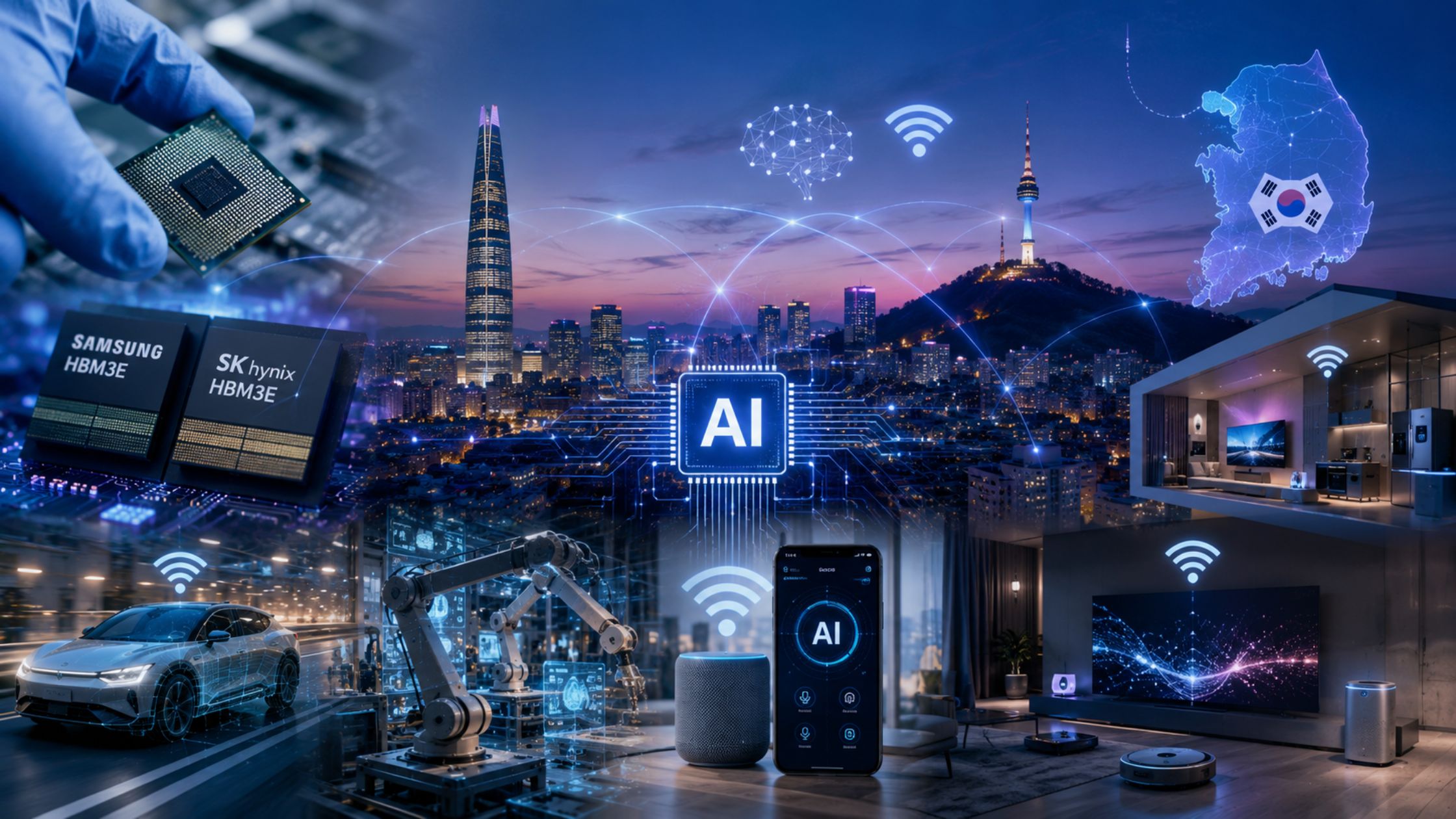
South Korea’s ambitions to become a global artificial intelligence powerhouse extend far beyond building larger data centers or manufacturing advanced semiconductors. The country has committed billions of dollars toward strengthening its AI ecosystem, while Samsung Electronics and SK hynix remain central suppliers of high-bandwidth memory (HBM), one of the most critical components powering AI servers worldwide. At the same time, Korean technology companies are embedding AI into smartphones, televisions, home appliances, vehicles, robotics, and industrial systems, reflecting a broader shift toward intelligent, connected devices.
This evolution comes as the global AI industry moves beyond cloud-centric computing. While the first wave of generative AI relied heavily on centralized hyperscale infrastructure, the next phase is increasingly expected to take place at the network edge, where AI models run directly on consumer devices, enterprise systems, factories, and connected homes. Analysts expect edge AI to become one of the fastest-growing segments of the AI market over the coming decade as organizations seek lower latency, improved privacy, and reduced cloud dependency.
That transition places countries like South Korea in a unique position. Few economies combine leadership in memory semiconductors, consumer electronics, advanced manufacturing, telecommunications infrastructure, and AI research at the same scale. However, capitalizing on this opportunity requires more than advances in chips alone. As AI workloads move closer to end users, the networks connecting those devices become an increasingly important part of the overall AI ecosystem.
During an exclusive conversation with KoreaTechToday, Affandy Johan, Industry Analyst at Ookla, argued that advanced wireless technologies should be viewed as a strategic component of AI infrastructure rather than simply a consumer networking upgrade.
AI is moving beyond the cloud
Much of today’s AI infrastructure discussion focuses on hyperscale data centers, GPUs, and large language models. These remain fundamental to AI development, but the next phase of adoption is gradually shifting toward edge computing.
Unlike cloud-based AI, edge AI processes data closer to where it is generated, enabling faster responses while reducing bandwidth requirements and improving privacy. This approach is becoming increasingly important for applications including AI-powered smartphones, autonomous robots, industrial automation, smart factories, connected vehicles, and intelligent home devices.
South Korean companies have already begun positioning themselves for this transition. Samsung Electronics has integrated Galaxy AI across its flagship smartphones while expanding AI capabilities throughout its SmartThings ecosystem. LG Electronics is investing in AI-powered home appliances and smart home platforms, while Hyundai Motor Group continues developing software-defined vehicles that rely on intelligent onboard computing. Together, these developments signal that AI is no longer confined to cloud servers but is becoming embedded across connected devices used in everyday life.
This broader technology shift also changes the infrastructure supporting AI. While data centers remain essential for model training, real-time AI experiences increasingly depend on fast, reliable, and low-latency local connectivity capable of supporting continuous interaction between users and intelligent devices.
South Korea occupies multiple layers of the AI value chain
South Korea’s competitive advantage lies not only in semiconductor manufacturing but also in the breadth of its technology ecosystem.
The country contributes across several critical layers of AI development:
- Advanced memory semiconductors, led by Samsung Electronics and SK hynix.
- Consumer electronics including smartphones, televisions, and connected appliances.
- Telecommunications infrastructure and one of the world’s most advanced broadband environments.
- Automotive and industrial technologies increasingly incorporating AI and edge computing.
- Government-backed investments supporting AI infrastructure, sovereign AI capabilities, and digital transformation.
This diversified ecosystem means Korea participates throughout the AI value chain rather than concentrating on a single technology segment. As AI expands beyond centralized cloud environments, integration across these layers becomes increasingly important.
Connectivity is becoming part of AI infrastructure
According to Johan, discussions around AI infrastructure often overlook one essential component: the networks connecting AI directly to consumers.
During his conversation with KoreaTechToday, he explained:
“Advanced Wi-Fi is the last-mile layer carrying the vast majority of indoor internet traffic. This makes it a critical enabler for AI and edge computing at scale, rather than a secondary concern. For latency-sensitive AI use cases such as real-time inference and on-device assistants, the low latency and reliable handoffs that Wi-Fi 7’s multi-link operation (MLO) provides matter more than peak speed.
However, the global AI buildout cuts both ways. Surging data center demand for high-performance memory and processing units is heavily inflating component costs across the semiconductor supply chain. Korea’s memory makers sit squarely on the supply side of this demand, producing the critical components required for both enterprise AI servers and the consumer CPE that brings these capabilities into homes.
Ultimately, Korea is uniquely positioned to profit from the AI wave while absorbing the associated cost pressures, with advanced Wi-Fi serving as an essential infrastructure connecting those ambitions to the end user.”
His comments reflect a broader change in how AI infrastructure is being understood. While network performance has traditionally been evaluated based on download speeds, future AI applications will increasingly prioritize low latency, stable connectivity, and seamless device communication to support real-time interactions.
Why edge AI changes the infrastructure equation
As AI becomes integrated into more connected devices, infrastructure requirements extend well beyond computing power. Traditional cloud workflows involved sending information to centralized servers for processing before returning results to users. Edge AI changes that model by allowing much of the inference to occur directly on local devices, dramatically reducing response times while lowering dependence on cloud connectivity.
This shift has several implications for technology ecosystems:
- AI assistants require near-instant responses during natural conversations.
- Smart homes increasingly coordinate dozens of connected devices simultaneously.
- Industrial AI systems must analyze sensor data in real time to optimize manufacturing.
- Autonomous machines and robots depend on reliable communication with minimal delay.
In these environments, connectivity is no longer simply a transport layer. It becomes an active enabler of AI performance.
South Korea’s early deployment of advanced wireless technologies and widespread fiber infrastructure provides a favorable environment for these applications, complementing the country’s strengths in semiconductors and consumer electronics.
Korea’s opportunity extends beyond semiconductor leadership
The rapid expansion of AI infrastructure is creating unprecedented demand for advanced chips, benefiting Korean memory manufacturers that supply critical components for AI servers worldwide. Yet the same demand is also increasing production costs across the semiconductor industry, particularly as competition intensifies for high-performance memory and advanced packaging technologies.
This dual position presents both opportunities and challenges. Korean companies benefit from rising global AI investment while simultaneously navigating higher manufacturing costs and increasingly complex supply chains.
However, Korea’s strengths extend beyond supplying components for hyperscale computing. By combining semiconductor leadership with globally competitive consumer electronics, telecommunications infrastructure, automotive innovation, and smart manufacturing capabilities, the country is positioned to participate across multiple stages of AI deployment, particularly as intelligence moves closer to users.
Rather than viewing networking, edge devices, and semiconductors as separate markets, they are becoming increasingly interconnected elements of a single AI ecosystem.
The next phase of AI will be built across the entire ecosystem
The first generation of AI competition centered on building larger models, deploying more GPUs, and expanding cloud infrastructure. Those investments will continue to define the industry’s foundation. The next phase, however, will increasingly be determined by how effectively AI reaches homes, workplaces, vehicles, factories, and other connected environments where people interact with intelligent systems every day.
For South Korea, this evolution aligns closely with its existing industrial strengths. The country already plays a central role in supplying AI memory, developing intelligent consumer electronics, advancing connected mobility, and expanding digital infrastructure. As edge AI adoption accelerates globally, these capabilities could become increasingly complementary rather than independent.
As Johan’s observations suggest, AI competitiveness will depend not only on the world’s most advanced chips or the largest data centers, but also on the infrastructure that enables intelligent experiences at the edge. For South Korea, that broader ecosystem approach may prove to be one of its greatest competitive advantages in the next stage of the global AI race.