
Partnership aims to accelerate industrial AI adoption under South Korea’s national AX strategy, bringing together leading institutes and companies
Panmnesia has signed a strategic partnership with the Korea Advanced Institute of Science and Technology (KAIST) to advance AI Transformation (AX) through its link semiconductor technology. The collaboration forms part of South Korea’s “AX Strategy of the Four Leading Science and Technology Institutes,” a national initiative aimed at accelerating industrial AI adoption across key sectors.
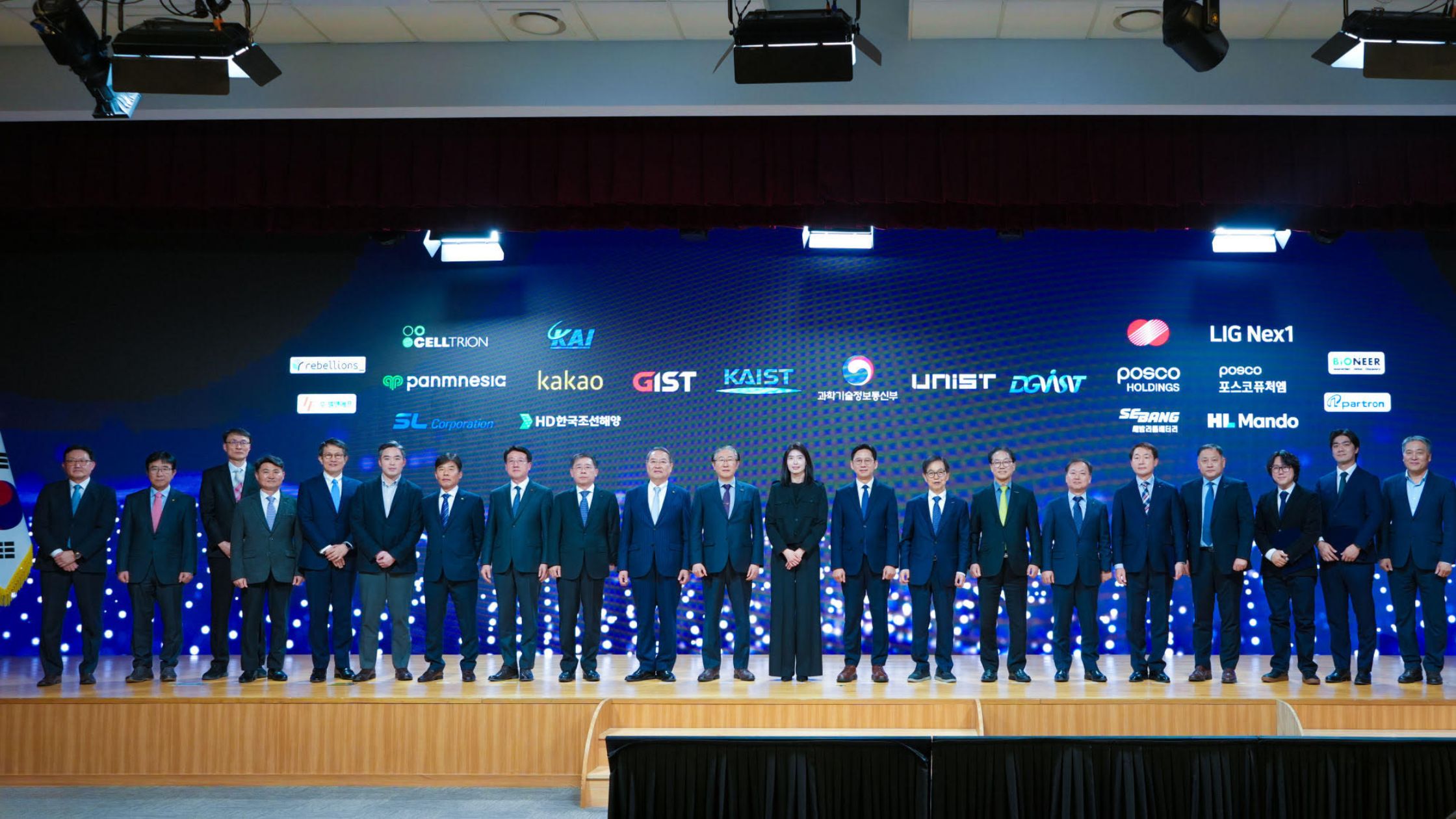
The initiative brings together four national science and technology institutes — KAIST, GIST, DGIST, and UNIST — alongside 16 companies spanning semiconductors, AI, energy, bio, defense, robotics, and materials. Participants include Panmnesia and Rebellions in semiconductors; Kakao in AI education; HD Hyundai and POSCO Holdings in shipbuilding and materials; KEPCO, POSCO Future M, and Sebang Lithium in energy and batteries; Celltrion and Bioneer in bio; LIG Nex1 and KAI in defense; HL Mando, SL, and L&F in robotics; and Partron in sensor semiconductors.
The group signing ceremony, held on April 23, was attended by the presidents of the four institutes and executives from participating companies. Bae Kyung-hoon, Deputy Prime Minister and Minister of Science and ICT, delivered congratulatory remarks.
AI Agents Drive Need for Advanced Interconnect Technologies
A key focus of the initiative is the growing role of “AI agents” — systems built on large-scale AI models that can autonomously plan and execute tasks based on high-level objectives. These systems rely on close coordination between AI accelerators such as GPUs and NPUs, CPUs, and memory, resulting in large volumes of inter-device communication.
In this context, interconnect, or “link,” technology is becoming increasingly important, as it enables efficient communication between system components. Panmnesia, a fabless semiconductor startup, develops link technologies ranging from semiconductor IP to hardware engines and switch chips, supporting interconnect standards such as Compute Express Link (CXL) and UALink.
Panmnesia Focuses on Link Semiconductor Innovation
The company has been developing solutions aimed at improving the efficiency of AI-driven systems, including AI agents, while contributing to the field through technical reports, academic publications, and industry engagements.
Panmnesia told KoreaTechToday, “Through this collaboration, we aim to foster mutual growth by bridging Panmnesia’s link semiconductor expertise with KAIST’s AI-driven semiconductor design capabilities.” The company added that its link semiconductor technology is expected to contribute to improving the efficiency of AX, including AI agent services.
Expanding AI Applications Into Semiconductor Design
Beyond infrastructure, Panmnesia is also exploring the application of AI within semiconductor design. With its processes — spanning silicon design, system-on-chip (SoC) development, and verification — handled in-house, the company is assessing how AI-driven approaches can be integrated into complex and data-intensive design workflows.
Panmnesia develops link solutions aimed at improving the efficiency of AI data centers. Its portfolio includes CXL controllers and switches, as well as hybrid link architectures integrating interconnect technologies such as UALink and NVLink Fusion, alongside advanced semiconductor technologies including high-bandwidth memory (HBM). In 2024, the company secured approximately USD 60 million in Series A funding, reaching a valuation of around USD 250 million.