

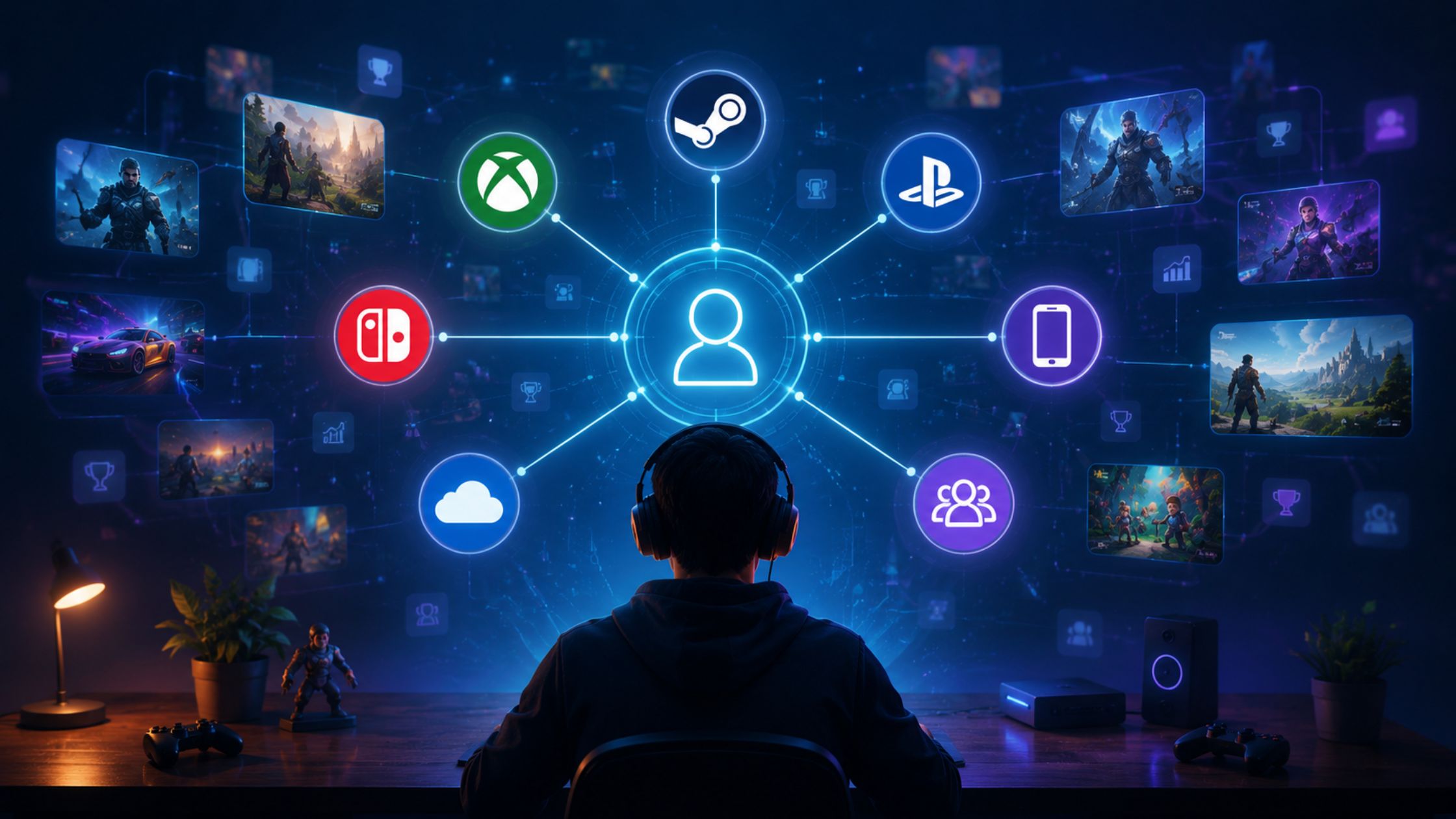
As gaming becomes increasingly fragmented across platforms, a new generation of services is attempting to unify player identity, discovery, and community beyond traditional gaming ecosystems.
The gaming industry has spent the last two decades building increasingly powerful platforms. Steam transformed PC game distribution. PlayStation and Xbox developed vast digital ecosystems. Nintendo cultivated one of the most loyal player communities in entertainment. Mobile gaming created entirely new audiences and business models.
Yet despite the industry’s technological progress, a new problem has emerged. Modern gamers rarely exist within a single ecosystem. A player might purchase games on Steam, maintain an extensive Nintendo Switch library, subscribe to Xbox Game Pass, occasionally play on PlayStation, and spend hours each week on mobile titles. Each platform captures a portion of that player’s gaming behavior, but none provides a complete picture.
The result is a fragmented gaming experience where identities, libraries, achievements, social connections, and preferences are scattered across multiple services. As the global gaming market continues to grow and the number of available games reaches unprecedented levels, this fragmentation is creating new challenges around discovery, personalization, and community. Increasingly, a new category of platforms is emerging to address those challenges. Rather than competing directly with Steam, PlayStation, or Xbox, these services operate above them, creating what could be described as gaming’s emerging “meta-layer.”
The concept reflects a broader shift within the gaming industry. The next major platform battle may not be about where games are sold. It may be about who understands players best.
The End of the Single-Platform Gamer
The gaming industry once revolved around relatively simple ecosystems. Console players stayed within a single hardware family, PC gamers primarily purchased through a limited number of storefronts, and mobile gaming remained largely separate from traditional gaming experiences.
That reality has changed dramatically.
Cross-platform gaming has become commonplace, cloud gaming services have expanded access across devices, and digital distribution has made purchasing games easier than ever. A growing number of players now move seamlessly between consoles, PCs, handheld devices, and smartphones.
This evolution has delivered greater flexibility for consumers, but it has also introduced a new form of fragmentation.
While speaking with KoreaTechToday, George Jeong, Chief Global Officer of Minimap, argued that modern gaming behavior is fundamentally different from the ecosystem structures that currently exist.
“One of the defining problems of modern gaming is scattered data,” Jeong said.
“Most gamers no longer play on a single device or ecosystem. Personally, I play on my phone, PC, Switch, and occasionally on a PS5 at the office. Each platform captures a fragment of my gaming history, but none show the full picture.”
The challenge extends beyond gaming activity itself. Digital purchases, playtime records, achievements, social connections, and gaming preferences are increasingly distributed across multiple services, making it difficult for players to maintain a cohesive understanding of their own gaming identity.
When Abundance Creates a Discovery Problem
Fragmentation is only one side of the equation. The gaming industry is also confronting a discoverability crisis. Digital distribution has dramatically lowered barriers to entry for developers. Thousands of games now launch every year across major platforms, providing consumers with unprecedented choice. While this abundance has benefited creators and players alike, it has also created a new challenge: finding the right game has become significantly harder.
Steam alone now adds thousands of new titles annually, while console storefronts, mobile app stores, subscription services, and independent marketplaces continue to expand their catalogs.
For players, the result is often what Jeong describes as the “backlog problem.”
“Today, purchasing a game is often just one click away,” he told KoreaTechToday.
“This has created what many gamers recognize as the backlog problem where people accumulate dozens, hundreds, or even thousands of games they haven’t really played.”
The problem becomes even more complex when those libraries are spread across multiple platforms. Players may own hundreds of games without having a clear understanding of what they already possess, what they have completed, or what they are most likely to enjoy next. This challenge has elevated the importance of recommendation systems throughout the industry.
Why Algorithms Are Not Enough
Most gaming platforms already invest heavily in recommendation engines. Storefronts analyze browsing behavior, purchase history, playtime, and engagement metrics to suggest new titles. Streaming platforms, social media networks, and content creators also play increasingly influential roles in game discovery. Yet many players continue to express dissatisfaction with recommendation quality.
According to Jeong, the issue lies in the limitations of the data being used.
“Most discovery algorithms rely on indirect or surface-level signals, such as search behavior, video views, or short-term engagement,” he said.
“Gamers aren’t just defined by what they click on. They’re defined by what genres they consistently return to, how many hours they invest, which games they finish, and how they emotionally respond to certain experiences.”
This distinction is becoming increasingly important as the gaming industry shifts toward personalization. Traditional recommendation systems excel at predicting short-term engagement. Understanding long-term player identity is far more difficult. The difference may seem subtle, but it has significant implications. A player who briefly explores a trending multiplayer title may generate engagement signals that suggest interest. However, their actual gaming preferences may remain rooted in role-playing games, strategy titles, or narrative-driven experiences. The challenge is not simply identifying what players click on. It is understanding who they are as gamers.
The Emergence of Gaming’s Meta-Layer
As fragmentation and discoverability challenges continue to grow, a new category of platforms is beginning to emerge. Rather than functioning as storefronts or game publishers, these services focus on aggregating gaming activity across ecosystems and building richer representations of player identity.
The concept mirrors developments that have already occurred in other media industries. Film enthusiasts increasingly use platforms such as Letterboxd to track viewing habits across streaming services. Readers rely on Goodreads to organize books regardless of where they were purchased. Music listeners frequently use third-party platforms that aggregate listening behavior across multiple services.
Gaming, despite its size and cultural influence, has yet to develop a universally adopted equivalent. That gap is creating opportunities for platforms focused on identity, community, and cross-platform visibility rather than transactions.
Community May Be More Powerful Than Algorithms
Perhaps the most significant insight emerging from this shift involves trust. The internet has become increasingly algorithm-driven, with recommendation systems shaping everything from entertainment consumption to online shopping. Yet consumers are also showing renewed interest in community-driven discovery.
Gaming appears particularly suited to this model. Players often trust recommendations from friends, communities, and individuals with similar tastes more than recommendations generated by algorithms alone. Jeong believes this dynamic will become even more important in the future.
“I believe it will be community-led,” he said when asked about the future of gaming discovery.
“Algorithms and creators both play important roles, but trust usually comes from people you relate to directly.”
This perspective reflects broader trends across digital culture. Online communities, niche interest groups, and trusted recommendation networks increasingly influence purchasing decisions across media categories. In gaming, where emotional investment and personal taste play particularly important roles, community-driven discovery may become one of the industry’s most valuable assets.
Why South Korea Is Well Positioned for This Shift
The emergence of gaming’s meta-layer has particular relevance for South Korea. Few countries possess a gaming ecosystem as mature and interconnected as Korea’s. The country is home to globally recognized publishers, a vibrant esports industry, advanced digital infrastructure, and one of the world’s most engaged gaming populations.
Korean gamers are also accustomed to navigating multiple gaming ecosystems. A single player may spend time on PC games, mobile titles, console releases, and competitive online experiences within the same week. This behavior creates an environment where fragmented gaming identities are especially common.
At the same time, South Korea’s technology sector has repeatedly demonstrated its ability to build infrastructure layers that support broader digital ecosystems. As gaming becomes increasingly platform-agnostic, Korean companies may find opportunities not only in developing games but also in building the systems that connect players, communities, and data across the industry.
The Next Battle for Gaming Platforms
For years, the gaming industry’s most important competition centered on content. Platforms fought to secure exclusive titles, attract developers, and expand digital storefronts. Success was largely measured by game sales, active users, and platform adoption.
The next phase may look very different. As gaming activity becomes distributed across multiple devices and ecosystems, the ability to understand player identity may become just as valuable as the ability to distribute games. Platforms that can help players navigate fragmented libraries, discover meaningful experiences, and connect with trusted communities may occupy an increasingly important position within the industry.
The rise of gaming’s meta-layer reflects a fundamental shift in how the industry thinks about value creation. The future may not belong solely to the companies that sell games. It may also belong to those that help players make sense of an increasingly complex gaming world. For an industry built on interaction, community, and personal expression, understanding the player may ultimately become the most important platform advantage of all.