

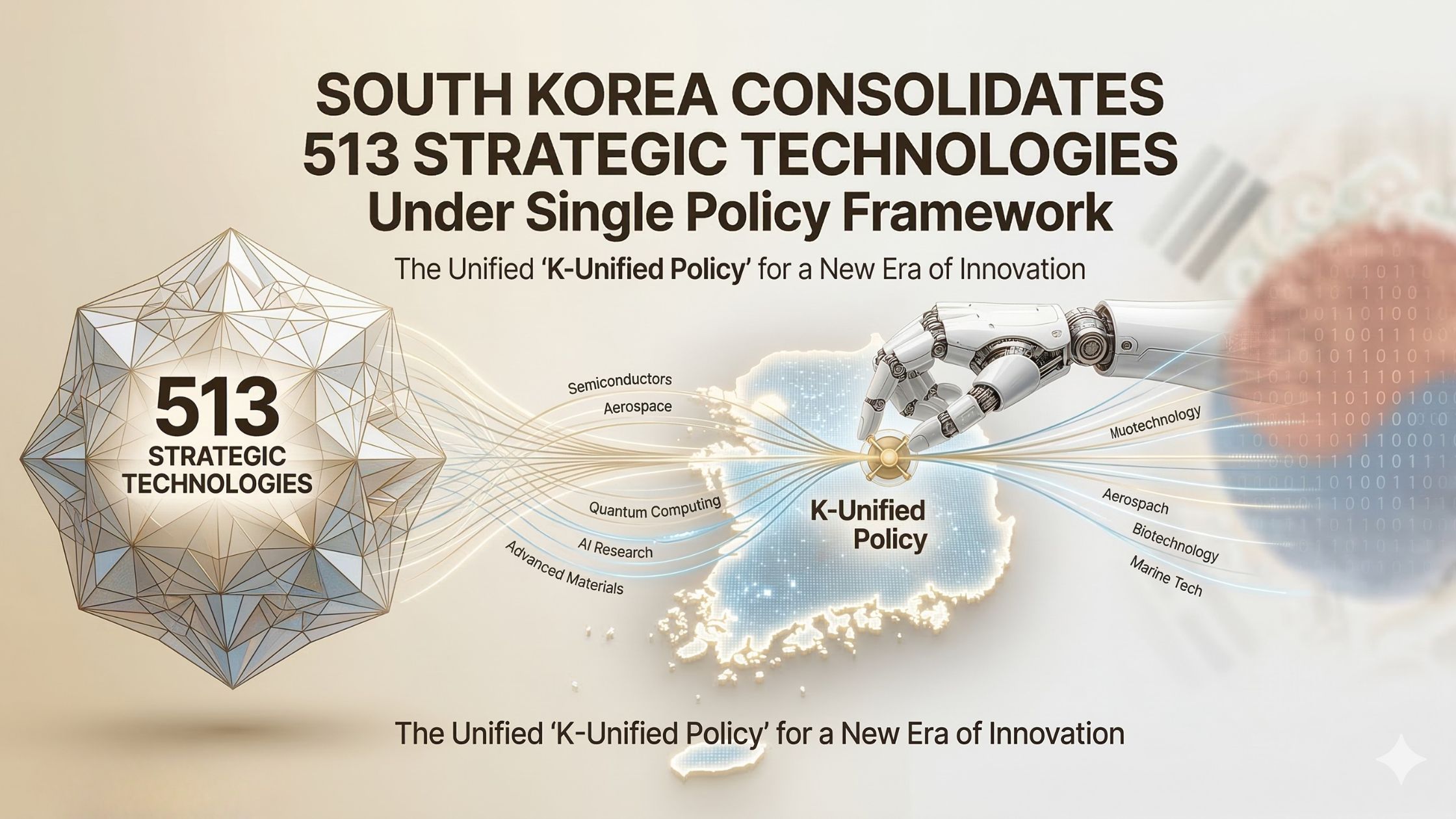
Government seeks to improve coordination across ministries and strengthen national tech competitiveness
South Korea is restructuring how it manages national strategic technologies, bringing previously fragmented systems under a single, coordinated framework. The move comes as governments around the world increase efforts to secure technological leadership in areas such as semiconductors, artificial intelligence, and energy.
Until now, different ministries in South Korea have overseen strategic technologies under separate laws and policy tools. This has often led to overlaps, gaps in support, and inconsistent implementation. The new approach aims to address these issues by integrating management into what officials describe as a “one-team” system.
The Ministry of Science and ICT, the Ministry of Economy and Finance, and the Ministry of Trade, Industry and Energy jointly announced the reform on March 11, following approval at a high-level ministerial meeting. Under the plan, 513 technologies will be consolidated into a unified system.
From multiple laws to a single framework
A key part of the reform is the integration of technologies that were previously managed under four separate laws, covering areas such as strategic technology development, tax incentives, industrial competitiveness, and technology protection.
To build the new system, the government conducted a broad review involving 104 experts from ministries, agencies, and academia. Based on this process, it identified 19 common technology fields that will serve as the foundation for policy coordination.
This consolidation is intended to simplify how companies and researchers interact with government programs, while also enabling more consistent policy design across ministries.
19 technology fields define national priorities
The newly defined fields cover a wide range of sectors considered critical to economic security and industrial competitiveness. These include semiconductors, displays, AI and software, quantum technologies, telecommunications, cybersecurity, biotechnology, robotics, aerospace, and advanced energy systems.
Rather than treating each sector in isolation, the government aims to manage them within a shared framework. This reflects the increasing convergence between technologies—for example, how AI supports semiconductor design or how software is embedded across industries.
By grouping technologies into broader categories, policymakers also hope to improve resource allocation and avoid duplication in funding and regulation.
Linking policy tools across R&D, tax, and finance
Another central feature of the reform is the alignment of different policy instruments. Previously, support measures such as R&D funding, tax incentives, and industrial programs were often designed independently.
Under the new system, the government plans to coordinate these tools more closely. “Priority support areas” have been identified within each technology field to guide investment and policy focus.
This includes:
- Structuring R&D portfolios around strategic technologies
- Expanding targeted tax incentives
- Strengthening industrial development programs
Policy financing will also be more tightly connected to these priorities. Funds such as the National Growth Fund and the Science and Technology Innovation Fund will be used to support designated technologies, with the aim of translating policy designation into measurable outcomes.
To support the unified system, the government is introducing new mechanisms for inter-ministerial collaboration. Major decisions—such as adding or revising strategic technologies—will be handled through joint meetings that bring together science, technology, and industrial policy leaders.
At the operational level, a permanent consultative body will coordinate day-to-day collaboration among ministries and working-level agencies. This structure is intended to reduce delays, improve information sharing, and ensure that policies are implemented consistently.
The government also plans to standardize procedures for designating and removing technologies from the list. This is expected to provide greater predictability for companies, particularly those making long-term investment decisions.
Improving transparency through a unified system map
As part of the reform, authorities have introduced a “Technology System Status Map,” designed to make the system easier to understand for businesses and researchers.
The map outlines how each technology field is supported, including available benefits and protection requirements. It also shows how different policies and laws are connected, offering a clearer view of the overall framework.
In the next phase, the government plans to develop this into an AI-based platform. Companies would be able to search for their technologies and identify relevant support programs and regulatory obligations. Over time, this could evolve into a single digital portal for accessing government technology policies.
Part of a broader push for technological sovereignty
The restructuring effort is part of a wider national strategy to strengthen South Korea’s position in global technology competition. The government has already outlined plans to invest heavily in key sectors and improve coordination across more than 20 ministries.
The emphasis on integration reflects a shift in policy thinking. Rather than treating technology development, industrial policy, and security separately, governments are increasingly linking them as part of a broader strategy.
Deputy Prime Minister and Minister of Science and ICT Bae Kyung-hoon said, “In the rapidly intensifying technology competition, the government, ministries, and private sector must work together to foster and protect the technologies that are essential for the country.”
Similarly, Minister Lee Jong-ho noted that the government will continue to improve communication so that “researchers and companies clearly understand the system, receive proper support, and fulfill their responsibilities for technology protection.”
Balancing coordination with execution
While the new framework is expected to improve coordination, its effectiveness will depend on execution. Aligning multiple ministries, funding systems, and regulatory tools is complex, particularly as technologies evolve quickly.
The success of the system will likely depend on how well it can adapt to emerging technologies while maintaining clarity for companies and researchers. If implemented effectively, the unified approach could help South Korea strengthen its innovation ecosystem and respond more quickly to global technological shifts.
At the same time, it signals a broader trend: governments are taking a more active and coordinated role in shaping the direction of critical technologies in an increasingly competitive global environment.