

South Korea’s largest telecom operator outlines plans for AI-driven networks, hyperscale data centers, and trillion-parameter models as it seeks to reshape its business for the AI era.
SK Telecom has unveiled a sweeping transformation strategy aimed at turning the telecom operator into what its leadership calls an “AI-native company,” signaling a major shift in how telecommunications infrastructure and services may evolve in the artificial intelligence era.
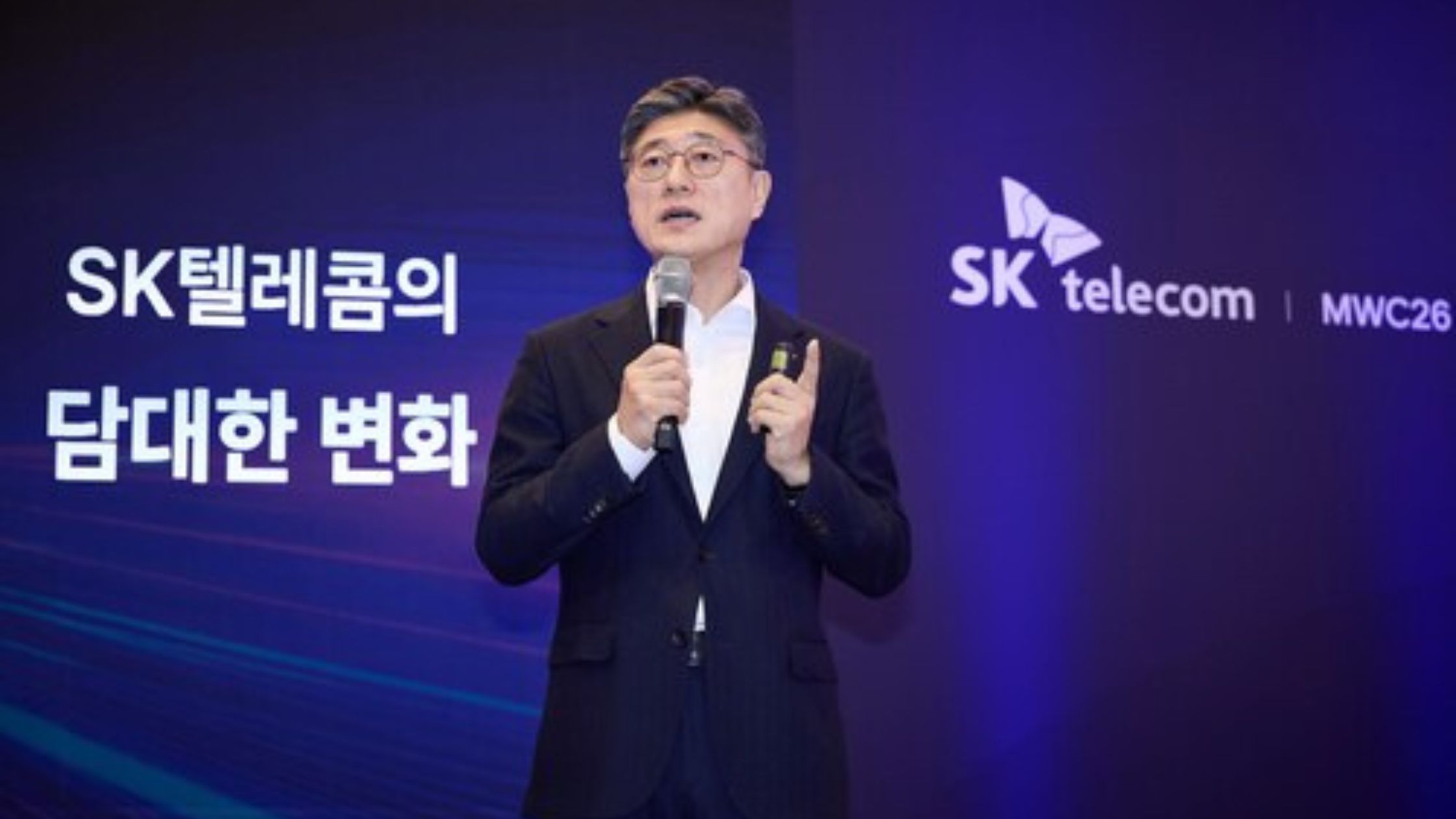
Speaking at a press conference during Mobile World Congress (MWC) 2026 in Barcelona, CEO Jung Jai-hun outlined plans to overhaul the company’s systems, expand national AI infrastructure, and integrate AI across all aspects of its telecom operations.
The strategy reflects SK Telecom’s belief that the future of telecommunications will increasingly revolve around AI-driven services and computing infrastructure rather than connectivity alone.
“SKT is currently at a golden time of transformation,” Jung said. “Through innovation driven by AI, we will evolve into a company that makes meaningful contributions to our customers and to Korea.”
A Telco Reinventing Itself for the AI Era
Telecommunications companies worldwide are searching for new growth engines as traditional mobile service revenues mature. For SK Telecom, the answer lies in embedding AI throughout its operations.
Under the “AI Native” strategy, the company plans to redesign the technological foundations of its telecom services. This includes rebuilding internal systems—such as billing, customer management, and network operations—to operate with AI at their core.
The goal is to move beyond conventional telecom operations and create an ecosystem where AI helps manage networks, personalize services, and automate large portions of customer interactions.
For example, the company intends to redesign customer plans and membership programs so that AI systems can automatically recommend personalized options based on individual usage patterns and preferences.
AI-Driven Networks and Customer Services
A key pillar of SK Telecom’s strategy involves applying AI to improve network operations and customer experience.
The company plans to expand autonomous network operations, where AI systems automatically manage traffic, monitor network performance, and detect potential service disruptions.
These systems will gradually shift operational tasks from human engineers to automated platforms capable of managing wireless quality, traffic control, and equipment maintenance in real time.
Another focus is the development of integrated AI agents that can assist customers across multiple service channels, including the company’s online portal and retail platforms.
These agents are designed to analyze customer behavior patterns and provide recommendations, manage subscriptions, and assist with customer service requests.
SK Telecom is also expanding its AI Contact Center (AICC) platform, enabling customer service representatives to rely on AI tools for faster and more accurate responses.
The company says offline retail stores will also incorporate AI tools that analyze customer needs and automatically suggest relevant services.
Building a National AI Infrastructure
Beyond telecom services, SK Telecom is positioning itself as a developer of large-scale AI infrastructure.
The company plans to build hyperscale AI data centers with a combined capacity of more than 1 gigawatt, one of the largest planned deployments of AI computing infrastructure in Asia.
These facilities—referred to as AI Data Centers (AIDCs)—will support AI training, cloud computing, and enterprise AI applications.
The project is part of a broader national effort to strengthen South Korea’s position in the global AI industry.
SK Telecom is working with several affiliates across the SK Group ecosystem—including SK hynix, SK Ecoplant, and SK Innovation—to build the infrastructure required for large-scale AI computing, from data center construction and servers to energy systems and cooling technology.
The company also plans to develop an additional data center in southwestern South Korea in collaboration with OpenAI, as part of a broader initiative to build an AI infrastructure network across the country.
Expanding Korea’s AI Capabilities
Another major component of the strategy involves strengthening the company’s proprietary AI technologies.
SK Telecom plans to expand its sovereign AI foundation model, currently one of the largest developed in South Korea, from 519 billion parameters to more than one trillion parameters.
The upgraded model will also gain multimodal capabilities, allowing it to process images, voice, and video in addition to text.
The company believes this type of sovereign AI technology will be important for industries and governments that want greater control over how their data is processed and used.
In addition to general-purpose AI models, SK Telecom is developing industry-specific AI solutions, particularly for manufacturing.
Working with semiconductor manufacturer SK hynix, the company plans to develop AI systems that analyze factory process data in real time to reduce defects and improve equipment efficiency.
These solutions will be offered as integrated packages that combine infrastructure, AI models, and industry applications.
A Shift in Corporate Culture
The transformation plan also extends beyond technology to the company’s internal operations.SK Telecom is introducing a company-wide AI transformation program, encouraging employees to incorporate AI tools into daily work.
The company has created an internal “AI Playground,” a platform that allows employees to build AI agents without coding. According to the company, more than 2,000 AI agents are already in use across departments such as marketing, legal, and public relations.
An internal dashboard tracks how AI tools are used across teams, helping management monitor adoption and identify opportunities to expand AI usage.
Jung said the shift toward AI must also reshape how employees work.
“To drive future growth, we must reinvent our way of working from the ground up,” he said. “SKT will fundamentally transform its corporate culture to be centered around AI.”
Telecom Operators Enter the AI Infrastructure Race
SK Telecom’s transformation reflects a broader shift across the telecommunications industry. As demand for AI computing grows, telecom operators are increasingly positioning themselves as providers of AI infrastructure, leveraging their access to fiber networks, power resources, and large data center facilities.
Industry observers note that telecom companies may have structural advantages in the emerging AI infrastructure market because they already manage large-scale networks and edge computing facilities.
SK Telecom has been pursuing this strategy for several years. Earlier initiatives included its AI Pyramid strategy, which focused on building capabilities across AI infrastructure, AI transformation of core telecom services, and AI-driven applications.
The company’s latest announcement suggests it is accelerating that transition as competition intensifies globallyac.
For SK Telecom, the ambition extends beyond corporate transformation.
“AIDC can be seen as the heart of Korea, and hyperscale AI models as the brain,” Jung said. “By combining SKT’s AI capabilities with collaboration from domestic and global partners, we will lead true AI-native transformation for Korean customers and enterprises.”