
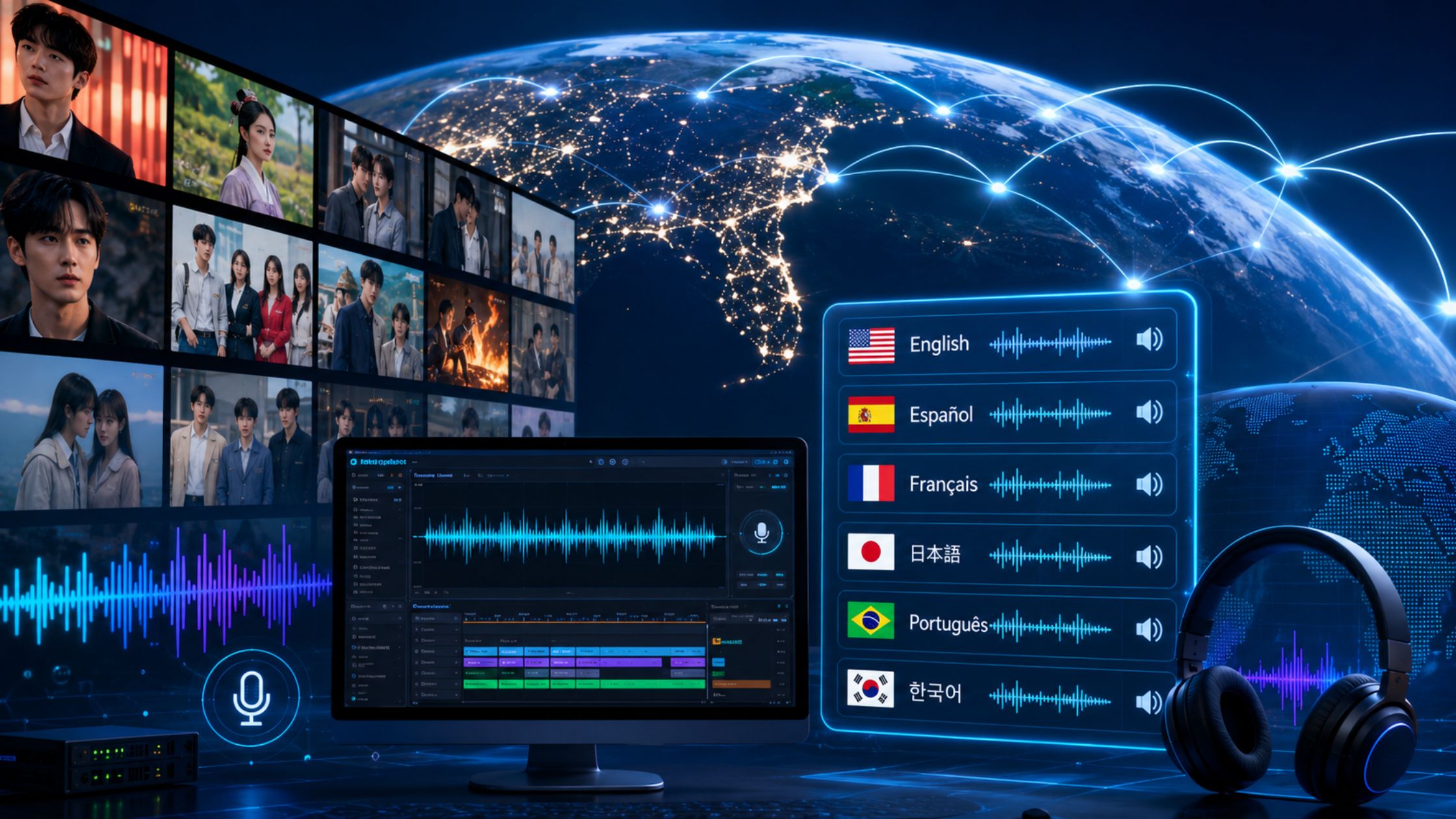
As global demand for Korean content continues to rise, AI-powered localization technologies are emerging as a critical layer of infrastructure that could help producers deliver multilingual releases faster, more efficiently, and at unprecedented scale.
K-content has never been more global. From streaming giants investing billions in Korean productions to international audiences driving demand for dramas, films, variety shows, and web-based content, South Korea’s entertainment industry has become one of the country’s most powerful export engines. Korean content now routinely reaches viewers across North America, Europe, Southeast Asia, Latin America, and the Middle East, transforming what was once a regional phenomenon into a truly global cultural force.
Yet the industry’s success has created a new challenge. For years, the primary question surrounding K-content was whether it could break through internationally. Today, the challenge is no longer visibility. It is scalability.
As the volume of Korean content expands and international audiences expect near-instant access to new releases, the traditional processes that make content accessible across languages are increasingly under pressure. Dubbing, subtitling, audio mixing, and localization workflows that once operated on monthly timelines are now being asked to support global audiences in real time.
The result is a growing recognition across the media industry that localization may become one of the most important infrastructure layers supporting the next phase of K-content’s global growth. Artificial intelligence is increasingly being positioned as a solution.
K-Content’s Global Success Has Created a Localization Bottleneck
The rise of streaming platforms has fundamentally changed the economics of content distribution. Historically, television shows and films often entered international markets months or even years after their original release. Localization workflows were designed around staggered launches, giving distributors time to translate scripts, record dubbed audio, perform quality assurance, and adapt content for local audiences.
Today’s global streaming environment operates differently. Platforms increasingly favor simultaneous worldwide releases. International audiences are accustomed to accessing content immediately, regardless of geography. Social media amplifies global conversations around new releases, making delayed localization increasingly problematic as spoilers and audience discussions spread across borders within hours.
While production and distribution technologies have evolved rapidly, localization workflows have often remained labor-intensive. This mismatch is becoming more apparent as content volumes continue to grow. While speaking with KoreaTechToday, audio AI company Gaudio Lab argued that localization is emerging as one of the industry’s most significant scaling challenges.
“K-content has already proven its strong IP competitiveness in global markets,” the company said.
“We believe the next leap forward will depend on how fast, into how many languages, and how faithfully to the original content can reach audiences.”
The observation reflects a growing industry reality. Success is no longer measured solely by the ability to create globally appealing content. Increasingly, it is also measured by how efficiently that content can be adapted and distributed across dozens of markets simultaneously.
Why Traditional Localization Models Are Under Pressure
Conventional localization involves multiple interconnected stages. Scripts must be translated. Voice actors need to be cast. Recording sessions must be scheduled. Audio engineering teams perform mixing and mastering. Quality control teams review localized versions before content is distributed.
Each step introduces costs and time requirements. This model remains highly effective for premium productions, but scaling it across an ever-growing volume of content is becoming increasingly difficult. The challenge is particularly acute as Korean content expands beyond major studio productions.
Streaming services, web-content creators, short-form video producers, and emerging formats such as micro-dramas are generating large volumes of material aimed at global audiences. Many of these creators lack the resources to support extensive traditional localization processes.
According to Gaudio Lab, the industry’s current infrastructure is approaching its limits.
“Until now, the global distribution of K-content has relied largely on platforms and outsourced dubbing and subtitling ecosystems,” the company told KoreaTechToday.
“But in an environment where the volume of content is exploding, this structure alone has clear limits.”
The company also argues that audience expectations are evolving alongside technological capabilities.
“Audiences do not want roughly processed AI dubbing.”
This distinction is important because it highlights a challenge facing the broader AI localization sector. Speed alone is not enough. Maintaining emotional nuance, production quality, and cultural authenticity remains essential for audience engagement.
The Push Toward Simultaneous Global Releases
The growing demand for simultaneous releases is reshaping how content companies think about localization. Historically, international launches often followed a phased approach. Content would debut in its domestic market before gradually expanding into overseas territories. Today, many platforms prefer coordinated global launches. This approach maximizes marketing impact, creates unified audience engagement, and allows content to participate in worldwide cultural conversations from day one. For Korean content producers, simultaneous releases create both opportunities and operational challenges.
The opportunities are clear:
- Larger global audiences
- Faster international monetization
- Stronger brand recognition
- Greater cultural influence
The challenge lies in preparing content for multiple markets at the same time. This is where AI-powered localization technologies are increasingly attracting attention. Companies across the media technology sector are exploring ways to automate portions of the localization process, including translation, voice synthesis, audio separation, dialogue adaptation, and quality assurance. The objective is not simply to reduce costs. It is to enable content to move across languages and markets at a speed that traditional workflows often struggle to achieve.
AI Is Evolving From a Tool Into Infrastructure
One of the most interesting aspects of Gaudio Lab’s vision is how it frames artificial intelligence. Rather than positioning AI as a standalone productivity tool, the company increasingly describes its role as infrastructure.
“This is precisely where Gaudio Lab aims to serve as the AI infrastructure layer of K-content’s global distribution,” the company said.
The distinction matters. Infrastructure supports entire ecosystems. It enables activity at scale without necessarily being visible to end users. In Gaudio Lab’s view, AI localization technologies could eventually play a role similar to cloud computing, digital payment networks, or content delivery systems by operating beneath the surface while enabling global distribution.
The company’s localization platform, Gaudio Studio Pro, aims to streamline multilingual dubbing and audio workflows that traditionally required significant manual effort. According to the company, reducing localization timelines from months to substantially shorter production cycles could help Korean content reach international audiences closer to its original release date. The implications extend beyond large media companies.
“Not only major production studios, but also OTT and streaming services, content distributors, and micro-drama producers across diverse industries can leverage AI technology to enter global markets,” the company explained.
If successful, this could lower barriers to international expansion for a wider range of Korean content creators.
Beyond Translation: The Next Evolution of AI Localization
Perhaps the most forward-looking element of Gaudio Lab’s strategy involves what it describes as “Beyond Localization.” Most discussions surrounding AI localization focus on translation and dubbing. The company’s longer-term vision is more ambitious.
Rather than simply converting content from one language to another, Gaudio Lab envisions AI systems capable of understanding audience preferences, cultural contexts, and regional consumption patterns. The company believes future AI systems could eventually help automate aspects of promotion, distribution planning, and market adaptation.
“We envision a future in which our AI capabilities learn the audiences and cultural contexts of each market and help automate even localized promotion and distribution strategies,” the company told KoreaTechToday.
If realized, such systems would transform localization from a technical process into a broader form of market intelligence. Instead of merely preparing content for different audiences, AI could help optimize how content is positioned, marketed, and distributed within each market. This represents a significant shift in how localization technology is perceived.
Why Localization Is Becoming Strategic Infrastructure for Korea
The implications extend beyond individual companies. As South Korea continues to strengthen its position as a global content exporter, localization infrastructure is becoming increasingly important to national competitiveness. For years, Korea’s content strategy focused on creative excellence, production quality, and international distribution partnerships.
Those factors remain critical. However, as content volumes increase and global competition intensifies, the ability to efficiently adapt content for international audiences may become equally important. In many ways, localization is evolving into a form of digital export infrastructure.
The ability to move Korean stories across languages, cultures, and markets efficiently could help determine how effectively the country sustains its global cultural influence over the coming decade. This is particularly relevant as emerging content formats generate increasing demand for multilingual accessibility.
From streaming originals and independent productions to short-form dramas and creator-driven media, future growth may depend on scalable localization systems capable of supporting a far larger content ecosystem.
The Next Phase of K-Content Globalization
K-content’s first wave of globalization was driven by creativity. Compelling storytelling, strong production values, and digital distribution helped Korean content reach audiences around the world. The next phase may depend increasingly on infrastructure.
As audience expectations shift toward immediate access and simultaneous global availability, the ability to localize content quickly, accurately, and at scale will become a strategic advantage. Artificial intelligence is unlikely to replace human creativity, cultural expertise, or storytelling. Those elements remain at the heart of successful content.
What AI may do, however, is remove many of the logistical barriers that prevent content from reaching audiences efficiently. For companies such as Gaudio Lab, that opportunity represents more than a technological challenge. It is an attempt to build the infrastructure layer supporting the future of K-content’s global expansion. As Korean entertainment continues to deepen its influence worldwide, the next breakthrough may not come from a new platform or a new blockbuster series. It may come from the technologies that ensure Korean stories can reach the world at the same moment the world wants to watch them.