

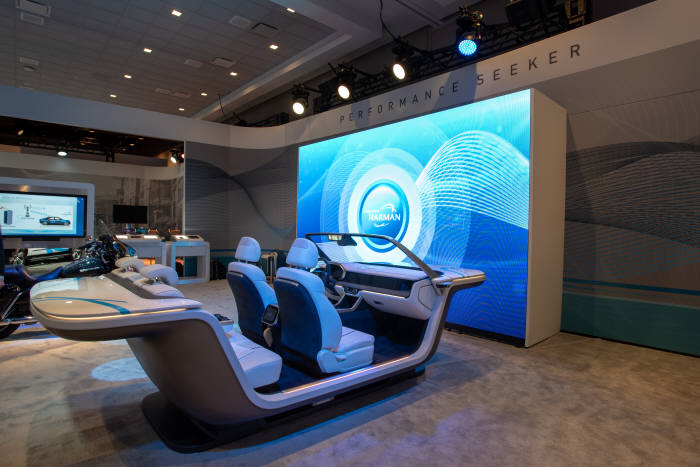
Technologies using Cloud Computing to run autonomously without computers in cars are just ahead. Samsung Electronics is planning to develop solutions that can run autonomously without computers in cars by 2020 along with its subsidiary Harman. Usually, self-driving cars are in charge of controlling final performance on high-performance computers inside vehicles even if V2X(vehicle to everything) is used. Harman is going to first attempt to compute and process information that is collected from sensors and network on Cloud computers and to give orders to vehicles in real time.
According to industries on the 22nd, Harman is planning to provide self-driving solutions without physical computers by 2020 by using ADAS (Advanced Driver Assistance System), 5G, and OTA (Advanced Wireless Function) technology that uses its own cameras and sensors. Although there were many plans to develop preceding technologies for self-driving solutions that utilize Cloud Computing, Harman is the first company that is able to produce these technologies.
Harman’s difference with self-driving technology is ‘cloud computing’ method. Instead of using high-performance computers in vehicles, it is equipped with multi-bandwidth common antennas and sends and receives information in real time from high-performance computers in the cloud. Cloud computer analyzes information that a vehicle gets from sensors such as cameras, radars, and radars and others and data on surrounding vehicles and infrastructures that are received through V2X and controls a vehicle in real time.
A reason why Harman is using Cloud Computing in self-driving solutions is because Samsung Electronics’ 5G network and semiconductor technologies are backed up. For the first time in the industry, Samsung Electronics received 5G telecommunication equipment certification from FCC (Federal Communications Commission). Because it has technology that is specialized for 3.5GHz band 5G network equipment, variety of information can be exchanged quickly through V2X. Harman’s OTA technology is also applied to reduce risk of hacking in the process of exchanging HD map data and infrastructure data.
Fact that Samsung Electronics had semiconductor technology that is suitable for edge computers also played a strong role. Edge computing is a method that distributes data near or near IoT devices. It is going to process data between IoT devices and Cloud. It was developed to handle amount of data as amount of data is increasing greatly due to spread of IoT devices.
Harman is also co-developing modular and advanced 5G Telematics that supports 1GB/s bandwidth to complete Cloud-based self-driving technology. Because 5G supports up to 100 times faster than current 4G (LTE) standards, it is able to provide high-resolution streaming, immersive virtual functions, AR (Augmented Reality) functions, and seamless cloud-based application (App) services in cars that are moving at high speed. An isometric antenna installed in a vehicle connects a cloud with an edge computer.
Harman is also going to apply self-driving technology to ADAS solution called DRVLINE(drive-line) that was developed with Samsung Electronics. DRVLINE is its own ‘sensor fusion’ solution that combines camera module developed by Samsung Electronics, LIDAR, cooperation with INNOBIZ technology, sensor fusion solution which have fusion laser technology by itself. It can respond from level 3 to level 5. However, solutions that are currently being developed as mass-produced will be targeted at Level 3 to 4.
Harman’s self-driving car is going to be applied with ‘Neuro-Sensor’ monitoring solution that is managed when control of driving is transferred from a self-driving system that is higher than level 3 to a person. Neuro-sensor detects most important primary biometric functions such as driver’s eye, head position, and pupil diameter through monitoring sensors. This can be applied to low-level self-driving cars and it can also play a role in the success of semi-automated vehicles in the future.
“Cloud method is the ultimate self-driving car in the future, and it is meaningful for Harman and Samsung Electronics to develop mass-production products for minimizing devices in cars and utilizing telecommunication network.”
Representative of an industry.