
Hyundai‘s Go Green Hackathon is framed publicly as a youth education initiative. But a closer look at HMGICS’s role inside Hyundai Motor Group’s global manufacturing network suggests the Singapore facility is doing something more consequential: testing ideas at small scale before they get exported to Hyundai’s much larger production sites overseas, including its $7.6 billion Metaplant in Georgia.
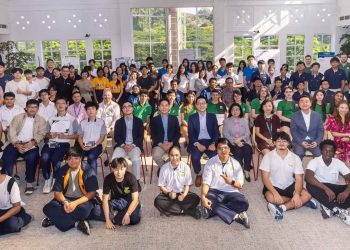
Hyundai Motor Group Innovation Center Singapore (HMGICS) and Hyundai CRADLE Singapore recently concluded the fifth edition of their annual Go Green Hackathon, bringing together a record 91 students across 25 teams from nine local and international schools to develop solutions for climate adaptation. Held for the first time at Temasek Shophouse, the event was organized in conjunction with Singapore’s Go Green SG 2026 campaign, in partnership with Temasek Foundation and with support from the National University of Singapore (NUS).
Students were tasked with addressing two real-world problems: redesigning community spaces to improve resilience against rising temperatures, and developing vehicle-based solutions that could serve as safe spaces during climate emergencies such as extreme heat, flooding, and deteriorating air quality. The initiative supported Singapore’s Year of Climate Adaptation and complemented the country’s effort to develop its first National Adaptation Plan, informed by findings from its Third National Climate Change Study.
Most coverage of the hackathon has treated it as a standalone story about youth engagement and corporate social responsibility. That framing isn’t wrong, but it overlooks the more interesting question: why does Hyundai keep running this kind of program through a facility whose primary stated purpose is manufacturing innovation, not education?
The answer lies in a detail that rarely makes it into hackathon coverage but is buried in Hyundai’s own announcements about its much larger U.S. plant. When Hyundai opened its Metaplant in Ellabell, Georgia, in March 2025, the company stated that the facility “has integrated a variety of proof-of-concept manufacturing technologies and systems from Hyundai Motor Group Innovation Center Singapore, scaling these to accommodate the larger production volume at the Georgia facility.” In other words, Singapore isn’t just where Hyundai builds cars and runs community programs. It’s where Hyundai tests ideas, at relatively small scale, before deciding which ones are worth scaling into a facility built to produce up to 500,000 vehicles a year.
Operational since November 2023, HMGICS is a seven-story, roughly 87,000-square-meter facility in Singapore’s Jurong Innovation District. It builds the IONIQ 5 and the fully autonomous IONIQ 5 robotaxi using a cell-based production system rather than a traditional conveyor belt, with around half of all manufacturing tasks carried out by robots working alongside humans. Hyundai’s own description of the facility frames it as a testbed: a place where production methods, AI-driven logistics, robotics, and digital-twin technology can be tried, refined, and validated before being deployed elsewhere in the company’s global manufacturing network.
The Georgia plant, by contrast, is built for volume. HMGMA spans roughly 2,900 acres and over 16 million square feet of factory floor space, employs more than 1,600 workers as of mid-2026, and is designed to eventually produce up to 500,000 Hyundai, Kia, and Genesis vehicles a year. It is the centerpiece of a $12.6 billion investment in Georgia (covering the plant and a joint battery venture), and according to Hyundai, the largest single economic development project in the state’s history.
Read together, the two facilities describe a deliberate division of labor. HMGICS is compact, flexible, and built to absorb risk on a smaller production run, which makes it a logical place to experiment with manufacturing approaches before committing them to a facility the size of HMGMA. That is a fundamentally different role than the one usually ascribed to it in coverage focused on its CSR programming, and it changes how the hackathon should be read. A program built around mentorship, climate adaptation problem statements, and youth engagement looks, on the surface, disconnected from heavy manufacturing strategy. But it sits inside a facility whose explicit institutional purpose is piloting ideas at small scale for later use at scale, which raises a more interesting question than “is this CSR or innovation?” It is: what is HMGICS actually testing when it runs these programs, and for whom?
During an exclusive conversation with KoreaTechToday, HMGICS addressed why Singapore occupies this position within Hyundai’s regional innovation strategy.
“HMGICS was first established in Singapore in November 2023 as the Group’s first global smart mobility hub and a testbed for future mobility innovation, to pilot advanced manufacturing technologies, new mobility concepts and open-innovation programs in close collaboration with government agencies, universities and partners.
“Our annual hackathon is one example of how we empower and nurture the next generation of innovators. As we continue to expand the hackathon and other youth-focused initiatives to more local and international schools, HMGICS will serve as a gateway for cultivating talents and solutions that can be further scaled and adapted to support a more resilient and sustainable future.”
That last phrase, “scaled and adapted,” is the operative one. It places the hackathon’s youth-led concepts in the same conceptual category as the manufacturing pilots that have already made the journey from Singapore to Georgia: ideas Hyundai tests small before deciding whether, and how, to scale them.
A Pattern That Extends Beyond Manufacturing
This isn’t a one-off arrangement specific to vehicle assembly. Hyundai Motor Group has spent the past several years building a broader architecture for testing and scaling technology across its global operations, and HMGICS fits a pattern visible elsewhere in the company’s strategy.
At CES 2026, Hyundai unveiled a Group-level AI robotics strategy built around what it calls a Group Value Network, anchored by its acquisition of Boston Dynamics. Central to that plan is a Robot Metaplant Application Center opening in 2026, designed specifically to train and validate humanoid robots such as Boston Dynamics’ Atlas before they are deployed into full manufacturing operations at HMGMA starting in 2028. The architecture is explicit: real-world data collected from operations flows back into a smaller, controlled environment for retraining, creating what Hyundai describes as a continuous improvement cycle before technologies are pushed into high-volume production.
HMGICS appears to function as an earlier-stage version of the same idea, applied more broadly than robotics alone. Where the Robot Metaplant Application Center is a dedicated facility for training robots specifically, HMGICS operates as a general-purpose pilot site, one that tests manufacturing processes, mobility concepts, and, through programs like the Go Green Hackathon, even early-stage problem framing contributed by people entirely outside the company. Few of Hyundai’s global facilities are explicitly designed to draw on external, non-employee ideation in this way. That distinguishes the hackathon from a typical CSR exercise: it is one of the few channels through which ideas generated by people who have no formal relationship with Hyundai feed into a pipeline that has, at least in manufacturing, demonstrably influenced what gets built at scale elsewhere in the company.
What This Means, and What It Doesn’t
None of this means a teenager’s evaporative cooling shelter concept is headed for a Georgia production line. The pipeline that carried proof-of-concept manufacturing technology from Singapore to Georgia involved Hyundai’s own engineering teams working on core production systems, not student hackathon submissions, and Hyundai has not stated that hackathon concepts feed into product development in the same way. The more accurate claim is structural rather than literal: HMGICS occupies a specific position in Hyundai’s global operations, as a place where the company tests things at smaller scale before larger commitments, and the hackathon is one of several mechanisms, alongside its core manufacturing pilots and robotics validation work, that the facility uses to generate and surface new ideas within that role.
That distinction matters for how the hackathon should be understood. It is not simply a goodwill gesture toward Singapore’s education sector, nor is it pure manufacturing R&D in disguise. It is best read as an extension of how HMGICS already operates: a facility whose institutional purpose, validated by its track record of feeding proof-of-concept technology into a much larger U.S. plant, is to generate and test ideas before Hyundai decides what is worth scaling. The fact that the company has chosen to extend that logic to climate adaptation concepts generated by 14-to-23-year-olds, rather than keeping it confined to internal engineering work, says something about how seriously Hyundai is treating open innovation as a complement to its in-house R&D, not a replacement for it.
Viewed through this lens, the actual winning ideas take on a slightly different significance. Team HeatSync from the Institute of Technical Education College Central won the community resilience category with a terracotta-based shelter using evaporative cooling to reduce outdoor temperatures. Team License to Chill from German European School Singapore won the smart mobility category with adaptive windows that use electronically controlled tinting to reduce heat buildup inside parked vehicles, a concept directly adjacent to the kind of climate-responsive cabin technology automakers are increasingly exploring for passenger comfort and safety. Five additional teams were recognized: River Valley High School’s Team Ephemeral and the School of Science and Technology’s Team WD-40 took second place in the two categories, United World Colleges East won both the Most Innovative award (Team EcoLink) and Best User Experience (Team Coolth), and Boon Lay Secondary School’s Team BLSparkler was named Most Feasible. The seven winning teams were evaluated against four criteria: relevance and alignment, feasibility and practicality, innovation and creativity, and impact and benefit.
Other student concepts explored AI-assisted flood detection, adaptive public transport for flood-prone environments, in-cabin air quality management, and emergency escape systems for vehicles caught in flooding. Several of these ideas, particularly the cabin-based climate and safety concepts, sit close to areas where automakers globally are already investing: in-cabin sensing, climate-adaptive materials, and vehicle-as-shelter use cases for disaster response. Whether or not any individual concept advances further, the alignment between student ideation and live industry priorities is itself notable.
Why This Matters Beyond Singapore
For South Korea’s broader technology and manufacturing sector, the more interesting story isn’t that Hyundai ran another hackathon. It’s that the company has built a working example of a small, fast-iteration innovation site feeding a much larger production network, and is now testing whether that same logic extends to ideas generated outside the company entirely. If HMGICS continues to function this way, expanding its hackathon to more schools while its manufacturing pilots continue informing larger plants like HMGMA, it offers a template other Korean manufacturers expanding overseas may find worth studying: pair a flagship high-volume facility with a smaller, lower-risk site explicitly designed to test ideas, whether they come from engineers or from teenagers, before committing capital at scale.
Hyundai’s stated ambition is for HMGICS to remain “a gateway for cultivating talents and solutions that can be further scaled and adapted.” Based on what the company has already demonstrated with its Georgia plant, that is not just marketing language. It describes a function the facility is already performing for its core manufacturing business. The Go Green Hackathon, in that light, looks less like an isolated CSR program and more like Hyundai testing whether the same small-scale, high-iteration model that has worked for production technology can also work for ideas.