
As South Korea expands investments in sovereign AI, data centers, and advanced computing, the country’s next competitive edge may depend on the infrastructure that powers artificial intelligence rather than semiconductors alone.
South Korea’s artificial intelligence ambitions are entering a new phase. After establishing itself as a global leader in advanced semiconductors, the country is increasingly shifting its focus toward building the infrastructure required to develop, deploy, and scale AI technologies.
The transition reflects a broader evolution in the global AI race. While semiconductor innovation remains critical, governments and technology companies are now investing just as aggressively in hyperscale data centers, cloud infrastructure, high-performance computing, AI networking, and sovereign AI capabilities. South Korea is no exception.
The Lee Jae Myung administration has placed AI at the center of its industrial strategy, announcing ambitious plans to strengthen the country’s AI ecosystem through investments in semiconductor competitiveness, AI computing infrastructure, and the National AI Computing Center. Major technology companies including Samsung Electronics, SK hynix, SK Group, NAVER, and SK Telecom are also expanding investments across AI hardware, cloud services, AI models, and enterprise AI applications.
These developments suggest that South Korea’s AI ambitions are no longer defined solely by manufacturing the chips that power artificial intelligence. Increasingly, they are about building the digital infrastructure capable of supporting AI at scale.
From semiconductor leadership to AI infrastructure
For years, South Korea’s competitive advantage in AI has been closely tied to its semiconductor industry. Samsung Electronics and SK hynix remain among the world’s leading suppliers of high-bandwidth memory, a critical component used in advanced AI accelerators developed by companies such as NVIDIA.
However, producing cutting-edge chips represents only one layer of today’s AI ecosystem.
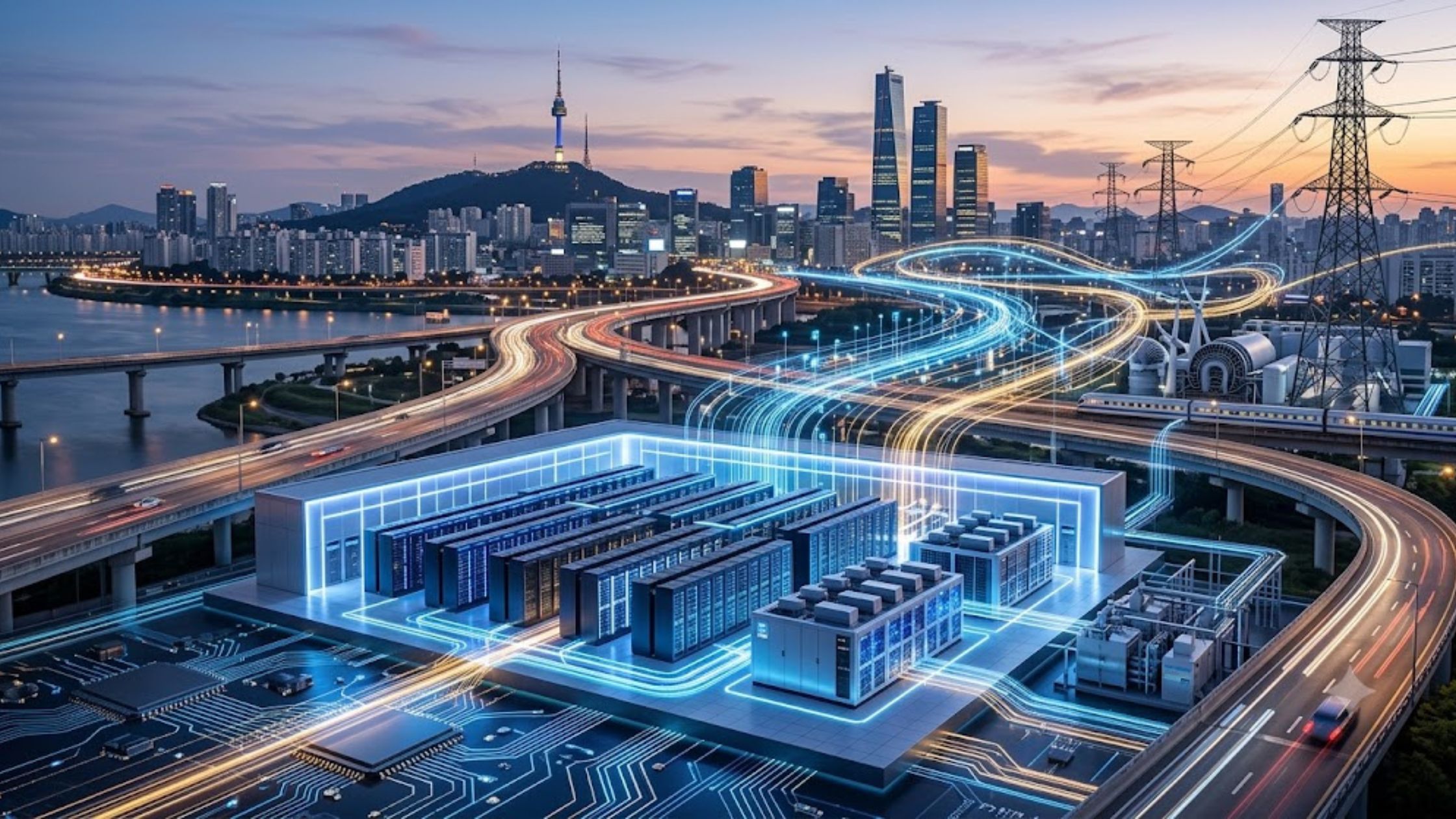
Generative AI and increasingly sophisticated AI agents require an extensive infrastructure stack that includes GPU clusters, high-speed networking, cloud platforms, data centers, storage systems, cooling technologies, and reliable energy supplies. As AI workloads continue to grow, the ability to operate and scale this infrastructure is becoming just as important as the hardware itself.
This shift is influencing national AI strategies around the world. Governments are increasingly viewing compute capacity and AI infrastructure as strategic assets that support economic competitiveness, industrial innovation, and technological sovereignty.
South Korea’s recent policy initiatives reflect this broader transition. Alongside investments in semiconductor manufacturing, the government is expanding support for sovereign AI, public AI infrastructure, GPU availability, and AI adoption across manufacturing, healthcare, mobility, and public services.
Infrastructure is becoming the next AI battleground
As AI adoption accelerates, industry leaders argue that the biggest constraints may no longer be semiconductor production alone.
During a conversation with KoreaTechToday, Greg Osuri, Founder and CEO of decentralized cloud computing platform Akash, said the discussion around AI shortages often overlooks the physical infrastructure supporting modern computing.
“Every GPU, LLM model, and AI agent ultimately depends on power, cooling, and grid capacity,” Osuri said. “So when people talk about a compute shortage, they are often also talking about an energy and infrastructure shortage underneath it.”
His comments reflect a growing discussion across the AI industry. Building AI infrastructure at scale requires substantial investments in electricity generation, transmission networks, cooling systems, high-speed networking, and data center construction. These challenges are becoming increasingly important as enterprises move beyond experimenting with generative AI toward deploying AI applications across manufacturing, finance, healthcare, logistics, and public administration.
For South Korea, the issue is particularly significant. The country combines world-class digital infrastructure with high industrial electricity demand, limited land availability, and ambitious plans to expand AI computing capacity. Ensuring that infrastructure keeps pace with AI adoption will become an increasingly important policy and industry challenge.
Building a more resilient AI ecosystem
Beyond infrastructure capacity, another issue gaining attention is resilience. Today’s AI ecosystem relies heavily on a relatively small number of hyperscale cloud providers and GPU manufacturers. While these platforms have accelerated AI adoption globally, they have also concentrated computing resources within a limited number of infrastructure providers.
Osuri believes expanding access to compute will be essential for supporting broader AI innovation.
“We can buy more chips, but if we cannot power them economically, cool them efficiently, or connect them to reliable infrastructure, they do not translate into usable AI capacity,” he told KoreaTechToday. “AI demand is scaling faster than the physical infrastructure needed to support it.”
While Akash advocates decentralized compute marketplaces as one possible approach, the broader conversation extends well beyond a single technology model. Governments, cloud providers, semiconductor companies, and AI developers are all exploring ways to increase computing capacity, improve resilience, and reduce infrastructure bottlenecks as AI adoption accelerates.
For South Korea, these discussions are particularly relevant as policymakers seek to balance sovereign AI ambitions with long-term infrastructure planning. Ensuring that startups, universities, research institutions, and enterprises have reliable access to AI computing resources will play an important role in determining how broadly AI innovation spreads across the economy.
The next phase of South Korea’s AI strategy
South Korea has already secured its place as one of the world’s leading semiconductor powers. The next challenge is translating that manufacturing strength into leadership across the broader AI ecosystem. As AI becomes embedded across industries, competitive advantage will increasingly depend on more than advanced chips. Reliable computing infrastructure, scalable cloud platforms, resilient energy systems, and accessible AI resources are emerging as equally important pillars of national AI competitiveness.
South Korea’s growing investments in sovereign AI, data centers, advanced computing infrastructure, and public-private AI initiatives suggest the country recognizes this shift. The focus is no longer simply on producing the world’s most advanced semiconductors. It is on building an AI ecosystem capable of supporting innovation over the long term.
If the first chapter of the global AI race was defined by who could build the most powerful chips, the next chapter may be defined by who can build the infrastructure that allows AI to scale efficiently, securely, and sustainably. South Korea appears determined to compete on both fronts.