
As labor shortages intensify across agriculture and food services, global robotics startups are increasingly looking to South Korea as a proving ground for next-generation automation technologies.
The global agriculture sector is facing a growing labor crisis. Across Europe, North America, and parts of Asia, farms are struggling to secure enough seasonal workers while rising operational costs and climate-related pressures continue to challenge food production systems. At the same time, advances in artificial intelligence, computer vision, and robotics are accelerating efforts to automate some of the industry’s most labor-intensive tasks. Industry estimates suggest the global agricultural robotics market is expected to grow rapidly through the end of the decade as growers seek technology-driven solutions to labor shortages and productivity challenges.
For global agri-robotics startup MiFood, these challenges have created what the company describes as a “Harvesting Crisis,” a problem it believes can only be solved through intelligent automation. But while the company is developing its technology in Europe, it increasingly views South Korea as one of the most important markets for the future of robotics.
While speaking with KoreaTechToday, a MiFood spokesperson described South Korea as “perhaps the most robot-friendly nation on Earth,” adding that the country has become more than just a commercial opportunity for robotics companies.
“For a robotics startup, it’s not just a market; it’s a living laboratory,” the spokesperson said.
The statement reflects a broader trend that is reshaping South Korea’s position in the global robotics ecosystem. As the country accelerates investments in artificial intelligence, service robotics, smart factories, and autonomous systems, international startups are increasingly viewing Korea as a strategic destination to test, refine, and commercialize emerging technologies.
Solving Agriculture’s Labor Shortage Through AI
MiFood was founded by Rubén Miranda, a fifth-generation farmer who transitioned into engineering after witnessing firsthand the growing challenges facing modern agriculture.
According to the company, labor shortages have become one of the most significant threats to agricultural productivity across Western Europe. In some regions, crops are left unharvested because farms cannot secure enough workers during peak seasons.
“The core problem we solve is the Harvesting Crisis,” the company told KoreaTechToday.
“In regions like the UK and Western Europe, billions of dollars in produce rot in fields every year because there aren’t enough hands to pick them.”
The issue extends far beyond Europe. Aging populations, declining rural workforces, and increasing labor costs are creating similar pressures across advanced economies, including South Korea and Japan. As governments and agricultural producers search for long-term solutions, robotics is increasingly being viewed as a strategic necessity rather than a future experiment.
Building Robotic Co-Workers Instead of Traditional Machines
Unlike conventional agricultural machinery designed to perform repetitive mechanical operations, MiFood positions its systems as autonomous robotic co-workers capable of making decisions in dynamic environments.
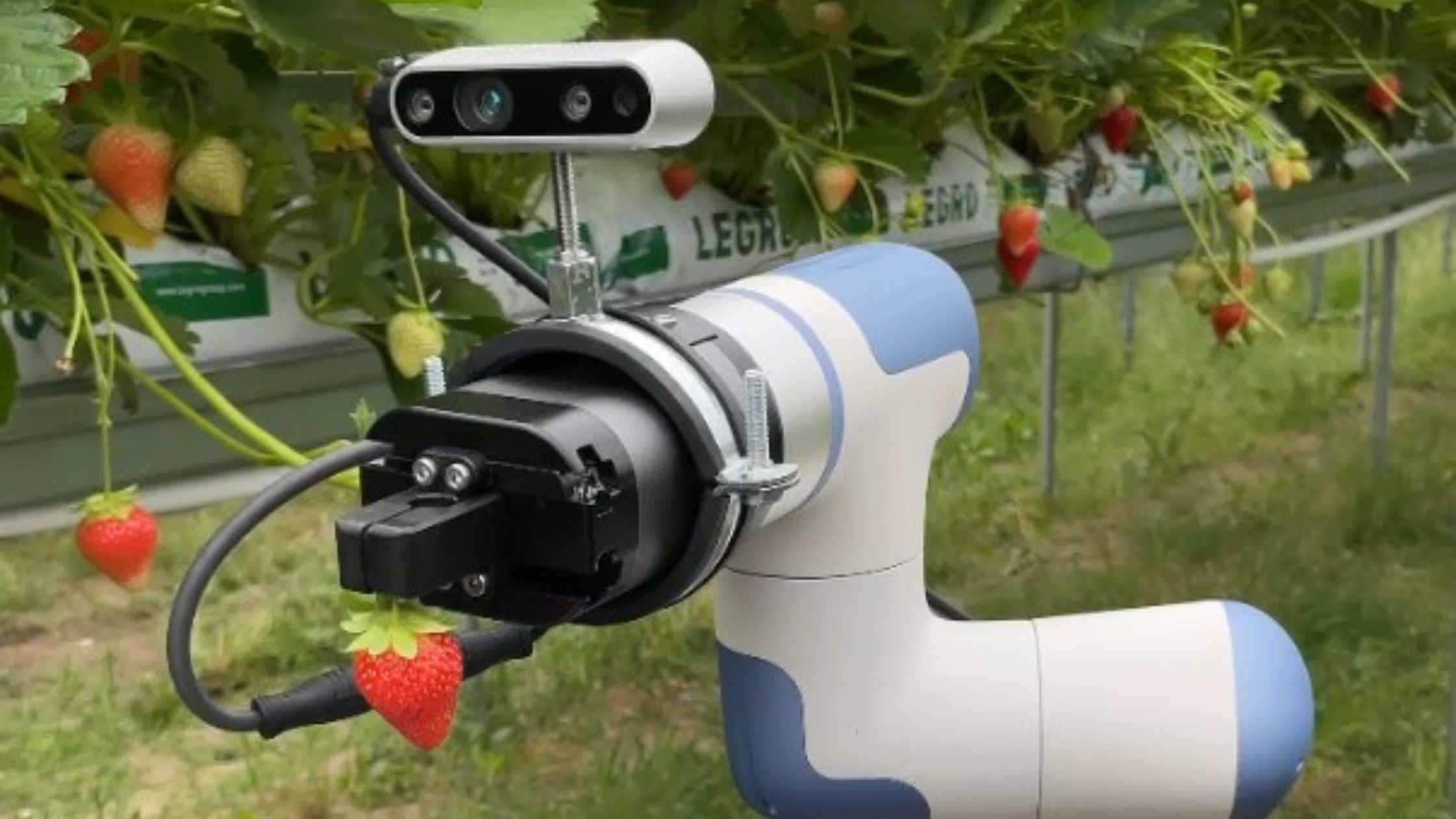
The company’s harvesting platform combines artificial intelligence, computer vision, and specialized robotic grippers designed for delicate produce such as strawberries and grapes. Using three-dimensional vision systems, the robots analyze crops at the plant level, identifying factors such as ripeness, size, and overall crop condition before harvesting.
One of the biggest technical challenges in agricultural robotics has been handling fragile fruits without causing damage. Industry researchers continue to identify fruit recognition, ripeness detection, and gentle harvesting as major obstacles preventing widespread deployment of harvesting robots.
MiFood says it has addressed part of this challenge through proprietary end-effectors designed to mimic the precision of human handling.
“They’ve developed specialized hands that can handle delicate fruits like strawberries or grapes without bruising them, a task that previously required human touch,” the company explained.
The startup’s systems are also designed around modularity. Rather than creating a single-purpose machine, MiFood aims to build adaptable robotic platforms that can be deployed across multiple food production environments, from greenhouse harvesting operations to commercial kitchen workflows.
This flexibility mirrors a larger trend emerging across the robotics sector, where companies are increasingly focusing on general-purpose physical AI systems capable of performing multiple tasks instead of narrowly specialized functions.
Why South Korea Has Become a Strategic Robotics Testbed
For MiFood, one of the most significant milestones in its international expansion came through participation in the K-Startup Grand Challenge (KSGC), South Korea’s flagship government-backed accelerator program for global startups.
Launched in 2016, KSGC has become a major entry point for international startups seeking access to the Korean market. The program provides office space, grants, visa support, corporate networking opportunities, and access to local investors.
According to MiFood, the program played a critical role in helping the company establish connections within Korea’s technology ecosystem.
The company highlighted access to Pangyo Techno Valley, often referred to as Korea’s Silicon Valley, as well as opportunities to engage with major Korean corporations exploring automation, smart-city infrastructure, and food technology solutions.
“KSGC gave us the cultural and professional bridge needed to scale where automation is actually embraced, not feared,” the company told KoreaTechToday.
That perspective aligns with broader developments taking place across South Korea’s technology landscape.
The country has emerged as one of the world’s most automation-intensive economies, driven by demographic decline, labor shortages, and a national strategy focused on robotics and AI-driven productivity. Korean companies are increasingly investing in physical AI, autonomous robots, and human-machine collaboration technologies designed to address workforce constraints across manufacturing, logistics, hospitality, healthcare, and agriculture.
For foreign robotics startups, this creates a unique environment where emerging technologies can be tested in real-world commercial settings while benefiting from a population that is generally receptive to automation.
Measuring the Sustainability Impact
Beyond labor efficiency, MiFood argues that automation can contribute to broader sustainability goals. The company claims its robotic systems can reduce crop losses by up to 30% through more precise harvesting operations while lowering harvesting labor costs by as much as 50%.
The company also says its electric-powered robotic platforms can reduce carbon emissions by up to 75% compared to traditional fossil-fuel-powered agricultural machinery. While these figures are company estimates, they highlight a growing focus among agri-tech startups on combining productivity gains with environmental performance.
Food waste reduction has become an increasingly important priority across global food supply chains. Harvest optimization technologies that improve crop recovery rates and reduce spoilage are attracting growing attention from investors and policymakers seeking more sustainable food production models.
The Next Phase of Agricultural Automation
Looking ahead, MiFood plans to expand beyond harvesting automation. One of the company’s upcoming initiatives is MiFood Scout, a robotic crop-monitoring system designed to identify plant diseases, nutrient deficiencies, and environmental stress factors before they become large-scale agricultural problems.
The long-term objective is even more ambitious. MiFood envisions what it describes as a closed-loop agricultural ecosystem in which autonomous systems manage planting, monitoring, harvesting, and operational decision-making with minimal human intervention.
Such visions remain technically challenging. Researchers continue to note that fully autonomous agriculture faces significant hurdles due to the complexity and unpredictability of real-world farming environments. However, advances in computer vision, machine learning, simulation-based robotics training, and sensor technologies are steadily pushing the industry closer to that goal.
South Korea’s Growing Role in the Future of Food Robotics
As nations confront aging populations, workforce shortages, and increasing pressure on food systems, robotics is moving from experimental pilot projects into core economic infrastructure. For startups like MiFood, South Korea represents more than an expansion market. It offers an environment where government support, technological sophistication, corporate participation, and public acceptance of automation converge in ways that remain difficult to replicate elsewhere.
The company’s experience through KSGC illustrates how Korea is increasingly positioning itself as a gateway for global robotics innovation entering Asia. At a time when automation is becoming central to economic competitiveness, the country’s growing role as a testing ground for next-generation robotics may prove just as significant as the technologies themselves. If MiFood’s assessment is correct, South Korea’s future may not simply involve adopting food robotics. It may help define how the industry evolves globally.