

Dispute highlights growing uncertainty over “from-scratch” standards in Korea’s flagship AI initiative
SK Telecom has pushed back against claims questioning the originality of its large-scale AI model, A.X K1, as controversy surrounding South Korea’s government-led national AI model project continues to widen. The debate, which initially focused on rival teams from Naver and Upstage, has now expanded to include SK Telecom’s elite team after allegations surfaced that A.X K1 bears similarities to China-based AI model DeepSeek.
The national AI model project, overseen by the Ministry of Science and ICT, is a core government initiative aimed at developing a foundation model unique to South Korea. SK Telecom submitted A.X K1 at the project’s first official briefing late last month, positioning the model as a key pillar of its broader AI strategy.
SK Telecom’s response to similarity claims
On Jan. 8, SK Telecom said A.X K1 was developed using an independent architecture and trained entirely from scratch. The company emphasized that the model contains 519 billion parameters trained from randomly initialized weights, arguing that both its scale and development process distinguish it from existing foreign models.
SK Telecom said allegations of similarity stem from confusion between training architecture and inference-related elements. According to the company, components cited as resembling DeepSeek’s V3—such as multi-head latent attention (MLA) and mixture of experts (MoE)—appear only in inference code used to run open models efficiently, not in the training code that determines originality.
“From-scratch development refers to how a model is designed and trained,” the company said, adding that inference code is widely reused across the AI industry and does not undermine independent development.
Technical debate reflects industry-wide practices
Industry observers note that architectures such as MLA and MoE are increasingly common across large language models, making surface-level similarities difficult to avoid. AI engineers often reuse standardized inference code to ensure compatibility and performance, while maintaining distinct training pipelines and parameter initialization.
The dispute has therefore shifted from whether SK Telecom copied a specific model to whether Korea’s national AI project has clearly defined how far architectural overlap is acceptable. Several engineers argue that originality should be judged primarily on training methodology, data, and weight initialization, rather than on post-training deployment code.
Public reassessment by industry figures
The debate eased somewhat after Lee Seung-hyun, vice president of AI firm FortyTwoMaru, publicly revised earlier remarks questioning A.X K1’s originality. In a social media post, Lee apologized to SK Telecom’s development team, stating that the model was trained entirely from scratch.
Lee acknowledged that while A.X K1 drew inspiration from techniques such as MLA and dual normalization, these were optimized through SK Telecom’s own scaling and engineering methods, producing results that went beyond simple reuse.
Part of a broader pattern across the project
SK Telecom’s case follows similar disputes involving other participants in the national AI model project. Upstage previously faced allegations that its Solar Open model reused elements from Zhipu AI’s GLM-4.5-Air, which it denied, saying only inference code styles were referenced. Naver Cloud also came under scrutiny for using an external encoder from Alibaba’s Qwen model, but said the choice did not violate from-scratch principles.
Together, the incidents have highlighted a recurring issue: the absence of detailed government guidelines on how “from scratch” should be interpreted for large, modern AI systems built within global open-source ecosystems.
Strategic stakes for SK Telecom
Despite the controversy, SK Telecom has continued to advance its long-term AI plans. The company recently consolidated its AI operations into a new in-house unit, AI CIC, and has said it plans to invest about 5 trillion won over the next five years to expand AI services, platforms, data centers, and proprietary foundation models.
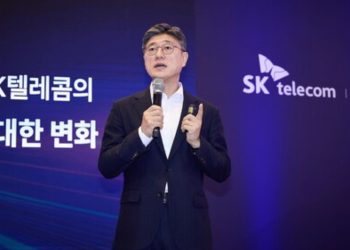
SK Telecom CEO Ryu Young-sang has said the reorganization is intended to ensure the company does not miss what he described as the “golden time for AI,” and to position SK Telecom as a central player in South Korea’s AI ecosystem.
Broader implications for national AI policy
The dispute over A.X K1 underscores a larger challenge facing the national AI model project: balancing the goal of technological sovereignty with the realities of modern AI development, where shared architectures and open-source components are widely used. As the government moves forward with evaluations, industry observers say clearer standards will be needed to prevent similar disputes and provide certainty to participating teams.
For now, SK Telecom’s defense of A.X K1 has become a focal point in a broader debate over how South Korea defines independence in AI—one that is likely to shape the direction of national AI policy in the years ahead.