
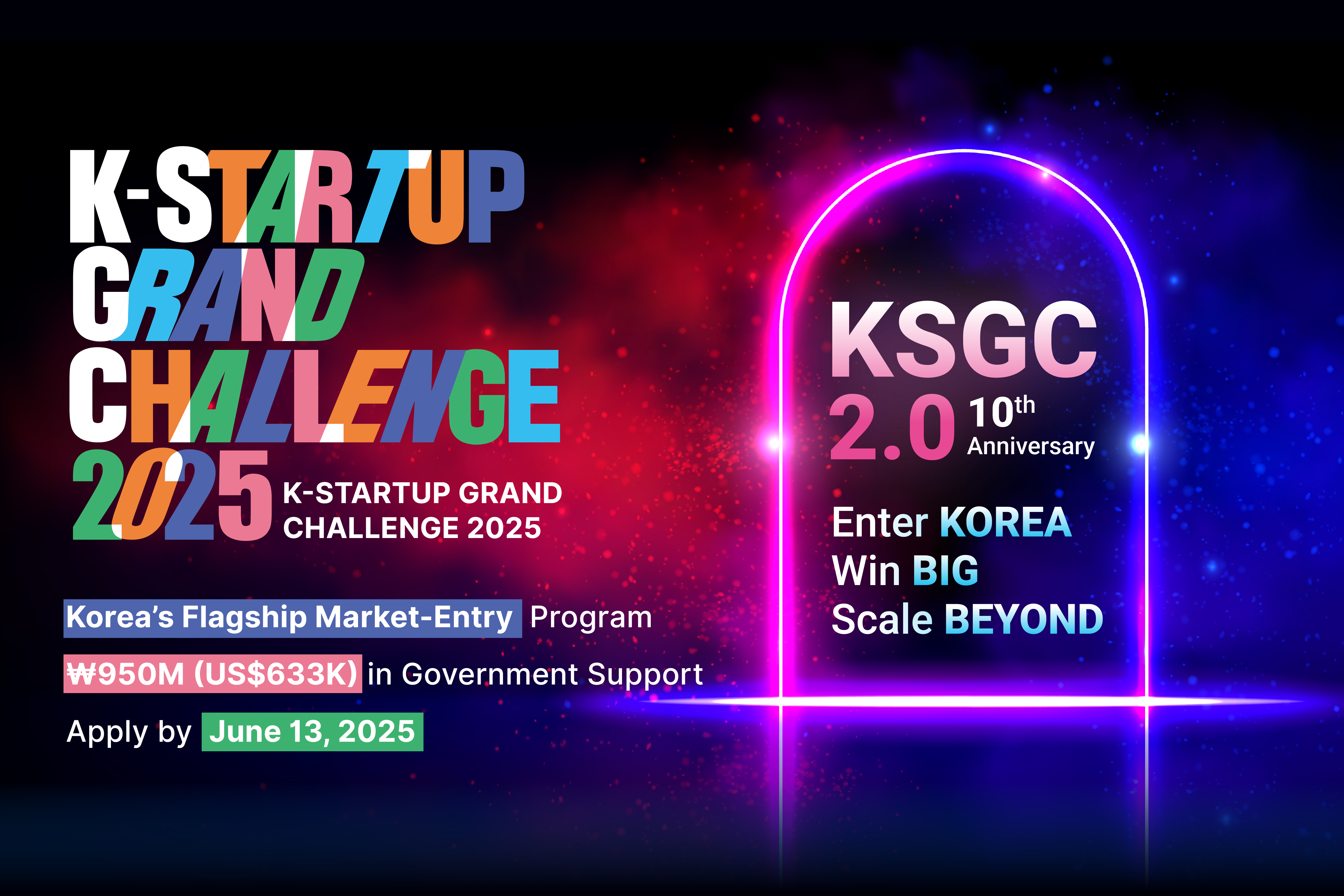
South Korea has launched the 10th edition of its flagship startup acceleration program, the K-Startup Grand Challenge (KSGC), with applications now open for foreign startups aiming to enter the Korean and broader Asian markets.
Backed by the Ministry of SMEs and Startups (MSS) and operated by the Gyeonggi Center for Creative Economy and Innovation (GCCEI), this year’s program will be helping startups on proof-of-concept (PoC) projects and corporate partnerships with major Korean conglomerates including Samsung, LG, Hyundai, and KT.
The KSGC initiative, which has supported nearly 300 international teams over the past decade, is structured to provide high-potential startups with both market access and commercialization pathways through a government-backed program that does not take equity.
Focus on PoC and Strategic Industry Collaboration
One of the program’s key features is its direct access to more than 20 of South Korea’s leading corporations. These industry connections are facilitated through Korea’s national Creative Economy and Innovation Center (CCEI) network, with each of the 19 regional centers paired with a major conglomerate. For participating startups, this creates targeted opportunities to develop and validate PoC projects within Korea’s advanced industrial ecosystem.
The organizing body, GCCEI, works closely with startups throughout the process—providing not only PoC matchmaking, but also visa sponsorship, legal incorporation support, and free office space for selected teams. Startups that demonstrate strong market potential may also qualify for follow-on scale-up grants of up to ₩50 million (US$33,000) in the final stage of the program.
Three-Phase Program Design
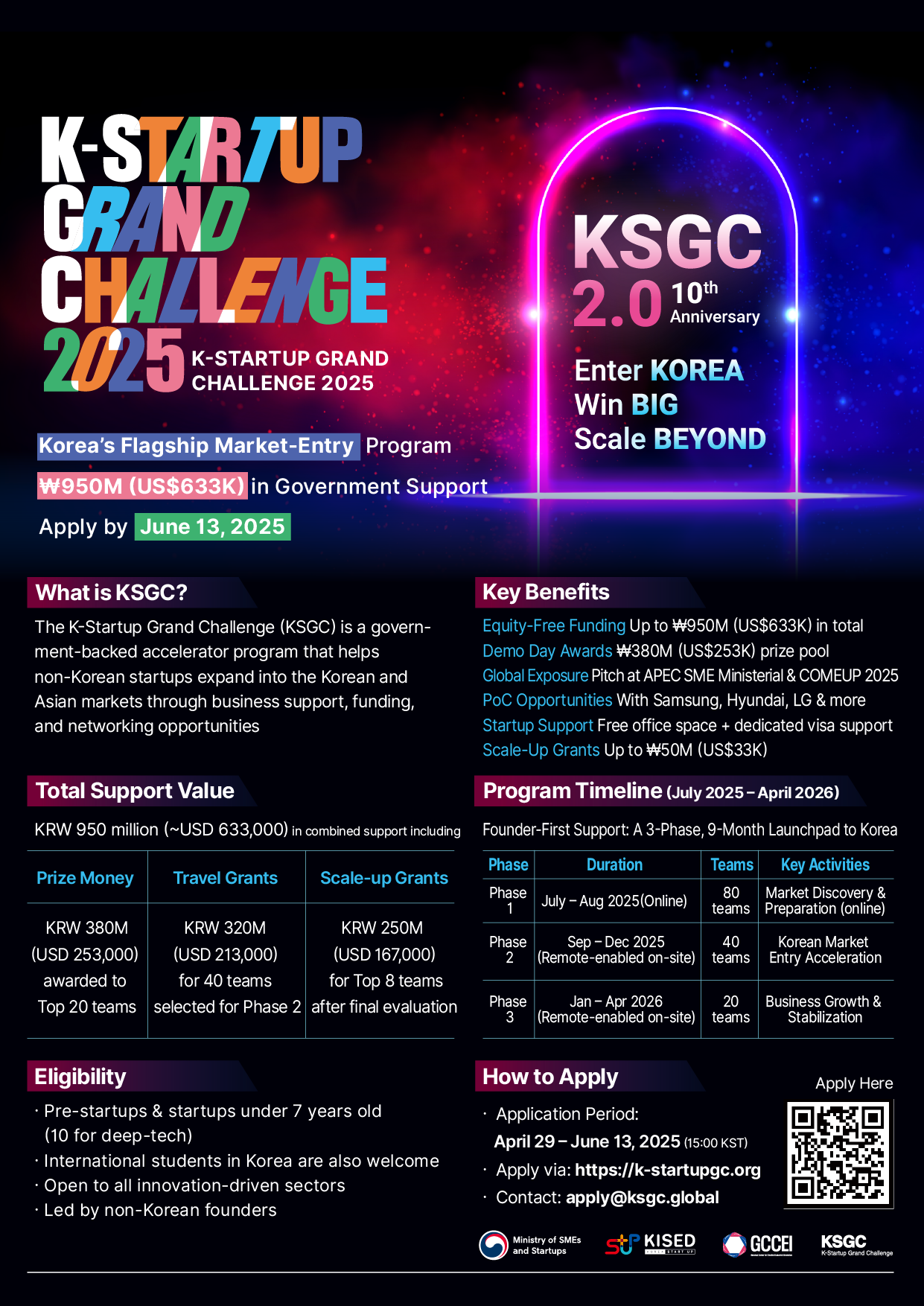
The KSGC 2025 cohort will be selected through a three-phase structure that combines remote onboarding with in-market acceleration and long-term commercialization support. The program will run from July 2025 to April 2026.
- Market Exploration (Online):
Beginning in July 2025, 80 startups will join a three-week remote session designed to introduce them to Korea’s business landscape. Startups will receive insights into the local regulatory environment, business practices, and sector-specific opportunities. The goal is to help founders assess feasibility and begin localization before entering the market physically. - Market Entry (On-site):
From September to December 2025, 40 selected teams will relocate to South Korea to engage in the full in-country acceleration phase. This includes business development support, workshops, and investor networking. Teams will receive resources to set up legal entities, attend targeted B2B meetings, and participate in PoC discussions with Korean corporates. - Market Growth (On-site):
From January to April 2026, 20 of the most promising teams will be invited to continue working from Korea. These teams will receive additional commercialization support, ongoing investor introductions, and scale-up grants aimed at accelerating partnerships and local expansion. The top eight performing teams will each receive a grant of ₩50 million (US$33,000).
Funding and Benefits
The program offers up to ₩950 million (US$633,000) in equity-free funding, distributed across various stages. In addition to the scale-up grants, participating teams will have access to:
- Full support for visa applications and company registration
- Free co-working space during on-site phases
- Structured mentorship and pitch training
- Curated investor and enterprise matchmaking
- Opportunities to present at major tech events and ministerial meetings
National and International Exposure
To raise visibility and foster commercial outcomes, startups will present their work at COMEUP 2025, Korea’s largest startup showcase, and take part in Demo Day, where a total of ₩380 million (US$253,000) in prize money will be distributed among 20 high-performing startups.
Select teams will also have the chance to pitch during the 2025 APEC SME Ministerial Meeting, gaining exposure to regional stakeholders, policymakers, and investors from across Asia-Pacific.
Alumni Case Study: Polymerize
Past participants have leveraged KSGC to launch deeper engagements with Korea’s research institutions and enterprise sector. Singapore-based startup Polymerize, which uses AI to accelerate materials discovery, secured a research partnership with KAIST, raised bridge funding from SparkLabs Korea, and ran 10+ PoC projects with Korean materials companies. The company has since signed a commercialization agreement with a leading Korean chemical firm—underscoring the long-term potential of the program beyond the initial four-month engagement.
Eligibility and Application
KSGC is open to startups operated by non-Korean nationals. Eligible applicants must have founded their startups within the last 7 years, though deep-tech startups can be up to 10 years old. The program is open to startups in all industries but is particularly focused on:
- Artificial Intelligence
- Healthcare and Biotech
- Fintech
- Smart Manufacturing
- Energy and Mobility
- Sustainable Technologies and Deep-Tech
Startups are expected to have at least a minimum viable product (MVP) or working prototype. International students currently residing in Korea are also encouraged to apply.
Applications close on June 13, 2025 at 15:00 KST.
More information is available at www.k-startupgc.org, and inquiries can be directed to [email protected].