

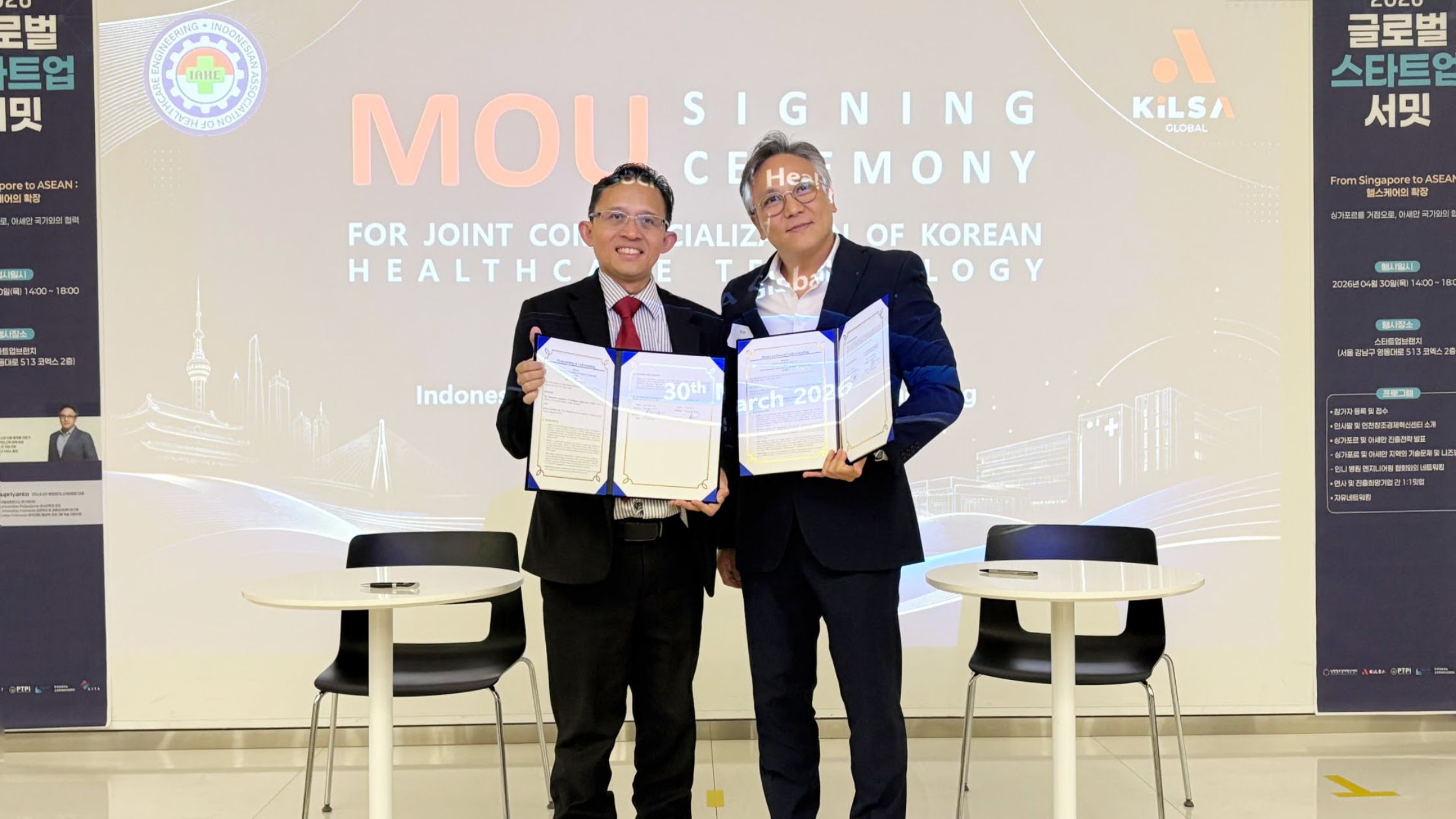
Kilsa Global and Indonesia’s IAHE aim to cut commercialization timelines for Korean healthcare firms navigating BPOM approvals, localization requirements, and hospital market access in Southeast Asia’s largest healthcare market.
Singapore-headquartered market entry specialist Kilsa Global has signed a memorandum of understanding with IAHE (Indonesian Association of Healthcare Engineering) to support the commercialization of Korean healthcare and medical technology companies in Indonesia. The agreement covers local partnerships, proof-of-concept deployments, and regulatory coordination, as Korean firms look to establish structured pathways into one of Southeast Asia’s most complex but fastest-growing healthcare markets.
Indonesia is investing heavily in its health system. President Prabowo’s administration has committed IDR 218.5 trillion in 2025 alone to improve healthcare access, upgrade hospitals, and expand infrastructure. That investment is creating real demand for advanced international medical technology, and Korea is already among Indonesia’s top medical device suppliers. The country ranks fourth in Indonesia’s import market for medical devices, behind China, the US, and Germany. The question for Korean startups has rarely been whether Indonesia wants their technology. It has been how to get it there.
Why Indonesia Remains Hard to Crack
Despite the opportunity, Indonesia is one of the more structurally demanding healthcare markets in Southeast Asia for foreign companies. Regulatory requirements, localization policies, and hospital procurement structures create barriers that can stretch standard commercialization timelines to anywhere between 18 and 36 months.
At the center of those barriers is BPOM, Indonesia’s National Agency of Drug and Food Control. Foreign manufacturers without a legal entity in Indonesia cannot directly hold product registrations. All devices must be registered through BPOM’s electronic system by an Indonesian entity, typically a local distributor, which limits the foreign company’s direct control over approvals, lifecycle management, and commercial strategy.
Layered on top of that is the TKDN policy, Indonesia’s domestic content requirement, which mandates that medical devices procured by government-funded hospitals must meet minimum local content thresholds to qualify for the national e-Katalog procurement system. The real-world impact has been significant. Since the 2022 regulation tightened requirements, the share of imported products in government procurement catalogues has dropped from 92% to 52%. For Korean companies targeting public hospitals, TKDN compliance is no longer optional.
The regulatory complexity is compounding as digital health technologies proliferate. AI diagnostics, SaMD platforms, and wearable monitoring systems still face ambiguous classification under current BPOM frameworks, adding further uncertainty for companies at the cutting edge of healthcare technology.
The Kilsa-IAHE agreement is structured around reducing the time and friction within this process. According to a spokesperson who shared responses directly with KoreaTechToday, the partnership approach involves IAHE’s distributor network, which is already familiar with BPOM, Kemenkes, and TKDN requirements, combined with early regulatory guidance, compliance preparation, and proof-of-concept implementation within IAHE-affiliated hospitals to generate local validation faster.
“Indonesia’s regulatory process can be complex, but IAHE can help shorten the timeline through strong distributor networks already familiar with BPOM, Kemenkes, and TKDN requirements,” the spokesperson told KoreaTechToday.
“The goal is not to bypass regulations, but to reduce inefficiencies and accelerate readiness, potentially shortening market-entry timelines by 30–50%,” the spokesperson added.
What Indonesian Hospitals Are Prioritizing
Understanding the demand side is as important as navigating the regulatory one. In responses shared directly with KoreaTechToday, representatives involved in the initiative laid out the specific technology categories that Indonesian hospitals are currently pursuing under the country’s SMART hospital transformation framework.
The highest-priority areas for Korean technology across the IAHE network include AI-based diagnostics and clinical decision support systems, smart hospital command center and operational AI, EMR interoperability and healthcare cybersecurity systems, telehealth and remote patient monitoring, healthcare automation and smart infrastructure systems, and innovative medical devices. Korea, the spokesperson noted, is considered particularly competitive across all of these categories, given the country’s depth in advanced manufacturing and medical technology development.
The demand profile confirms a broader shift playing out across Indonesia’s hospital sector. Procurement decisions are no longer focused on standalone software or single-device deployments. Hospitals are increasingly seeking integrated systems that address workflow efficiency, diagnostics, patient monitoring, and data management as a unified layer. That scope plays directly to the strengths of Korean companies that combine software platforms with embedded AI and hardware-based medical devices.
Physical AI and SaMD Both Gaining Ground
Discussions surrounding the partnership also highlighted the technology profile of Korean startups actively pursuing the Indonesian market. In responses shared with KoreaTechToday, the spokesperson described the cohort of 14 startups selected for in-depth consultations at the 2026 Global Startup Summit in Seoul. The group spanned AI-powered diagnostics, digital therapeutics, wearable healthcare platforms, medical imaging, biosignal sensing systems, implant technologies, semiconductors, and smart medical devices.
A notable trend within that group was the strong presence of Physical AI companies, those combining AI software with hardware-based technologies such as imaging devices, biosignal sensing systems, monitoring platforms, and semiconductor technologies. Korea’s advanced manufacturing ecosystem and medical technology depth continue to underpin its competitiveness in these areas, particularly as Indonesian hospitals seek technologies that can operate across multiple clinical functions simultaneously.
Software-as-a-Medical-Device (SaMD) platforms are also seeing growing demand, with particular interest in AI-assisted clinical decision support, remote patient monitoring, workflow optimization, and mental health tools.
Rather than pointing toward one category over the other, the consultations reflected a convergence. AI-enabled devices and SaMD platforms are increasingly operating as complementary layers within hospital ecosystems, and Korean companies that span both are better positioned to meet the integrated infrastructure demands of Indonesia’s SMART hospital buildout.
A Shift in How Korean Companies Are Approaching Overseas Expansion
Philip Park, Managing Director of Kilsa Global, which has operated as a market entry specialist for Korean companies across Southeast Asia since its founding in Singapore in 2015, said the collaboration with IAHE is designed to give Korean healthcare companies a structured path into Indonesia that avoids the trial-and-error cycle that has slowed many previous attempts.
“Through our collaboration with IAHE, we have established a commercialization structure that enables Korean healthcare companies to stably settle into the Indonesian market without trial and error,” Park said.
IAHE, connected to approximately 3,000 hospitals and healthcare facilities across Indonesia, is expected to support demand verification, institutional introductions, and PoC facilitation for participating companies.
Eko Supriyanto, chairman of IAHE and professor at the National Institute of Technology Malaysia, framed Indonesia’s current healthcare transformation as an active pull factor for international technology partners.
“Indonesia is pursuing a massive healthcare transformation under the ‘Golden Indonesia 2045’ vision, and there is a great need to introduce world-class medical technology, including that from Korea,” Supriyanto said.
The broader pattern here is notable. Rather than relying on export-oriented strategies or distributor-only models, a growing number of Korean healthcare companies are seeking operational commercialization partners capable of handling regulatory preparation, institutional access, and on-the-ground execution in tandem. The Kilsa-IAHE structure reflects that shift directly.
KOTRA, South Korea’s state trade promotion agency, has also been active on this front, running a Southeast Asia Biomedical Export Roadshow across Kuala Lumpur, Jakarta, and Manila in 2025, with 20 pharmaceutical and medical device companies participating. The government-level push and private-sector partnerships are increasingly moving in parallel.
Indonesia as a Long-Term Market, Not Just an Export Target
For Korean healthtech firms, Indonesia has historically been treated as an export destination: ship the product, find a distributor, wait for approvals. That model is showing its limits. The combination of tightening TKDN requirements, BPOM’s mandatory local entity rules, and the rising complexity of hospital procurement means that the companies gaining ground in Indonesia are those building institutional relationships and local validation from the start, not after the fact.
The Kilsa-IAHE partnership is a commercial bet that this shift is accelerating. Whether it delivers on the promised 30–50% reduction in market-entry timelines will depend on execution, and on how effectively IAHE’s hospital network can generate the local proof-of-concept traction that Korean startups need to move from product approval to commercial scale in a market that remains, for all its opportunity, structurally unforgiving for those who arrive unprepared.