
Missile system discussions during the Modi–Lee summit highlight growing overlap between defence, semiconductors, and satellite infrastructure
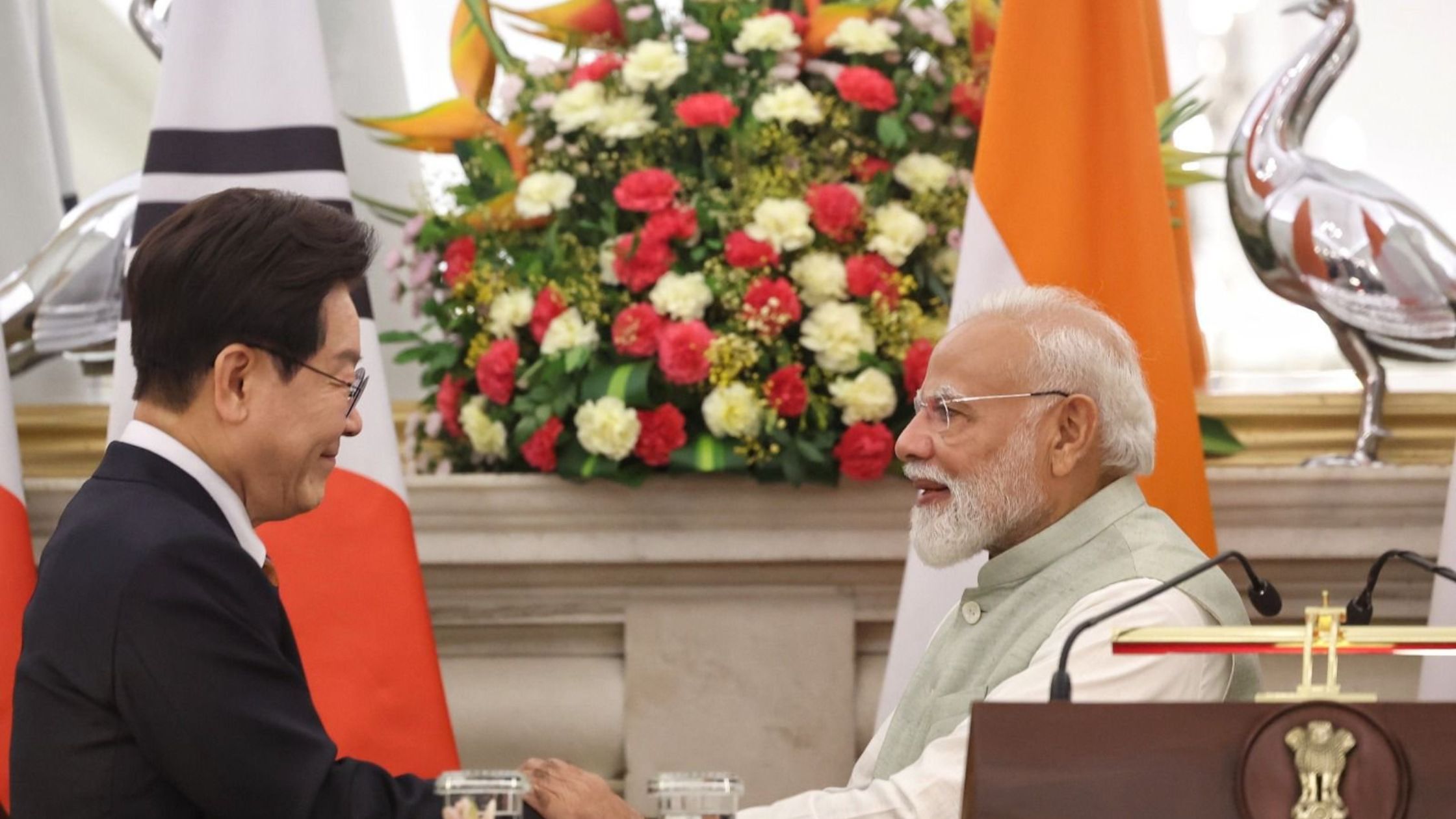
South Korea is seeking to expand its defence and technology footprint in India, as discussions during President Lee Jae Myung’s visit to New Delhi highlighted potential cooperation in missile systems, advanced manufacturing, and emerging technologies. Talks with Prime Minister Narendra Modi also pointed to a broader push to deepen industrial ties between India and South Korea.
In meetings with Prime Minister Narendra Modi, India signalled interest in South Korean missile systems and air defence platforms, alongside discussions on co-development and technology transfer, according to official briefings and regional reports. The visit—the first by a South Korean president to India in nearly eight years also saw both sides commit to expanding cooperation in semiconductors, artificial intelligence, and shipbuilding, while targeting $50 billion in bilateral trade by 2030.
For Seoul, the talks are a broader strategy: scale its defence exports while embedding itself deeper in partner ecosystems. South Korea’s defence industry has built momentum globally on the back of competitive pricing, fast delivery, and flexible industrial partnerships. India, with its large procurement pipeline and focus on domestic production, is a key market.
The K-9 Vajra artillery programme remains the anchor of this relationship. Built in India using South Korean technology, it highlights Seoul’s ability to combine exports with local manufacturing and technology sharing. Discussions around future phases—and potential expansion into missile systems—suggest a move toward more advanced collaboration. Rather than standalone deals, the focus is shifting to long-term industrial partnerships.
Tech ties widen beyond defence
The summit also reinforced cooperation in semiconductors, artificial intelligence, and advanced manufacturing, sectors that increasingly underpin modern defence systems and where South Korea holds a clear advantage.
“Our talks today covered ways to deepen cooperation in various sectors ranging from chips to ships, from talent to technology, from entertainment to energy. We have taken numerous important decisions to take bilateral trade to fifty billion dollars by 2030,” said Narendra Modi following talks with Lee Jae Myung.
India’s push for local production and technology transfer creates demand across the entire industrial stack—from core components to system-level integration.
In semiconductors, South Korean firms could play a role in supplying memory chips and specialised processors used in radar systems, communications equipment, and surveillance platforms. As defence systems become more software-driven, AI capabilities are also gaining importance in areas such as target recognition, predictive maintenance, and real-time data analysis.
Advanced manufacturing is another key area. South Korea’s strengths in precision engineering, materials, and high-quality production processes position its companies to support India’s efforts to build domestic capacity for complex systems, including defence and aerospace equipment.
These sectors form the backbone of next-generation military technologies. The result is a growing overlap between commercial and defence applications—where the same chips, sensors, and software architectures power both civilian industries and security systems.
Defence cooperation extends into space-linked capabilities
Modern air and missile defence systems depend on more than interceptors and radar. They are built around a wider network that includes satellite-based detection, tracking, and communications, enabling early warning and real-time targeting over long distances.
This is where the India–South Korea discussions begin to intersect with space. As India explores South Korean missile and air defence systems, the underlying requirements extend to data from space-based assets, including imaging satellites, navigation systems, and secure communications links.
For South Korea, this aligns with its push to strengthen capabilities across launch vehicles, satellite development, and aerospace engineering. Seoul has been investing in building a more competitive space ecosystem, with a focus on high-resolution imaging, communications satellites, and defence-linked space assets.
Collaboration with India—supported by the Indian Space Research Organisation—offers practical areas of overlap. These include:
- satellite components and payloads, where South Korea’s manufacturing strengths can complement India’s launch capabilities
- earth observation systems, particularly for surveillance and border monitoring
- data processing and analytics, where AI is increasingly used to interpret satellite imagery for defence and security applications
While the summit did not produce a dedicated space agreement, the direction of travel is evident. As defence systems become more networked and data-driven, cooperation is likely to extend beyond hardware into the space-based infrastructure that supports it.
Strategic positioning in the Indo-Pacific
The renewed engagement comes as South Korea and India respond to growing economic and security pressures across the Indo-Pacific, where supply chains, energy flows, and trade routes are increasingly exposed to geopolitical risks.
Bilateral trade between the two countries stands at around $27 billion, with both sides targeting $50 billion by 2030, alongside efforts to upgrade their existing trade agreement and expand cooperation in critical technologies. For South Korea, which exported nearly $18.6 billion worth of goods to India in 2024, the relationship offers access to one of the world’s fastest-growing major markets and a way to scale its industrial footprint.
At the same time, the partnership is being shaped by concerns around supply chain resilience and resource security. Both governments have emphasised cooperation in areas such as semiconductors, critical minerals, and energy, reflecting a broader shift toward reducing exposure to external disruptions and building more trusted economic networks.
Security considerations are also playing a larger role. South Korea has highlighted the importance of working with India to safeguard key maritime routes, including those critical for energy imports, underscoring the link between economic stability and regional security.
Within this context, India is emerging as a strategic partner in South Korea’s Indo-Pacific approach—offering not just a market, but a platform for expanding cooperation across defence, technology, and industrial ecosystems. The relationship is increasingly defined by resilience, diversification, and long-term alignment, rather than transactional engagement.
The shift in tone is notable. South Korea is no longer just positioning itself as a defence supplier—but as a partner in building integrated capabilities across defence and advanced technologies. Missile system discussions may be the immediate focus. But they point to a broader trajectory—one that could extend into satellites, data infrastructure, and next-generation space technologies.
For Seoul, India is not just another export destination. It is becoming a strategic platform for scaling its defence and tech ambitions globally.