

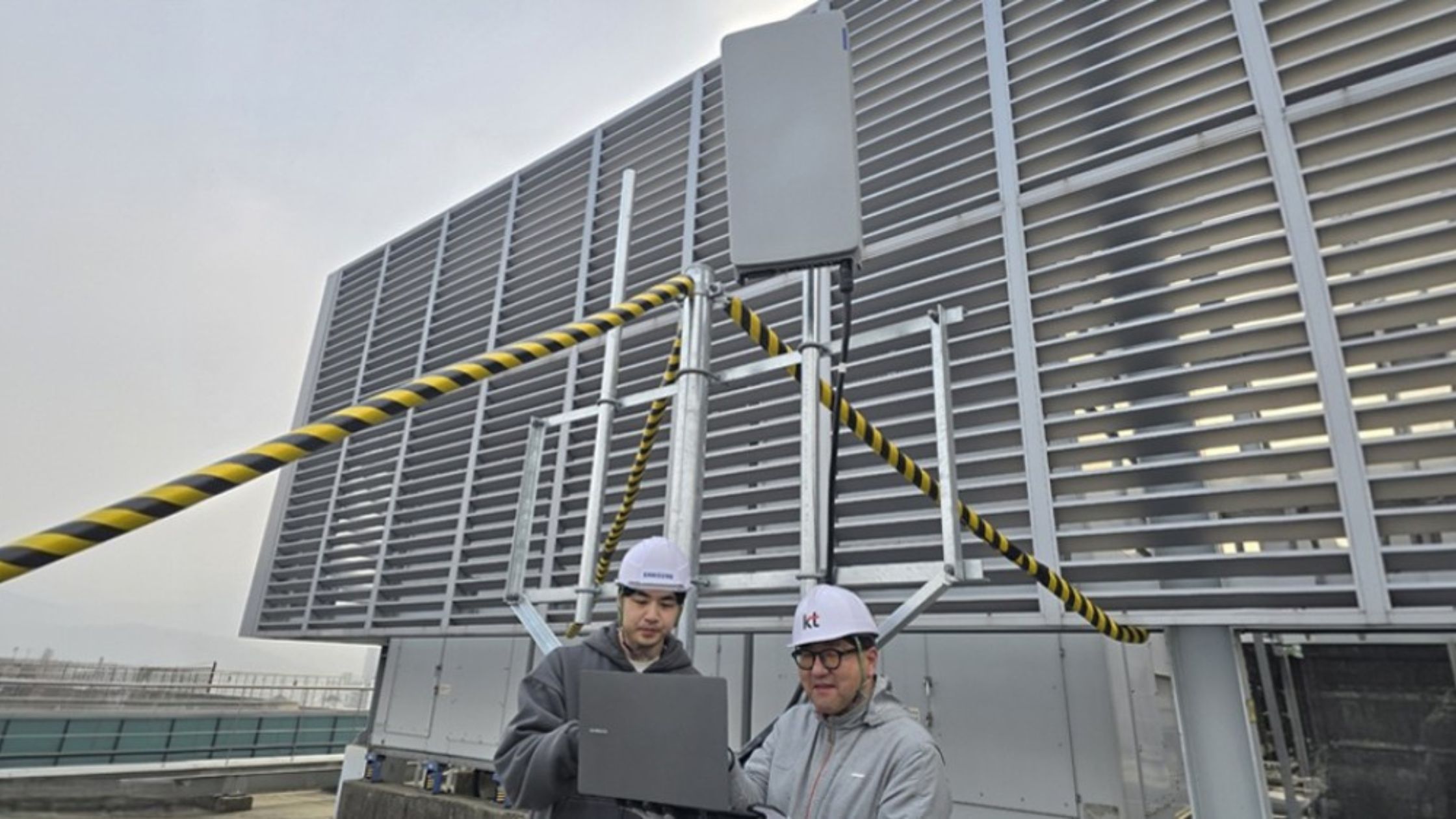
South Korean vendors validate eXtreme MIMO in outdoor testing, highlighting the potential of upper mid-band spectrum for 6G deployment.
Samsung Electronics, together with KT Corporation and Keysight Technologies, has successfully verified a key 6G radio technology in the 7 GHz band, achieving peak downlink speeds of up to 3 gigabits per second (Gbps) in outdoor testing. The milestone, which relied on eXtreme multiple-input multiple-output (X-MIMO) and ultra-high-density antenna arrays, demonstrates the performance potential of mid-range spectrum bands that are emerging as candidates for next-generation wireless systems.
The outdoor test was carried out at Samsung’s research facility in Seoul, where the companies deployed a prototype 6G base station featuring 256 digital antenna ports along with measurement systems provided by Keysight. KT helped configure the wireless environment to reflect real-world network conditions. During the trial, the setup delivered eight concurrent data streams to a single user device, demonstrating that the 7 GHz band can support both high throughput and consistent coverage despite operating at a higher frequency.
Technical Context: Why 7 GHz Matters
The 7 GHz band, sometimes called the upper mid-band or FR3, sits between the traditional mid-band 3.5 GHz spectrum used by 5G and the millimeter-wave bands above 24 GHz. Mid-band frequencies like 3.5 GHz have been central to 5G deployments because they offer good coverage and reasonable data speeds, while mmWave delivers very high speeds but with limited reach.
For 6G, the 7 GHz range is gaining attention because it can unlock wider channels and higher data capacity without the steep propagation losses typical of millimeter-wave frequencies. That makes it attractive for early 6G rollouts where operators aim to balance speed, coverage and cost.
However, higher frequencies come with challenges — shorter wavelengths reduce propagation distance and can struggle with obstacles and terrain. Research like this trial aims to show how technologies such as X-MIMO can compensate for those limitations by packing more antenna elements into a base station and improving spatial multiplexing.
What X-MIMO and Ultra-High-Density Antennas Do
At the core of the trial is eXtreme MIMO (X-MIMO), an evolution of massive MIMO that has been a backbone of 5G. By integrating significantly more antenna elements into a radio unit of similar size, ultra-high-density antenna systems boost spectral efficiency and throughput. In practical terms:
- More antennas enable more simultaneous data streams to a single user.
- Spatial multiplexing increases data throughput without consuming extra spectrum.
- Beamforming precision improves, helping maintain coverage at higher frequencies.
This field test showed that such an arrangement can deliver multi-gigabit data rates in a real outdoor environment — an important step beyond laboratory verification.
Official Views from Samsung, KT and Keysight
Samsung provided the prototype radio hardware and led the system integration effort. JinGuk Jeong, Executive Vice President and head of the Advanced Communications Research Center at Samsung Research, said:
“Through our collaboration with KT and Keysight, we have demonstrated the potential for significant improvements in data rates for next-generation communications,” said JinGuk. “We remain committed to pioneering future network technologies that will enable diverse services and enhanced user experiences in the 6G era.”
From the carrier side, Jong-Sik Lee, Executive Vice President and head of KT’s Future Network Laboratory, highlighted the importance of the test for commercial progress:
“The validation of ultra-high-density antenna technology performance in the 7 GHz band marks a critical step toward 6G commercialization. By securing stable, high-capacity operation in high-frequency bands, we have established a foundational technology for enabling ultra-fast, immersive services,” said Jong-Sik Lee, “Moving forward, we will continue to drive network innovation in collaboration with Samsung Electronics.”
Keysight’s leadership, which provided the measurement and test platforms, framed the milestone as part of broader ecosystem readiness:
“This work with Samsung and KT highlights how Keysight’s industry-leading 6G capabilities are accelerating real-world innovation, unlocking new spectrum for early 6G deployments and bridging the gap between research and commercial readiness to enable next-generation, AI-driven wireless communications that deliver greater value to customers.”
What This Means for 6G Development
While the trial does not itself translate into immediate commercial service, it sends several important signals:
- Spectrum readiness: The 7 GHz band is emerging as a realistic option for early 6G trials and deployments because it offers a practical mix of capacity and reach compared with higher mmWave bands.
- RAN evolution: Ultra-high-density antenna systems and X-MIMO demonstrate how radio designs must evolve to support increased data rates and intelligent beam control at higher frequencies.
- Ecosystem collaboration: Successful testing with a carrier (KT) and a measurement specialist (Keysight) underscores the importance of cross-industry partnerships in validating technologies beyond labs and into real-world conditions.
Looking Ahead: The Road to 6G Commercialization
Although 6G remains in the research and early standardisation phase, commercial deployment is widely expected around 2030. At this stage, field demonstrations such as the 7 GHz X-MIMO trial are less about immediate rollout and more about shaping the technical and regulatory foundation of the next generation of wireless networks.
First, spectrum validation plays a critical role. Before regulators allocate new frequency bands, there must be evidence that those bands can deliver both high capacity and reliable coverage. Trials in the 7 GHz range help policymakers determine whether upper mid-band spectrum should become a core component of future 6G networks.
Second, these experiments influence radio access network (RAN) design. Moving to higher frequencies requires new antenna architectures, improved beamforming and tighter integration of hardware and software. Ultra-high-density antenna systems tested today inform the engineering roadmap for future commercial base stations.
Third, early technical validation guides the broader device ecosystem. Chipmakers and device manufacturers need clarity on which frequency bands and radio technologies will be prioritized. Demonstrations like this provide signals that can shape the development of RF components, modems and future terminals.
Finally, 6G is expected to be more deeply integrated with artificial intelligence than previous generations. AI-native network optimisation, intelligent traffic management and advanced network slicing are all being studied as core features. Trials help identify how these capabilities can operate in higher-frequency environments and under real-world conditions.
Global standards bodies such as 3GPP are currently defining the evolution beyond 5G-Advanced toward what is often referred to as IMT-2030. These early technology verifications feed into that process, ensuring that spectrum policy, equipment design and commercial strategy develop in parallel rather than in isolation.