
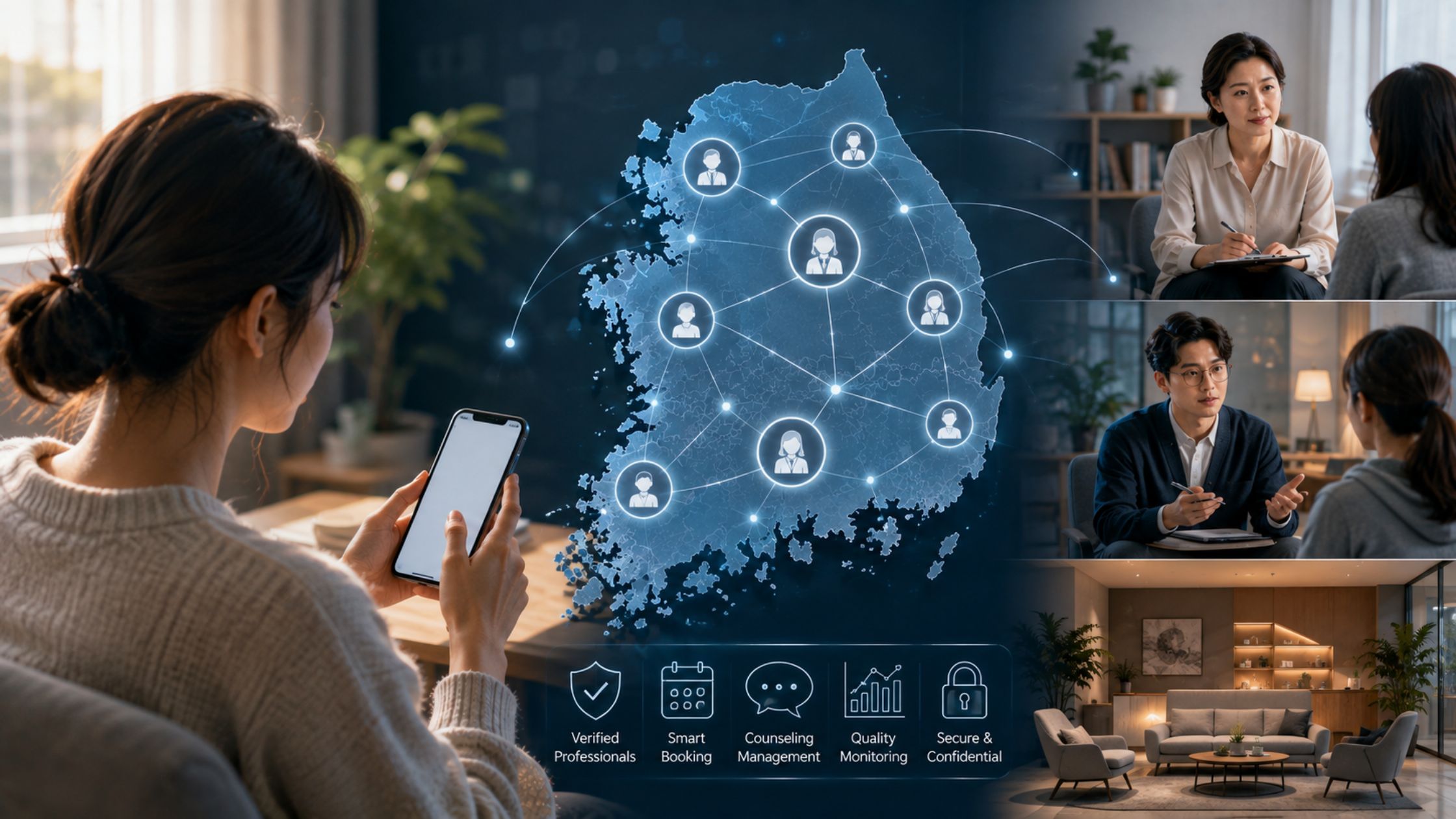
With millions of users and a nationwide professional network, Mind Cafe is building a technology layer around counseling that connects digital access, professional expertise, quality management and offline care.
South Korea’s mental-health system is entering a period of expansion. The government finalized its Third Basic Plan for Mental Health Welfare for 2026-2030 in March, covering prevention, treatment, recovery, suicide prevention and policy infrastructure. The plan also calls for stronger access to psychological counseling, earlier intervention for young people, big-data infrastructure and development of digital therapeutics.
Against that backdrop, the challenge for private digital-health platforms is changing. Getting people onto an app is only one part of the equation. The harder question is how to connect a growing number of people with qualified professionals while maintaining a reliable experience across different providers and settings.
That is the problem Mind Cafe, operated by Atommerce, is attempting to solve. The platform says it has more than 4 million members and a network of more than 2,000 counselors, while its EAP business serves corporate customers with mental-health services.
Its model is increasingly less about putting counseling online and more about building the technology and operating infrastructure around human counseling.
Technology Around the Counselor, Not Instead of the Counselor
Mind Cafe’s most important technology proposition is not that software can replace professional judgment. It is that software can coordinate the complex operational layer surrounding it.
Speaking with KoreaTechToday, Kim Kyu-tae, CEO of Atommerce, said Mind Cafe’s nationwide network is designed to do more than simply connect users with available providers.
“Mind Cafe’s nationwide network is not simply a directory of counseling providers. Atomus operates a technology-based platform that manages professional qualifications, service processes, customer experience, and counseling quality under standardized operational guidelines.”
That distinction is important for a healthcare platform.
A conventional marketplace can largely focus on matching supply with demand. A mental-health platform has to consider professional qualifications, ethical standards, service consistency, feedback and continuity of care.
Mind Cafe says it reviews professionals’ qualifications and experience, provides service and ethical guidelines, and monitors customer feedback and service quality. Its technology also supports booking, counseling management and follow-up. The result is a division of responsibilities. The platform manages the operating environment, while counselors retain their professional expertise.
The Scaling Challenge Is Managing a Distributed Professional Network
A nationwide counseling network inevitably contains variation. Professionals have different backgrounds, specialties and approaches to working with clients. The objective, therefore, cannot be to make every counseling session identical. Instead, the platform needs to create common standards around the experience without removing the discretion required from individual professionals.
Kim described that balance to KoreaTechToday:
“At the same time, we maintain close communication with partner clinics and professionals so that they can preserve their clinical expertise while providing services that meet Mind Cafe’s quality standards.”
This approach makes the platform closer to a network-management system than a conventional counseling marketplace. The distinction could become increasingly important as South Korea expands its mental-health infrastructure. Current mental-health legislation calls for linking mental-health welfare centers, mental-health facilities and medical institutions to improve early detection and treatment. Digital platforms can potentially provide another layer of coordination between these different parts of the ecosystem.
Mind Cafe Is Connecting Digital and Physical Care
Mind Cafe’s evolution also reflects a broader shift from standalone digital services toward hybrid care. The company operates online counseling while also maintaining physical counseling centers and connections with medical services. Its recent expansion through Hyundai Department Store’s The Hyundai Hi platform illustrates this direction. The partnership began with remote psychological assessment and is expected to expand into face-to-face initial counseling and programs for children, adolescents and adults. This model matters because digital access and physical care solve different problems.
Online services can lower barriers related to location, scheduling and initial access. Offline counseling can provide a different environment for longer-term or more specialized interactions. Technology can serve as the connective layer between them. Instead of asking whether online counseling will replace offline counseling, Mind Cafe’s model suggests that the more relevant question may be how effectively the two can work together.
Data Becomes the Coordination Layer
Data also plays a role beyond the personalization commonly associated with digital health. A platform that manages assessment, matching, bookings, counseling, feedback and follow-up generates information across the customer journey. Used appropriately, that information can help identify operational issues, improve provider matching and monitor service quality.
Kim said:
“This combination of technology, data, and professional networks enables us to scale nationwide without compromising counseling quality.”
The claim is fundamentally about coordination, rather than replacing clinical decision-making with algorithms.
That distinction will matter as AI becomes more prominent in mental health. South Korea’s new 2026-2030 mental-health plan explicitly includes building big-data infrastructure and developing digital therapeutics, indicating that technology is becoming part of the country’s longer-term mental-health strategy. For platforms such as Mind Cafe, the opportunity may therefore be to use AI and data where they improve access, administration and continuity while keeping professional expertise at the center of care.
From Consumer Counseling to a Broader Mental-Health Network
Mind Cafe’s enterprise business provides another indication of how the underlying infrastructure can be reused. Its EAP platform markets mental-health services to employers and currently cites more than 4 million app members, a network of 2,000 counselors and round-the-clock counseling availability.
The same basic infrastructure can consequently support different entry points into care: an individual seeking counseling, an employee accessing an EAP service or a user beginning with a psychological assessment. That makes the professional network itself an increasingly important part of the platform. The most interesting aspect of Mind Cafe’s model is not simply the number of people using its platform or the number of professionals in its network. It is the attempt to solve a difficult technology problem: how to scale access to a fundamentally human service without reducing the service to software.
Mind Cafe’s answer is to put technology around the professional. Qualifications, workflows, booking, feedback, data and follow-up can be managed systematically, while counselors retain the expertise and judgment at the center of the interaction.
As South Korea expands its mental-health infrastructure and invests in digital approaches, this distinction could become increasingly important. The future of digital mental healthcare may not be defined by how much of counseling technology can replace. It may instead be defined by how effectively technology can connect more people to qualified human expertise, across more settings, with a more consistent experience. For Mind Cafe, that is the infrastructure it is trying to build across South Korea.