
As South Korea’s population ages rapidly, healthcare innovators are exploring whether AI, health data and everyday devices can identify physical decline before it leads to falls, fractures and loss of independence.
For an older patient, a fall can appear to be the moment when a health problem begins. In reality, the physical changes that make a person vulnerable to falling may have been developing for years. That distinction is becoming increasingly important in South Korea. People aged 65 and over accounted for 20.3% of the country’s population in 2025, officially placing Korea deep into its super-aged era. The share is projected to exceed 30% by 2036 and 40% by 2050. Healthcare demand is already reflecting that shift. In 2023, average medical expenditure for a person aged 65 or older reached KRW 5.306 million, while 69.3% of older adults participated in health screenings.
The challenge is therefore moving beyond how Korea treats illness in an aging population. It is increasingly about whether healthcare can recognize deterioration early enough to prevent a more serious event.
Jungwoo Lee, CEO of Korean healthtech company Biobytes and an orthopedic surgeon, sees this gap directly in clinical practice.
“I often meet older patients only after a fall or fracture,” Lee told KoreaTechToday. “Many say they were fine until they fell, although their strength, balance, and mobility may have been declining silently for years.”
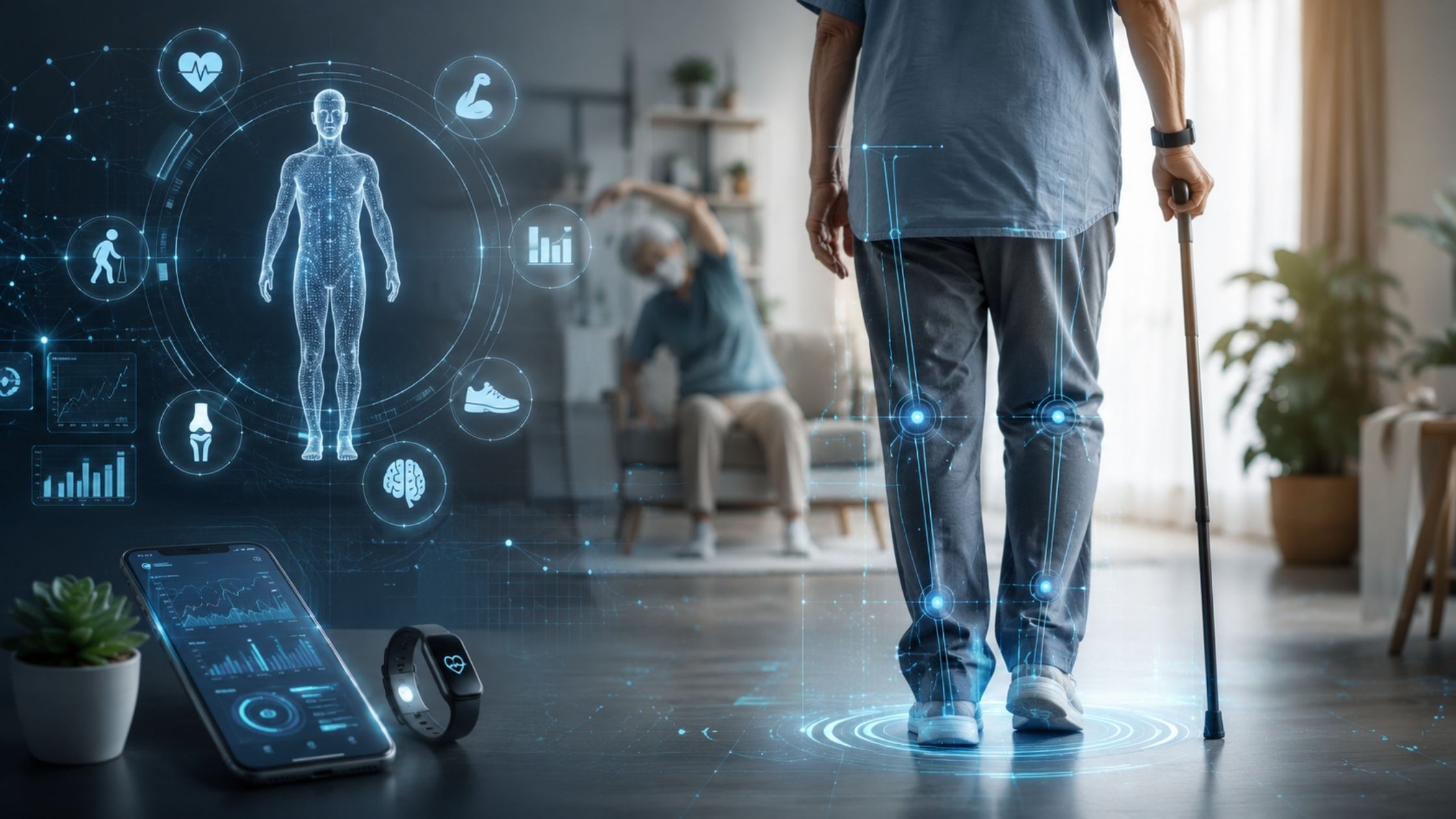
His observation points toward a different role for artificial intelligence in healthcare. Rather than waiting for a visible medical crisis, AI could eventually help identify subtle changes in strength, mobility and physical function through smartphones, wearables, simple strength tests and movement analysis. For Korea, where demographic aging is happening at extraordinary speed, that could turn preventive healthcare into one of the country’s most important AI applications.
The hidden health problem behind the fall
Aging does not produce a single, predictable medical trajectory. Physical decline can begin gradually, with reductions in muscle strength, mobility and balance that may not immediately interfere with everyday life. Sarcopenia is one of the clearest examples. A 2026 analysis of the 2024 Korea National Health and Nutrition Examination Survey found that sarcopenia prevalence rises sharply among the oldest adults. Using the 2025 criteria from the Asian Working Group for Sarcopenia, researchers found prevalence among people aged 80 and older reached 35.4% in women and 28.8% in men when assessed using DEXA measurements.
The significance extends beyond muscle mass. Sarcopenia is associated with frailty, disability and other adverse outcomes among older adults. A decline in physical function can also increase vulnerability to falls, which can in turn trigger a much larger loss of independence.
This creates a difficult problem for conventional healthcare. A patient may receive medical attention after a fracture, but the underlying decline in strength and mobility may have begun much earlier. The clinical system can treat the consequence without necessarily having a continuous picture of the process that preceded it. That is the gap AI-powered monitoring could eventually address.
From occasional checkups to continuous signals
Lee believes Korea could develop technologies that identify physical changes earlier by combining information from devices and relatively simple assessments.
“Technology should connect directly to exercise, nutrition, rehabilitation, and medical care, not just produce another health score,” he said.
That distinction is important. The promise of AI in preventive healthcare is not simply to generate more measurements. Smartphones and wearables already produce large amounts of data. The more difficult task is determining which changes are meaningful, when they indicate elevated risk and what should happen next.
A future system could potentially combine measurements such as strength, movement and activity patterns over time. Instead of asking whether a person is healthy on a particular day, it could help identify whether their physical condition is changing.
The technology would not replace a physician or independently diagnose every condition. Its potential role would be closer to an early-warning layer, identifying people who may benefit from a more detailed clinical assessment or an intervention. That could be particularly valuable for conditions such as sarcopenia, where gradual decline can be difficult to recognize during ordinary life.
Biobytes is building around the early-detection problem
This is the problem Biobytes is attempting to address. The Korean company has developed MyoTest, an AI-powered muscle-health assessment platform that uses relatively simple muscle-strength measurements and blood-test information to assess muscle health and predict the risk of muscle loss. The system uses Korean data from the KoGES-ARIRANG cohort and the Korea National Health and Nutrition Examination Survey.
MyoTest is designed to generate a muscle-health report, track patient information and calculate Biobytes’ muscle functional index, or eMF. The company also holds a patent application for a method and device for predicting sarcopenia.
That approach illustrates a broader shift in digital health. The value of an AI system may not lie in replacing expensive medical equipment with a cheaper algorithm alone. It may lie in making assessments easier to repeat and track, allowing changes to be observed over time.
For an aging population, that longitudinal view could be more useful than a single measurement. It also explains why Lee emphasizes the connection between detection and intervention. Identifying a decline is only useful if the healthcare system can respond.
Korea is building the data infrastructure behind predictive healthcare
The broader Korean healthcare ecosystem is moving in a similar direction. In July, the Korea Disease Control and Prevention Agency’s National Institute of Health announced its Mid- to Long-Term R&D Roadmap 2035 for Ultra-Precision Healthcare AI. The plan calls for the development of 45 types of Korean AI training datasets covering 1 million people, integrating clinical and epidemiological information with medical imaging, lifelog data and genomic information.
The roadmap is divided into three stages: data resource development from 2027 to 2029, model intelligence enhancement from 2030 to 2032, and value realization from 2033 to 2035. Its stated objective is to support more personalized health management as well as disease prediction and prevention. This matters for preventive aging technology because AI becomes more useful when it can understand change over time.
A single blood test, mobility assessment or wearable reading provides limited context. Connected longitudinal data can potentially reveal patterns that are difficult to identify from isolated observations. Korea’s strategy is therefore moving toward something broader than AI-assisted diagnosis. It is building the foundations for AI systems that can understand individual health trajectories.
The government is pushing AI beyond the hospital
The policy environment is also changing. In August, the Korean government finalized its AI Basic Healthcare Strategy, explicitly citing the country’s super-aged population and healthcare workforce shortages as reasons to expand AI across healthcare. The strategy aims to use AI to address gaps in regional, essential and public healthcare while making AI-enabled healthcare services more accessible in everyday life.
That direction is particularly relevant to aging. A hospital can intervene after a fracture. But prevention needs to happen before a person reaches the emergency department. The government is also increasingly considering AI-enabled care for older adults. Its broader AI government strategy includes plans to use AI care devices for health management among older populations.
Together, these initiatives point toward a healthcare model in which AI is not confined to imaging, diagnosis or administrative automation. It could increasingly operate between clinical visits, helping individuals and healthcare providers understand changes taking place in everyday life.
The real opportunity is a feedback loop
For startups such as Biobytes, the larger opportunity is therefore not simply to build a better health score. The more important model is a continuous loop: detect → assess → intervene → monitor → adjust
If an AI system identifies declining muscle function, the next step could involve exercise, nutritional support, rehabilitation or medical assessment. Subsequent measurements could then show whether the intervention is working. That would make AI part of a broader preventive-care system rather than a standalone diagnostic product. It also changes how healthcare technology should be evaluated. A system that produces an accurate prediction but does not lead to better patient outcomes has limited practical value.
Clinical validation, integration with healthcare providers and evidence that patients actually act on recommendations will ultimately determine whether preventive AI can move from promising technology to mainstream healthcare.
Korea could become a testbed for healthy-aging technology
South Korea’s demographic challenge could give its technology companies an unusual development environment. Korea combines rapid aging with high digital connectivity, sophisticated healthcare institutions, large-scale health datasets and a strong technology sector. Statistics Korea reported that 76.9% of people aged 65 and over used the internet in 2024, suggesting that older adults are not entirely outside the country’s digital ecosystem.
That creates the possibility of developing technologies around a population that urgently needs them. Lee believes the opportunity could extend beyond Korea.
“Because Korea is aging so rapidly, solutions developed here could eventually help other aging societies, including communities with limited access to specialists or expensive equipment,” he told KoreaTechToday.
The international opportunity is significant. Japan, China, Singapore and many European countries are also confronting aging populations and growing pressure on healthcare and care systems. But Korea should not assume that domestic demand automatically translates into global leadership. Technologies will need to demonstrate clinical effectiveness, regulatory compliance, usability and economic value in different healthcare systems.
The harder question is whether prediction changes outcomes
The most important limitation is also the easiest to overlook. Detecting risk is not the same as preventing it. AI models can generate false positives or miss important changes. Wearables and smartphones can produce incomplete data. Older users may not consistently engage with digital health tools. Healthcare providers may not have the capacity to respond to every new risk signal.
There are also questions around privacy, consent, data ownership and reimbursement. Most importantly, preventive technologies must prove that earlier detection actually leads to better outcomes.
If identifying declining mobility results in earlier exercise or rehabilitation and helps preserve independence, the technology could have significant value. If it simply generates another notification that patients ignore, its impact will be limited.
This is why Lee’s emphasis on connecting technology to intervention is important. The future of preventive AI will depend less on how many health indicators an algorithm can measure and more on whether those indicators lead to useful action.
From treating the fall to understanding the decline
South Korea’s demographic trajectory is forcing healthcare to confront a difficult reality: there will be more older people living longer, but the healthcare system cannot simply respond to every consequence after it happens. The country is already building pieces of a different model. Its 2035 healthcare-AI roadmap seeks to integrate large-scale clinical, genomic and real-world health data, while the government’s AI healthcare strategy aims to bring AI into more areas of everyday and public healthcare.
Companies such as Biobytes are approaching the problem from another direction, using AI and relatively accessible measurements to make muscle health and potential sarcopenia risk easier to assess and track. The goal is not to predict the exact moment someone will fall.
It is to recognize that the fall may not actually be the beginning of the problem. The decline in strength, balance and mobility may have started months or years earlier. If AI can help make those changes visible, and if healthcare systems can act on the information, Korea could move closer to a model in which aging is managed continuously rather than primarily through crises.
For a country already confronting one of the world’s fastest demographic transitions, that shift could become more than a healthcare innovation. It could become one of South Korea’s most important tests of whether its AI capabilities can translate into measurable improvements in everyday life.