
New industrial complex in Gunsan aims to anchor Korea’s push into robotics, physical AI and hydrogen energy through large-scale infrastructure investment.
Hyundai Motor Group has signed a memorandum of understanding with the South Korean government and Jeonbuk State to establish a large-scale innovation hub in the Saemangeum area of Gunsan City. The group plans to invest nearly KRW 9 trillion starting in 2026, positioning the project as a long-term anchor for robotics, artificial intelligence and hydrogen energy development in Korea.
The initiative forms part of Hyundai Motor Group’s broader domestic investment plan of KRW 125.2 trillion through 2030. Unlike incremental factory expansions, the Saemangeum project combines data infrastructure, advanced manufacturing and clean energy production within a single industrial complex — reflecting a strategic shift toward what the group calls “physical AI” and energy-integrated mobility.
Why Saemangeum?
Saemangeum has emerged as a key development zone in southwestern Korea, backed by government-led land reclamation and renewable energy expansion plans. The region offers large-scale land availability, port access and growing solar generation capacity — factors that align with Hyundai’s energy-intensive AI and hydrogen ambitions.
By selecting Saemangeum, Hyundai is also aligning with national policy goals aimed at balanced regional development outside the Seoul metropolitan area. Senior government officials, including President Jae Myung Lee, attended the signing ceremony, signaling strong political backing for the project.
Five Pillars of the Investment
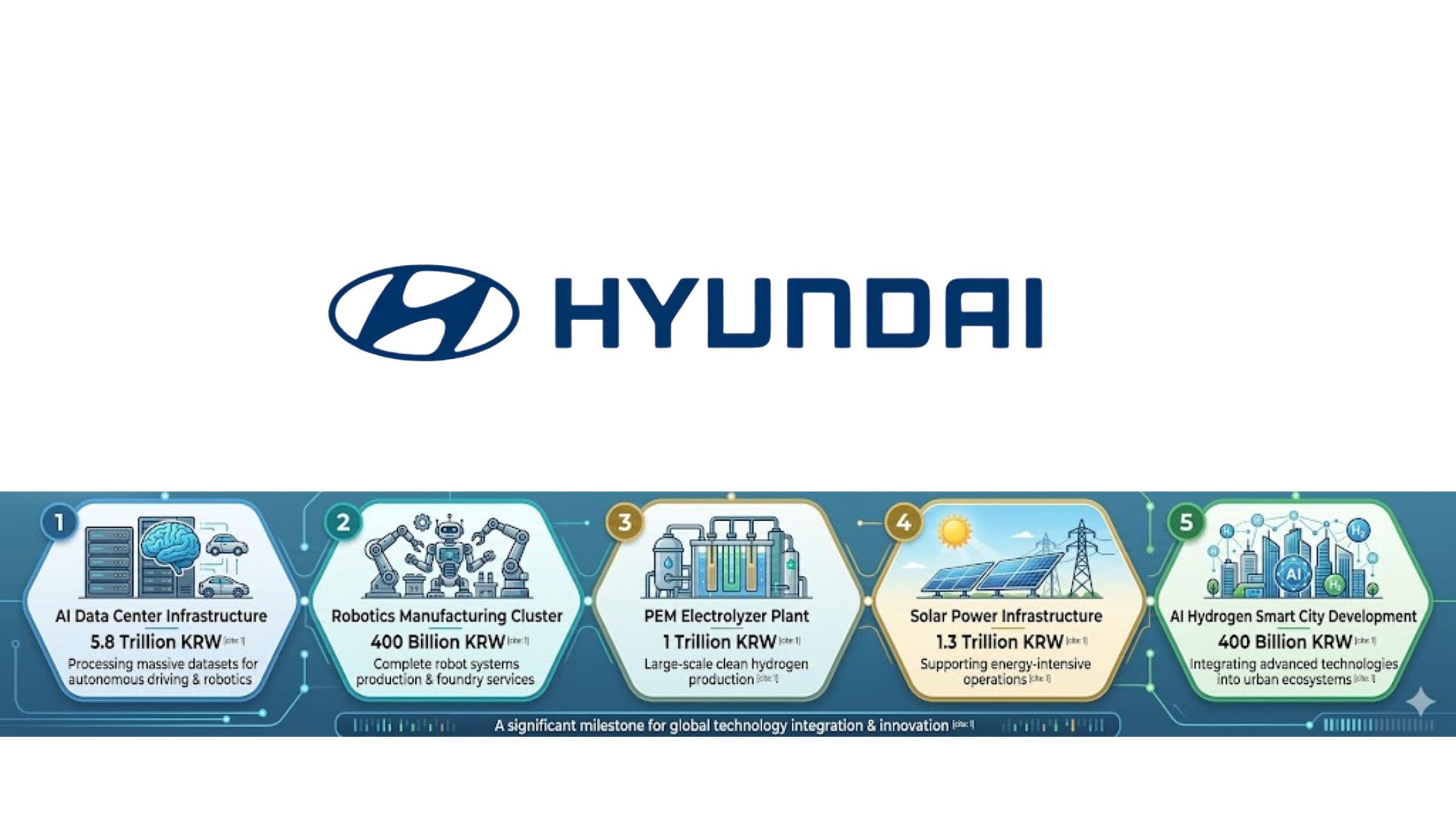
The KRW 9 trillion investment will be distributed across five major areas:
- AI Data Center Infrastructure (KRW 5.8 trillion)
- Robotics Manufacturing Cluster (KRW 400 billion)
- PEM Electrolyzer Hydrogen Plant (KRW 1 trillion)
- Solar Power Infrastructure (KRW 1.3 trillion)
- AI Hydrogen Smart City Development (KRW 400 billion)
The AI data center represents the largest portion of spending, underscoring Hyundai’s emphasis on computing power as foundational infrastructure.
Building Infrastructure for “Physical AI”
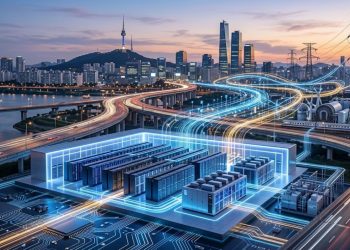
A central feature of the hub is a high-capacity AI data center expected to scale up to 50,000 GPU units in phases. The facility will process large datasets for autonomous driving systems, robotics training and software-defined vehicle (SDV) platforms.
Vice Chair Jaehoon Chang said at the ceremony:
“What we’re building in Saemangeum will reshape not just a region, but Korea’s industrial future.”
From an industry perspective, the data center signals Hyundai’s intent to internalize AI capabilities rather than rely solely on external cloud providers. As robotics and autonomous systems become more compute-intensive, domestic GPU capacity could become a strategic advantage.
Expanding Robotics Manufacturing
The planned robotics manufacturing cluster will focus on producing complete robot systems and components, with annual capacity targeted at around 30,000 units. The facility will incorporate autonomous logistics technologies such as automated guided vehicles (AGVs) and autonomous mobile robots (AMRs).
The cluster also aims to help traditional automotive suppliers diversify into robotics components, potentially reshaping Korea’s supplier ecosystem. This reflects Hyundai’s broader effort to integrate robotics — including capabilities developed through its acquisition of Boston Dynamics — into both industrial and mobility applications.
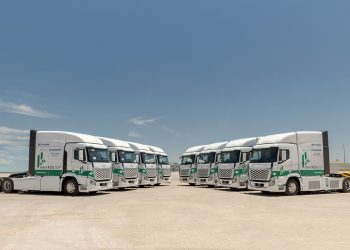
Another major component is a 200 MW-class polymer electrolyte membrane (PEM) electrolyzer plant designed to produce green hydrogen using renewable energy. The facility is intended to support mobility solutions such as hydrogen buses, trams and logistics vehicles.
Hyundai has stated that it aims to expand domestic electrolyzer capacity to 1 GW over time. The group’s Ulsan fuel cell plant, scheduled for completion in 2027, will support manufacturing of hydrogen-related components.
This hydrogen push aligns with Korea’s long-term national hydrogen roadmap, though commercialization challenges — including cost competitiveness and infrastructure scaling — remain significant.
Solar Integration and Energy Self-Sufficiency
To power the data center and hydrogen facilities, Hyundai plans to develop gigawatt-scale solar generation capacity by 2035. The strategy builds on existing renewable installations in Saemangeum and supports the group’s carbon neutrality and RE100 commitments.
Energy integration is central to the project’s concept. Rather than treating power supply as separate infrastructure, Hyundai is embedding renewable generation directly into the industrial ecosystem.
The final element is an AI-driven smart city concept that integrates robotics, hydrogen energy and AI into urban systems. The plan includes localized hydrogen production, AI-powered transportation networks and automated logistics systems operating within a unified infrastructure framework.
While the smart city component remains conceptual, it positions Saemangeum as a demonstration site for integrated industrial ecosystems that Hyundai could later export internationally.
Economic and Strategic Impact
Hyundai estimates that the investment could generate around KRW 16 trillion in economic impact and create approximately 71,000 jobs across direct and indirect employment. Construction is expected to begin in phases from 2027, with key facilities targeted for completion by 2029.
Beyond regional economic effects, the project reflects a broader industrial transition. Hyundai Motor Group is moving beyond its traditional automotive identity toward becoming a diversified mobility, AI and energy conglomerate.
At a time when global competition in robotics, AI infrastructure and clean energy is intensifying, the Saemangeum hub represents one of the most ambitious integrated industrial bets announced in Korea in recent years. Whether it delivers on its technological and economic targets will likely shape Korea’s positioning in next-generation industries through the next decade.