
South Korean retailers are moving quickly from recommendation engines to conversational shopping assistants and AI-powered sales tools. As personalization becomes easier to replicate, the competitive advantage may shift from having AI to using it to build a meaningfully better customer experience.
For years, personalization was one of the most valuable tools in digital retail. A retailer that understood what a customer had purchased, searched for or browsed could recommend products more effectively than a competitor relying on generic merchandising.
Artificial intelligence is now accelerating that model. South Korean retailers are moving from basic recommendations toward AI systems that can interpret natural-language requests, compare products, understand customer preferences and increasingly assist with the shopping journey itself. Lotte Hi-Mart introduced its AI shopping agent HAVI in April, allowing customers to describe what they want conversationally and receive personalized recommendations and explanations.
Coupang has also expanded AI across product discovery and comparison, using the technology to summarize reviews, simplify complex specifications and proactively surface product comparisons. Shinsegae is taking the personalization model further. Joint research with Seoul National University, accepted at the International Conference on Machine Learning, found in a preliminary simulation that AI-based personalized recommendations could increase average transaction value by up to 46%. The retailer plans to develop an AI sales agent based on the research.
The direction is clear. But it raises a more important strategic question: when every major retailer can offer AI-powered personalization, does personalization remain a moat?
As Sunay Kumat, an angel investor, told KoreaTechToday, “AI-led personalization will be a competitive advantage initially, but over time it will become basic expectations, and the real winners will be the brands that use AI to create a much better customer experience.”
From recommendations to AI shopping agents
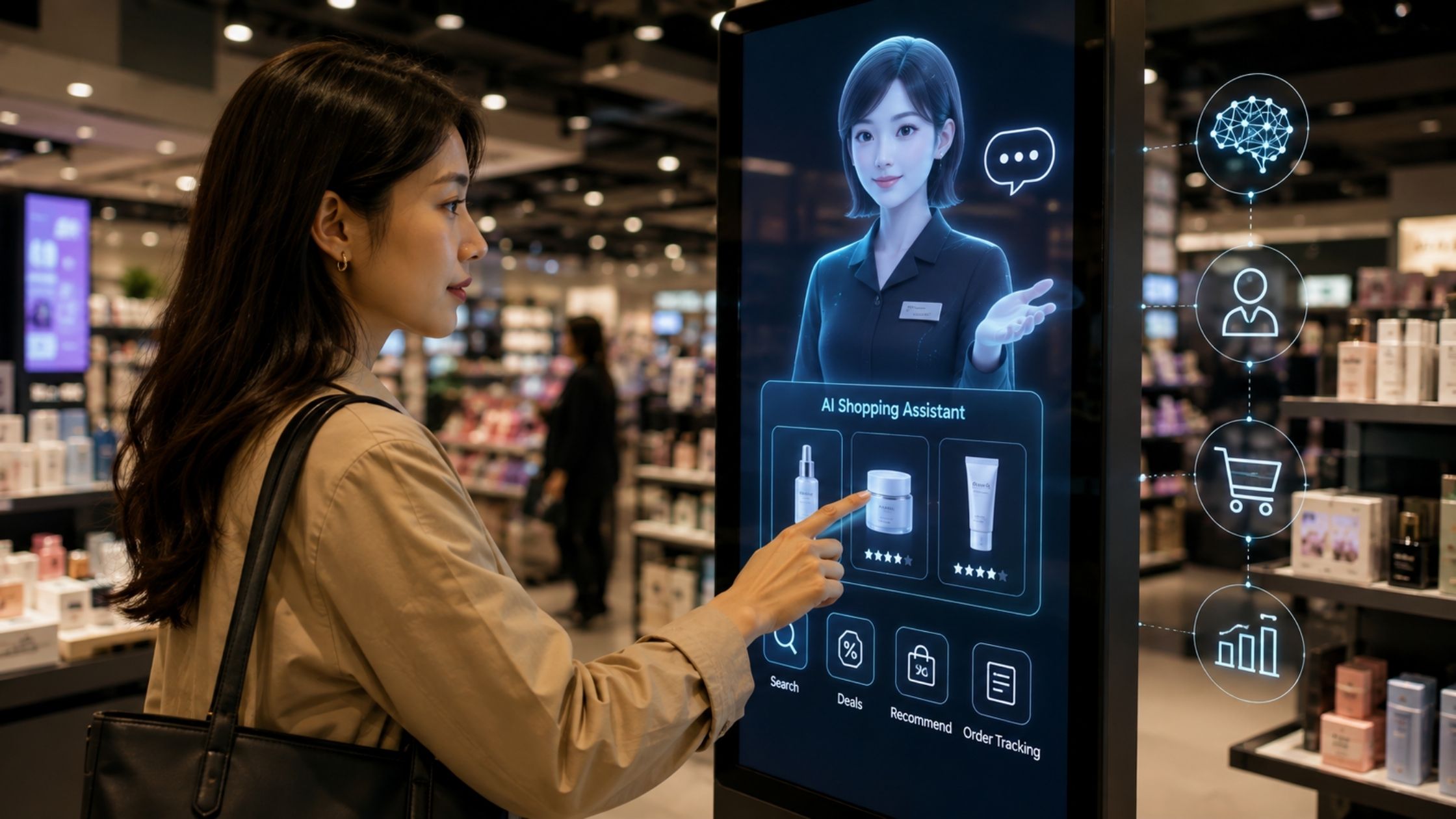
The significance of the current shift is that AI is changing what personalization actually means. Traditional recommendation engines largely predict what a customer might want based on previous behavior. AI shopping assistants can instead interpret intent. A customer might ask for a laptop for video editing under a particular budget, a skincare routine for a specific concern, or a refrigerator suitable for a certain household. Rather than forcing the consumer to search through dozens of filters, an AI assistant can potentially interpret the request, compare options and explain its recommendations.
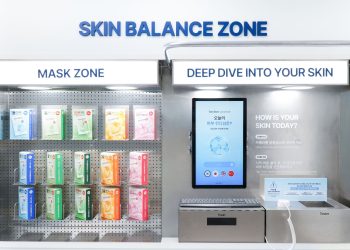
Lotte Hi-Mart’s HAVI reflects this transition from product-centered search to conversational, customer-centered shopping. CJ Olive Young is applying a similar approach in physical stores. Its AI shopping assistant can provide product information, inventory checks, store navigation and personalized recommendations based on skin characteristics and preferences. The system is initially being deployed at stores with high foreign-customer traffic and supports multilingual interactions.
The technology is therefore becoming less about recommending another product and more about reducing the friction involved in making a purchase.
The first-mover advantage will not last forever
This is where Kumat’s observation becomes important. AI personalization can initially differentiate a retailer because implementation requires data, technology and experimentation. But the underlying capabilities are becoming increasingly accessible. As retailers adopt conversational interfaces, recommendation models and AI shopping agents, consumers may eventually stop viewing them as innovative. They will simply expect them.
That creates a familiar technology cycle. A capability begins as differentiation, becomes widely adopted and eventually becomes part of the baseline customer experience. The competitive question consequently shifts from “Do you have AI?” to “What does AI allow you to do better than everyone else?”That distinction could become particularly important in Korean retail, where large companies already possess extensive transaction histories, loyalty programs, logistics networks and physical stores.
Data matters, but experience matters more
The strongest retail AI systems are likely to benefit from a continuous feedback loop:
Customer interaction → data → better prediction → better experience → more interaction.
Large retailers have an inherent advantage here because they already interact with millions of consumers across multiple channels. But possessing data does not automatically create a moat. The value comes from how effectively a company turns that information into something consumers actually find useful.
Shinsegae’s research is revealing in this context. The reported 46% potential increase in average transaction value suggests that personalization can have measurable commercial benefits. But the longer-term question is whether those gains translate into stronger customer relationships, greater loyalty and better experiences across channels. A recommendation that increases the value of one transaction is useful. An AI system that consistently makes shopping easier, faster and more relevant is strategically more valuable.
Personalization can also become intrusive
There is another challenge that retailers cannot ignore. More personalization does not necessarily mean a better customer experience. Consumers may appreciate relevant recommendations, but they can also become uncomfortable when a retailer appears to know too much about them or uses personal data in ways they do not understand. This makes trust an important part of the AI retail equation.
South Korea’s AI regulatory environment is also becoming more explicit around transparency and user protection. The country’s AI Basic Act, which took effect in 2026, establishes responsibilities around risk management, user protection and transparency for high-impact AI systems. Retailers therefore face a dual challenge: make AI useful enough to improve the experience while ensuring that personalization does not become surveillance in the consumer’s eyes.
As AI becomes embedded throughout retail, another strategic question will emerge: who owns the customer relationship? If consumers increasingly ask AI agents what to buy instead of browsing individual retailer websites, the traditional retail interface could become less important. The retailer may no longer be the first destination for product discovery. It may instead become one of several suppliers evaluated by an AI intermediary.
That makes proprietary customer data, product information, fulfillment capabilities, pricing and brand trust increasingly important. It also means retailers cannot rely on the novelty of an AI assistant. They need an underlying customer experience that gives consumers a reason to remain within their ecosystem.
AI is the tool, not the moat
South Korea’s retail sector is moving quickly toward AI-powered personalization, conversational shopping and automated sales assistance. The technology is already producing measurable results and changing how consumers discover and evaluate products.
But the adoption curve could eventually make personalization itself ordinary. That is why Kumat’s distinction matters. AI-led personalization may provide an initial competitive advantage, but the lasting advantage will come from what retailers build on top of it. The strongest retailers may be those that combine AI with proprietary data, trusted brands, efficient fulfillment, useful service and a deep understanding of customer needs.
In other words, the future retail moat may not be the smartest shopping assistant. It may be the company that uses AI to make the entire customer relationship meaningfully better. As AI becomes ubiquitous, the question for Korean retailers will no longer be whether they can personalize the shopping experience. It will be whether consumers can actually tell the difference between a retailer that merely uses AI and one that has rethought retail around it.