
As climate risk becomes an economic reality, trusted weather data is evolving from a forecasting tool into critical infrastructure for insurance, investment, and automated financial systems. South Korea’s sophisticated meteorological network could position it at the forefront of this transformation.
Climate change has fundamentally altered the way governments and businesses think about weather. What was once treated primarily as an operational concern is increasingly being recognized as a financial variable capable of influencing investment decisions, insurance payouts, supply chain resilience, renewable energy production, and corporate risk management.
The economic consequences are becoming difficult to ignore. As extreme weather events grow more frequent and unpredictable, insurers, financial institutions, and enterprises are searching for faster and more transparent ways to quantify and manage climate-related risks. This has fueled growing interest in parametric insurance, weather derivatives, and climate-linked financial products that rely on objective environmental data rather than traditional claims assessments. Industry forecasts suggest the global parametric insurance market will continue expanding rapidly over the coming years as organizations seek data-driven approaches to climate resilience.
At the center of this evolution is an often-overlooked asset: weather data. For decades, meteorological information primarily helped people decide whether to carry an umbrella, reroute flights, or prepare for storms. Today, the same datasets are increasingly becoming the foundation for financial products that can automatically execute contracts, trigger insurance payouts, optimize energy trading, and help investors quantify climate risk. As the value of climate intelligence grows, the quality, density, and reliability of the underlying data have become strategic advantages rather than technical details.
For South Korea, this shift presents an opportunity to leverage decades of investment in meteorological infrastructure to support an emerging segment of climate finance.
Climate Risk Is Becoming Financial Risk
Weather has always influenced economic activity. What has changed is the scale and speed with which climate events now affect financial markets. Floods disrupt manufacturing supply chains. Heatwaves strain electricity grids and reduce industrial productivity. Typhoons interrupt logistics networks and create volatility across agriculture, shipping, and commodity markets. These disruptions increasingly translate into measurable financial exposure for insurers, banks, investors, and corporations.
Traditional insurance models often require lengthy claims investigations before compensation is paid. However, businesses facing operational disruptions frequently need immediate liquidity rather than prolonged assessments. This has accelerated interest in parametric insurance, where payouts are automatically triggered when predefined environmental thresholds, such as rainfall levels, wind speeds, or temperatures, are reached through independently verified datasets. Reliable environmental observations therefore become central to the integrity of these financial products.
The result is a subtle but significant shift. Weather is no longer simply something to forecast. Increasingly, it is becoming something to measure, verify, and integrate into financial decision-making.
Climate Data Is Emerging as an Economic Asset
The growing commercialization of climate intelligence extends well beyond insurance. High-quality meteorological datasets are increasingly supporting:
- Climate risk modeling for institutional investors
- Renewable energy forecasting and electricity market optimization
- Agricultural risk management
- Commodity and weather derivatives
- Enterprise supply chain planning
- AI-driven operational decision-making
In each of these applications, accuracy matters far more than prediction alone. Financial systems require trusted, objective data that can withstand regulatory scrutiny, execute automated contracts, and minimize disputes. Unlike traditional weather forecasts designed primarily for human interpretation, financial applications require standardized datasets that machines can verify and process with consistency. This transition is gradually transforming meteorological infrastructure into digital economic infrastructure.
South Korea’s Weather Infrastructure Offers a Competitive Advantage
South Korea occupies a unique position in this transition. The Korean Peninsula’s mountainous terrain, densely populated urban regions, and four distinct seasons create one of the more complex forecasting environments in East Asia. Producing accurate forecasts under these conditions requires an exceptionally dense observation network capable of capturing localized weather variations in real time.
According to Dong-sik Kim, CEO of Kweather, this challenge has ultimately become one of South Korea’s greatest strengths.
Speaking with KoreaTechToday, Kim said:
“The most distinct strengths of South Korea’s meteorological infrastructure are its unparalleled observation density and hyper-local, real-time data collection capabilities.”
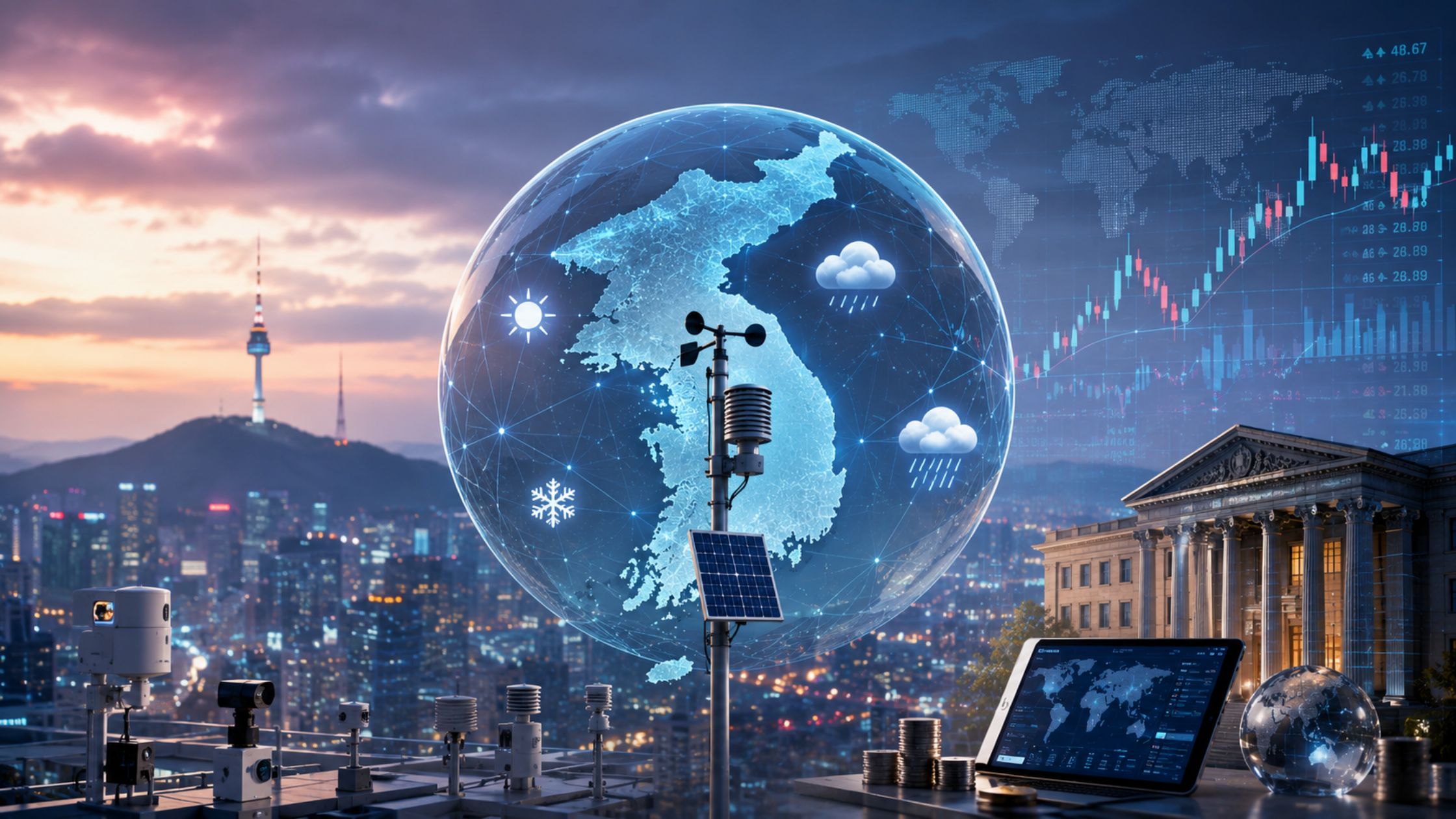
Rather than relying solely on conventional forecasting systems, Kweather has spent years building a nationwide network of thousands of proprietary IoT-based weather and air quality observation stations designed to capture highly localized environmental conditions.
Kim believes this level of precision becomes particularly important when weather information begins supporting financial applications instead of simply informing forecasts.
Speaking with KoreaTechToday, he explained:
“Korea’s complex topography and four distinct seasons make weather forecasting exceptionally challenging. To overcome this, Kweather built a dense, proprietary network of thousands of IoT-based weather and air quality observation stations nationwide. This high-resolution, real-time data serves as the most accurate and reliable trigger for climate finance solutions where smart contracts must execute flawlessly. Only precise, high-density data can support sophisticated climate derivatives without margin of error.”
His comments reflect a broader reality emerging across climate finance. The success of automated insurance products, blockchain-based contracts, and weather-linked financial instruments ultimately depends less on the technology executing transactions and more on the credibility of the real-world data feeding those systems.
This thinking is reflected in Kweather’s recent collaboration with blockchain platform Flare, which aims to explore how independently verifiable weather data can support applications such as parametric insurance and weather derivatives by bringing trusted meteorological datasets on-chain.
From Forecasting People to Powering Financial Markets
The evolution of weather data mirrors a broader shift occurring across enterprise technology. Increasingly, value is moving away from standalone software toward trusted data infrastructure. Artificial intelligence can optimize decisions only when reliable inputs are available. Blockchain applications require trusted external information to execute automated agreements. Financial institutions require independently verifiable datasets to satisfy governance and compliance requirements.
Weather observations are becoming one of those trusted inputs. Instead of serving only meteorologists, environmental datasets are increasingly being consumed by enterprise software platforms, AI systems, insurers, renewable energy operators, logistics providers, and financial institutions seeking to automate increasingly complex decisions.
In this context, the competitive advantage lies not merely in predicting tomorrow’s weather more accurately. It lies in producing environmental data that markets, institutions, and automated systems can trust.
A Strategic Opportunity for South Korea
South Korea has invested extensively in digital infrastructure, semiconductors, artificial intelligence, and advanced manufacturing over the past two decades. Its meteorological infrastructure may now become another strategic asset supporting emerging digital industries.
The country’s dense observation networks, growing AI capabilities, expanding climate technology ecosystem, and increasing focus on digital finance create favorable conditions for developing next-generation climate intelligence services.
Recent developments also suggest growing institutional momentum. Earlier this month, South Korea’s insurance industry announced plans to establish a comprehensive climate insurance portal that will integrate meteorological data to support index-based insurance products and climate risk analysis, reflecting wider recognition of weather data as a critical financial resource.
As climate volatility reshapes global markets, the ability to produce trusted, high-resolution environmental data could become an important source of technological competitiveness.
The future of climate finance may ultimately depend less on sophisticated financial engineering than on the quality of the data underpinning it. From automated insurance payouts and renewable energy forecasting to investment risk analysis and blockchain-enabled financial products, reliable climate intelligence is becoming foundational infrastructure for an increasingly climate-conscious economy.
South Korea’s experience demonstrates that building this infrastructure requires years of investment in observation networks, data quality, and technological capability. What was once developed to improve weather forecasting is now finding relevance in entirely different sectors, where environmental information is becoming an economic asset in its own right.
As climate risk continues to converge with financial risk, the next competitive advantage may not belong solely to those creating new financial products. It may belong to those capable of providing the trusted, real-world data that allows those products to function with confidence. In that transition, South Korea’s weather infrastructure offers a glimpse of how climate intelligence could become one of the country’s next strategic digital exports.