
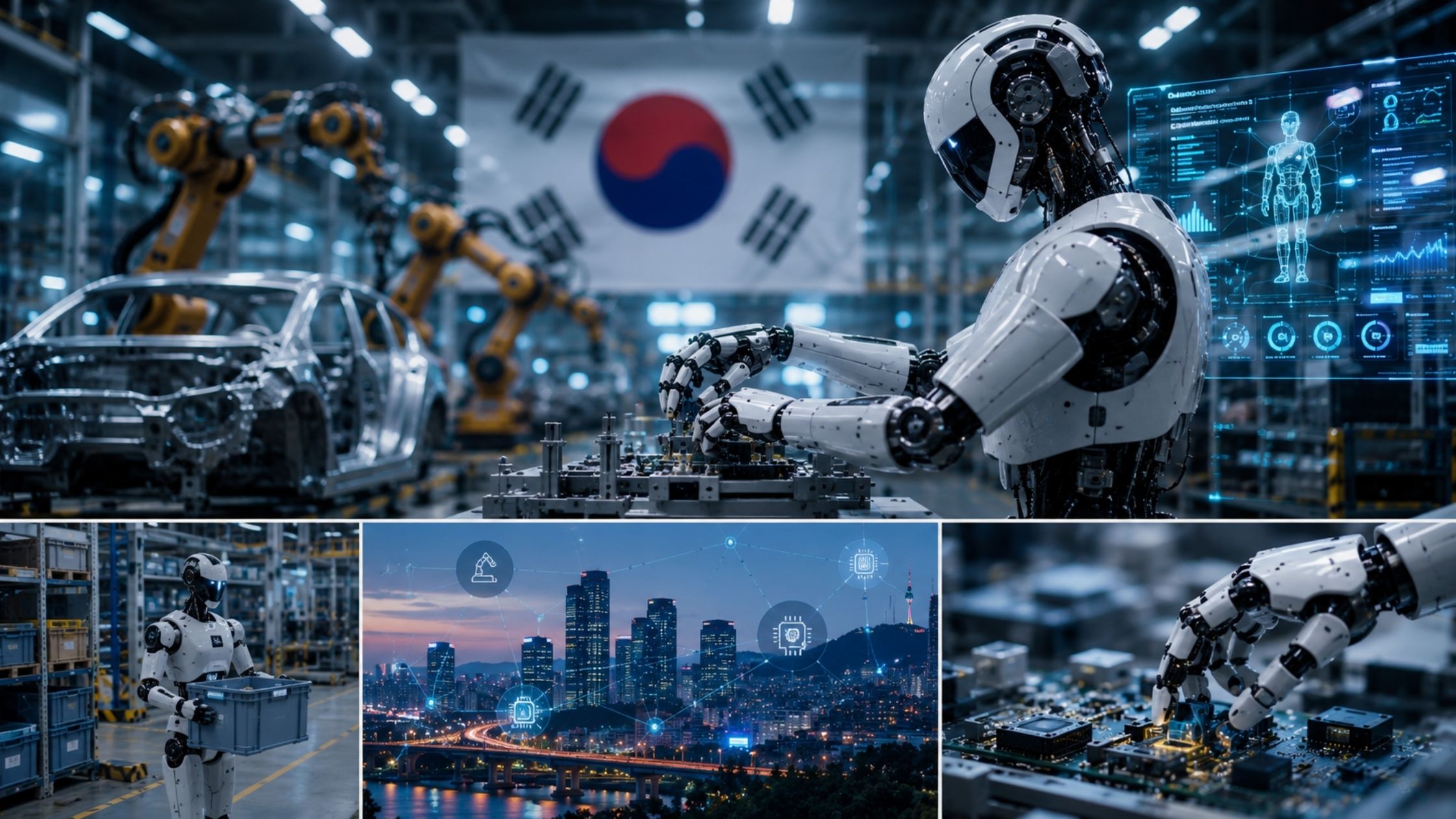
Korea’s advantage in the humanoid race may not be its ability to build robots alone, but its ability to expose them to some of the world’s most demanding industrial environments.
The global humanoid robotics industry is entering a more difficult phase. Building a robot that can walk, balance or perform a polished demonstration is no longer the central challenge. The harder test is whether that robot can work safely and repeatedly inside a real factory, where tolerances are measured in millimeters, downtime has a cost, and a machine must recover when the physical world does not behave as expected.
South Korea may be unusually well positioned for that test. The country had 1,220 industrial robots per 10,000 manufacturing employees in 2024, the highest robot density in the world, according to the International Federation of Robotics. Its manufacturing base is concentrated in industries such as semiconductors, automotive and electronics, which are among the most demanding users of industrial automation.
That existing automation infrastructure is becoming relevant to a new generation of machines. Unlike conventional industrial robots designed around fixed, predictable movements, humanoids powered by physical AI are intended to perceive environments, manipulate objects, adapt to variations and perform a wider range of tasks.
For Korea, the factory could therefore become more than an end market. It could become a testing, training and commercialization environment for physical AI.
In an exclusive conversation with KoreaTechToday, a spokesperson for Holiday Robotics said the company deliberately chose manufacturing as its first market because of the demands it encounters in Korea.
“For a company that chose manufacturing as its first market, Korea is where the most demanding customers in the world are concentrated,” the spokesperson said.
Korea’s manufacturing density creates a demanding proving ground
The importance of Korea’s manufacturing ecosystem is not simply that the country has many factories. It is that advanced manufacturing creates conditions in which weaknesses in a robot become immediately visible.
Holiday Robotics works with companies in semiconductors, automotive and electronics, industries where precision, repeatability and reliability are critical. The company said some of the work it handles today calls for tolerances within 5 millimeters.
“The requirements are high, and the engineers there will tell you exactly what failed and why,” the spokesperson said.
That feedback loop could become an important competitive advantage.
A humanoid that performs adequately in a controlled demonstration can still fail when confronted with variations in object position, friction, weight, contact forces or the timing of a production process. Industrial customers cannot simply accept those failures as part of research. The robot has to perform a useful task consistently and integrate into an existing workflow.
This is also where Korea’s existing automation culture matters. The country’s manufacturing industry has spent decades integrating robotics into production, giving companies and engineers extensive experience in evaluating machines according to productivity, precision, safety and uptime rather than novelty.
For humanoid developers, that raises the standard from “Can the robot do this?” to “Can the robot do this reliably enough to justify putting it on the production line?”
From factory automation to physical-AI training
Korea’s emerging robotics strategy increasingly reflects this shift. Hyundai Motor Group, which owns Boston Dynamics, has outlined a plan to train and validate Atlas humanoid robots in manufacturing environments. Its Robot Metaplant Application Center is designed to train robots on movements such as lifting, turning and recovery, while data from real-world factory operations can flow back into the training system for retraining. Hyundai plans to begin deploying Atlas for parts-sequencing tasks in 2028 and expand toward more complex assembly applications by 2030. It has also targeted production capacity of 30,000 robots annually by 2028.
The significance goes beyond Hyundai. Samsung Electronics established its Robotics eXperience division in July 2026 to accelerate robotics development and commercialization. Manufacturing sites are expected to be among the initial environments for its humanoid robotics efforts.
Together, these developments point toward a broader model in which factories are not simply customers for robots. They become part of the learning loop. The basic cycle is straightforward: robots enter real environments, encounter failures and variations, generate operational data, and use that experience to improve their next deployment. That is fundamentally different from treating robotics as a finished hardware product.
The factory exposes what simulation cannot
This is particularly important because physical AI faces a data problem that software AI does not encounter in quite the same way. A language model can learn from enormous quantities of digital information. A robot has to learn about gravity, friction, contact, force, balance, object deformation and the countless small variations that occur when humans and machines interact with physical objects.
Holiday Robotics is building its platform around this problem. The company raised $105 million in Series A funding in July 2026 and says its FRIDAY humanoid, Holiday Sim simulator, Holiday Lab robot-learning platform and OASys deployment system are designed to work together as a full-stack system for industrial applications.
The company argues that the robot’s hands are particularly important because industrial value is often created through manipulation rather than locomotion. A humanoid must grasp, position, adjust and sense contact while dealing with variations in the physical environment.
That helps explain why Holiday has chosen to build much of its technology stack internally.
“The same reasoning is behind our decision to build the full stack ourselves, from actuators and tactile sensors through the simulator and control software,” the spokesperson told KoreaTechToday.
“Buying off the shelf can be faster at the start. But at this level of customer, when something goes wrong, explaining the cause, fixing it, and getting the robot back on the line has to happen within days.”
For an industrial humanoid, this is not merely an engineering preference. It is a commercial requirement.
A factory cannot afford a robot whose hardware, sensing and software are so fragmented that diagnosing a failure becomes a prolonged exercise involving multiple vendors. The closer the manufacturer controls the entire system, the more quickly it can potentially identify failures and modify the machine.
Korea’s advantage is broader than humanoids
South Korea’s opportunity therefore lies in the combination of capabilities surrounding the robot. The country already has advanced semiconductor and electronics manufacturing, a large automotive industry, a highly automated industrial base and established robotics expertise. The government has also been pushing the convergence of AI and robotics as part of a broader strategy to strengthen domestic robotics capabilities.
The result could be an unusually tight connection between robot developers and industrial users. That connection matters because humanoid robotics is still far from commercially mature. A recent Reuters investigation into China’s rapidly expanding humanoid sector highlighted the gap between impressive demonstrations and robots capable of reliably performing complex factory tasks, particularly where precision and adaptability are required. Korea therefore has an opportunity to compete not only by producing humanoids, but by becoming particularly good at making humanoids work.
The harder question is whether factories will accept them
That opportunity should not be confused with a guaranteed advantage. Industrial customers will ultimately judge humanoids against conventional automation. For highly structured tasks, traditional robotic arms are already fast, precise and reliable. A humanoid has to demonstrate that its flexibility and ability to operate in environments designed for people create enough additional value to justify its cost and complexity.
There is also a workforce question. Hyundai’s expansion of humanoid robotics has already generated debate with its Korean labor union over the implications of automation for workers. That tension illustrates a broader reality: the factory that provides valuable training data is also a workplace where the economic consequences of automation are experienced directly.
For Korea, successful physical-AI adoption will therefore require more than better robots. It will require new approaches to workforce training, safety, maintenance and human-robot collaboration.
Holiday Robotics itself is cautious about extrapolating too far from the Korean market.
“We are careful about drawing lessons for other markets. We are still building our track record in a single environment,” the spokesperson said.
That caution is important. Korea’s manufacturing ecosystem may provide an exceptional environment for testing industrial humanoids, but the model still has to prove that it can translate into economically sustainable deployments elsewhere.
Korea’s factory advantage could become a physical-AI feedback loop
The deeper opportunity is that Korea already possesses many of the ingredients needed for such a feedback loop. Its factories provide demanding environments. Its industrial companies provide potential customers and deployment sites. Its electronics and semiconductor sectors contribute critical components and manufacturing expertise. Its robotics industry provides engineering capabilities, while government policy is increasingly focused on physical AI.
If those pieces connect effectively, the advantage could compound. Factories generate real-world experience. That experience improves robots. Better robots become easier to deploy. More deployments generate more operational data, which can then improve the next generation of machines.
In that model, the factory is no longer simply where the robot is sold. It becomes part of how the robot learns.
That may ultimately be the more important story behind Korea’s humanoid ambitions.
“Embodied AI is not completed by software alone, and the closer you are to the ability to build, the faster you move,” the Holiday Robotics spokesperson told KoreaTechToday.
South Korea has spent decades building the industrial systems needed to manufacture some of the world’s most sophisticated physical products. The next challenge is to use those same systems to teach machines how to operate inside the physical world.
The country’s advantage in humanoid robotics, if it emerges, may therefore not come from producing the most spectacular robot demonstration. It may come from having some of the world’s most demanding factories ready to tell those robots exactly where they still fall short.