KoreaTechToday - Korea's Leading Tech and Startup Media Platform
  • Topics
    • Naver
    • Kakao
    • Nexon
    • Netmarble
    • NCsoft
    • Samsung
    • Hyundai
    • SKT
    • LG
    • KT
    • Retail
    • Startup
    • Blockchain
    • government
  • Lists
KoreaTechToday - Korea's Leading Tech and Startup Media Platform
  • Topics
    • Naver
    • Kakao
    • Nexon
    • Netmarble
    • NCsoft
    • Samsung
    • Hyundai
    • SKT
    • LG
    • KT
    • Retail
    • Startup
    • Blockchain
    • government
  • Lists
KoreaTechToday - Korea's Leading Tech and Startup Media Platform
No Result
View All Result
Home Food Service

KRICT Develops Safety Sticker that Indicates Spoiled Food

James Jung by James Jung
PUBLISHED: April 8, 2020 UPDATED: April 18, 2020
in Food Service, Science and Technology, South Korea
0
krict safety sticker on food item
The Korea Research Institute of Chemical Technology developed a cold-chain safety sticker that indicates if frozen food products become spoiled. / photo courtesy of KRICT

The Korea Research Institute of Chemical Technology developed a cold-chain safety sticker that indicates if frozen food products become spoiled. / photo courtesy of KRICT

The Korea Research Institute of Chemical Technology (KRICT) developed a cold-chain safety sticker that indicates if food products such as meat, fish, vegetables, and fruits become spoiled or mishandled during delivery or storage.

Korea Institute of Chemical Technology is a part of the National Research Council of Science and Technology.

A research team from the Research Center for Bio-based Chemistry of KRICT invented the nanofiber-film sticker technology. The team published the study in the Advanced Materials Online journal with the title “A Self-Healing Nanofiber-Based Self-Responsive Time-Temperature Indicator for Securing a Cold-Supply Chain.”

The KRICT designed the cold-chain safety sticker to prevent the occurrence of food poisoning from spoiling food. The technology is becoming critical as food deliveries are becoming more popular amid the coronavirus spread.

Safetry Sticker Technology

The core technology of the safety sticker lies within its nanofiber film. At low temperatures, the film stays opaque due to its stable structure, where thin threads intersect one another, scattering light. However, when exposed to temperatures 10°C or higher, the nanofiber structure collapses, allowing light to pass through the film. The sticker’s thin threads melt, thus making it appear transparent.

KRICT researcher Dr. Oh Dong-yeop said that once the sticker stays transparent, it would remain transparent. It shows an image displaying the status of the food, and if refrigerated again, cannot return to its original opacity.
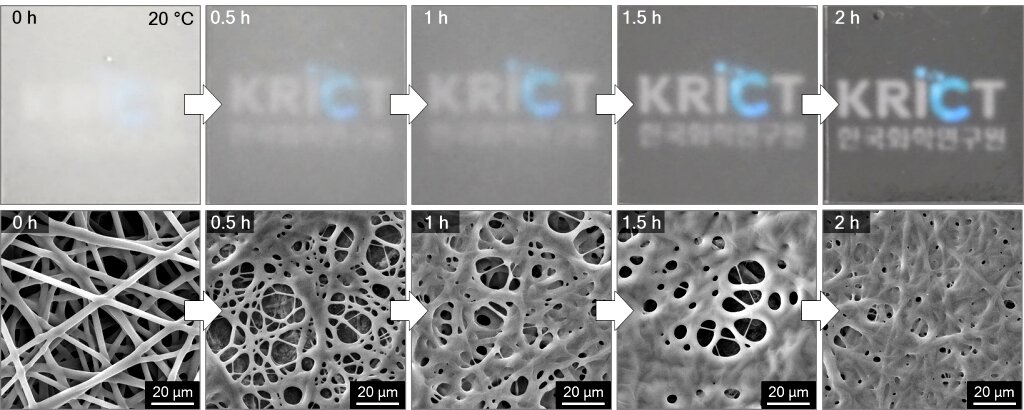
Change on nanofiber structure of the sticker after exposure to room temperature.
Change on nanofiber structure of the sticker after exposure to room temperature. / photo credit to KRICT

The research team could also control the time when the sticker could become transparent. The stickers would become transparent after a minimum of 30 minutes or a maximum of 24 hours of exposure to room temperature, depending on the thickness of the nanofibers. This feature would allow distributors to choose from different stickers for different types of products.

The nanofiber-film sticker costs about 12 won (1 cent) to manufacture. The research team said that the technology could be used during the transport of various types of frozen foods. The sticker could also benefit the pharmaceutical industry as it can ensure the safety of medical supplies and expensive medicines.

“As the delivery market is growing rapidly, the demand for this technology would grow.”

– Dr. Oh Dong-yeop, KRICT researcher
Tags: food deliveryfood safetyfrozen foodKRICTnanofiberroom temperaturesafety stickerSouth Korea newsspoiled

Related Posts

AI Ads Can Win Attention. But What Happens to Brand Trust?
The Korea Research Institute of Chemical Technology developed a cold-chain safety sticker that indicates if frozen food products become spoiled. / photo courtesy of KRICT
AI

AI Ads Can Win Attention. But What Happens to Brand Trust?

September 1, 2026
K-Beauty Has the U.S. Audience. Can Other Korean Startups Replicate the Playbook?
The Korea Research Institute of Chemical Technology developed a cold-chain safety sticker that indicates if frozen food products become spoiled. / photo courtesy of KRICT
AI

K-Beauty Has the U.S. Audience. Can Other Korean Startups Replicate the Playbook?

September 2, 2026
Korean Healthtech Startups Want to Go Global. They May Need Local Partners More Than Local Technology.
The Korea Research Institute of Chemical Technology developed a cold-chain safety sticker that indicates if frozen food products become spoiled. / photo courtesy of KRICT
South Korea

Korean Healthtech Startups Want to Go Global. They May Need Local Partners More Than Local Technology.

September 2, 2026
How Mind Cafe Is Using Technology to Scale Human Counseling Across South Korea
The Korea Research Institute of Chemical Technology developed a cold-chain safety sticker that indicates if frozen food products become spoiled. / photo courtesy of KRICT
AI

How Mind Cafe Is Using Technology to Scale Human Counseling Across South Korea

September 2, 2026
Why Seoul’s Beauty Experts Are Becoming Part of AI Systems
The Korea Research Institute of Chemical Technology developed a cold-chain safety sticker that indicates if frozen food products become spoiled. / photo courtesy of KRICT
beautytech

Why Seoul’s Beauty Experts Are Becoming Part of AI Systems

July 31, 2026
Gamescom Signals South Korea’s Next Phase in Global Gaming as Studios Expand Beyond Traditional Strengths
The Korea Research Institute of Chemical Technology developed a cold-chain safety sticker that indicates if frozen food products become spoiled. / photo courtesy of KRICT
South Korea

Gamescom Signals South Korea’s Next Phase in Global Gaming as Studios Expand Beyond Traditional Strengths

July 31, 2026
No Result
View All Result

Most Popular

  • AI Ads Can Win Attention. But What Happens to Brand Trust?

    0 shares
    Share 0 Tweet 0
  • Samsung Secures $752 Million Contract with Naver for Mach-1 AI Accelerator Chips

    0 shares
    Share 0 Tweet 0
  • Korea’s AI Advertising Rules Could Create a New Market for Creative Compliance

    0 shares
    Share 0 Tweet 0
  • South Korea’s AI Investment Is Moving From Models to Machines

    0 shares
    Share 0 Tweet 0
  • SK Group backed PhynX Lab Introduces Cheiron: A Game-Changer for AI in the Pharmaceutical Industry

    0 shares
    Share 0 Tweet 0
  • South Korea’s Kakao Mobility Debuts Global Taxi-Hailing Platform to Challenge Uber

    0 shares
    Share 0 Tweet 0

PRODUCTS

[ads_amazon]

TOPICS

  • Naver
  • Kakao
  • Nexon
  • Netmarble
  • NCsoft
  • Samsung
  • Hyundai

FREE NEWSLETTER

[mc4wp_form id="4726"]

FOLLOW US

  • About Us
  • Cookie policy
  • home
  • homepage
  • mainhome
  • Our Services
  • Privacy Policy
  • Terms of Use

Copyright © 2024 KoreaTechToday | About Us | Terms of Use |Privacy Policy |Cookie Policy| Contact : [email protected] |

No Result
View All Result
  • Topics
    • Naver
    • Kakao
    • Nexon
    • Netmarble
    • NCsoft
    • Samsung
    • Hyundai
    • SKT
    • LG
    • KT
    • Retail
    • Startup
    • Blockchain
    • government
  • Lists

Copyright © 2024 KoreaTechToday | About Us | Terms of Use |Privacy Policy |Cookie Policy| Contact : [email protected] |