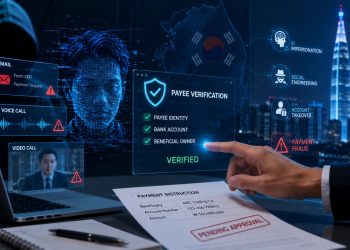


South Korean AI companies are expanding on-premises offerings as businesses seek greater control over sensitive information. But competing with global providers will require more than keeping data within domestic infrastructure.
South Korean AI companies are increasingly taking their models and services directly to enterprise customers’ own infrastructure. On October 21, Seoul Economic Daily reported that Flitto had secured a 3.9 billion won ($2.7 million) on-premises translation contract, while Twelve Labs was discussing deployments of its video AI models with four South Korean organizations. The shift reflects growing concerns about exposing confidential business information to external AI services.
For South Korea’s AI industry, this creates an opportunity to compete on more than model performance. Companies that offer greater control over data processing, deployment and security could appeal to enterprises handling sensitive information. However, international providers are pursuing similar capabilities, raising a more difficult question: can data sovereignty become a lasting competitive advantage for Korean AI companies, or will it become a standard enterprise requirement?
Why Enterprises Want Greater Control Over AI
Businesses increasingly want to use AI without exposing proprietary information, manufacturing processes, internal documents or other sensitive data to external services.
On-premises deployment offers one approach. Instead of sending requests to an externally operated service, companies can run AI software on their own servers, potentially within networks disconnected from the public internet. This gives customers greater control over data access and infrastructure, although security still depends on how systems are configured and managed.
South Korean companies are adapting their business models accordingly. Flitto, which has traditionally offered translation through software-as-a-service and application programming interfaces, is expanding its on-premises business. Twelve Labs is exploring similar deployments for its video-understanding models, which analyze video content and associated sounds.
These developments suggest that deployment flexibility can influence how enterprises purchase AI. But data control is not a single technical feature. Customers must consider where information is stored, where inference occurs, who can access the system and which legal protections apply.
South Korea’s Opportunity Lies Beyond Local Hosting
South Korea has several advantages that could help its AI companies serve security-conscious enterprises. Its manufacturing, semiconductor, automotive and electronics industries generate valuable operational data, while its technology ecosystem includes companies developing AI infrastructure, specialized models and enterprise software.
The country’s sovereign AI ambitions also reflect a wider effort to strengthen domestic capabilities. A report by South Korea’s Institute for National Security Strategy identifies the country’s semiconductor and manufacturing strengths but highlights external dependencies across parts of its AI ecosystem. It argues that strategic autonomy requires attention to data, computing infrastructure, models, security and other components of the AI stack.
For Korean AI companies, the commercial opportunity is to combine control over sensitive data with capabilities that customers cannot easily obtain from a generic AI service. That could mean models tailored to Korean-language business needs, AI systems designed for specialized industrial workflows, or software that integrates with existing enterprise infrastructure. Companies could also differentiate themselves through deployment options that allow customers to retain control over where their data is processed.
The distinction matters. A provider that simply installs an existing model on a customer’s server may address a deployment concern, but it does not necessarily offer superior performance, security or technological independence.
Global AI Providers Are Closing the Gap
Domestic companies cannot assume that data sovereignty will automatically steer customers toward Korean providers. In September 2026, The Chosun Daily reported that OpenAI Korea was pursuing a domestic inference data center initiative. The company was seeking to support inference residency, allowing AI model processing to take place within South Korea, extending local control beyond data storage. The report also noted that data residency was already available to certain enterprise, education and API customers.
This development complicates the competitive picture. International AI providers can combine their models and research capabilities with locally deployed infrastructure, potentially addressing concerns that previously encouraged customers to consider domestic alternatives.
South Korean companies will therefore need to demonstrate advantages beyond geography. Specialized performance, integration with local systems, responsive support and competitive operating costs could all influence purchasing decisions. Data sovereignty may help open the door to enterprise customers. It will not necessarily determine which provider wins their business.
Data Control Comes With Trade-Offs
On-premises AI can give organizations greater control, but it also introduces costs. Customers may need to purchase computing equipment, maintain infrastructure, manage software updates and employ technical staff. Deployment can require customization because server configurations and security requirements vary between organizations. Seoul Economic Daily highlighted these implementation and maintenance burdens in its October report.
Nor does keeping information within South Korea automatically establish data sovereignty. Control also depends on access permissions, contractual arrangements, applicable laws and the ownership of underlying technology. A locally hosted system may still rely on foreign models, software or computing components.
Regulation presents a related challenge. In August 2026, South Korea’s National Assembly passed amendments to the Personal Information Protection Act establishing special provisions for using personal information in certain AI development activities. The framework includes additional safeguards and oversight by the Personal Information Protection Commission. The changes seek to facilitate AI development while maintaining privacy protections.
For AI providers, the task is to offer meaningful control without making deployment prohibitively expensive or limiting the utility of the technology.
Why Original Technology Still Matters
Speaking with KoreaTechToday, Berkay Başeski, co-founder of Turkish AI startup MLVisor, argued that Asia could become an important source of original AI technology, rather than merely a market for products developed elsewhere.
“From our own experience as a team building outside the main US hubs, the difference comes from building something original at the core rather than adapting an existing product,” Başeski said.
He emphasized the importance of proprietary technology and data advantages, adding that companies should design for data sovereignty from the beginning because many countries and industries consider it important.
His argument reflects a broader strategic question for South Korean AI companies: whether they can turn local requirements into products with international appeal.
MLVisor’s own approach includes developing its inference technology and planning deployment options that keep systems within customer-controlled infrastructure. However, the company remains pre-launch, with initial commercial deployments planned for 2027. Its strategy is therefore an example of an approach being pursued, not proof of established commercial success in South Korea.
Data Sovereignty Must Deliver Business Value
South Korean AI companies have an opportunity to serve enterprises that need tighter control over sensitive information. Yet local deployment alone is unlikely to protect them from competition as global providers expand their enterprise offerings.
The stronger proposition combines data control with reliable performance, specialized capabilities, integration and sustainable economics. Those attributes could help domestic companies build lasting relationships with customers in South Korea and beyond.
Ultimately, data sovereignty may become an important reason for enterprises to evaluate an AI provider. Whether it becomes a competitive advantage will depend on what the provider delivers beyond control over the data itself.