
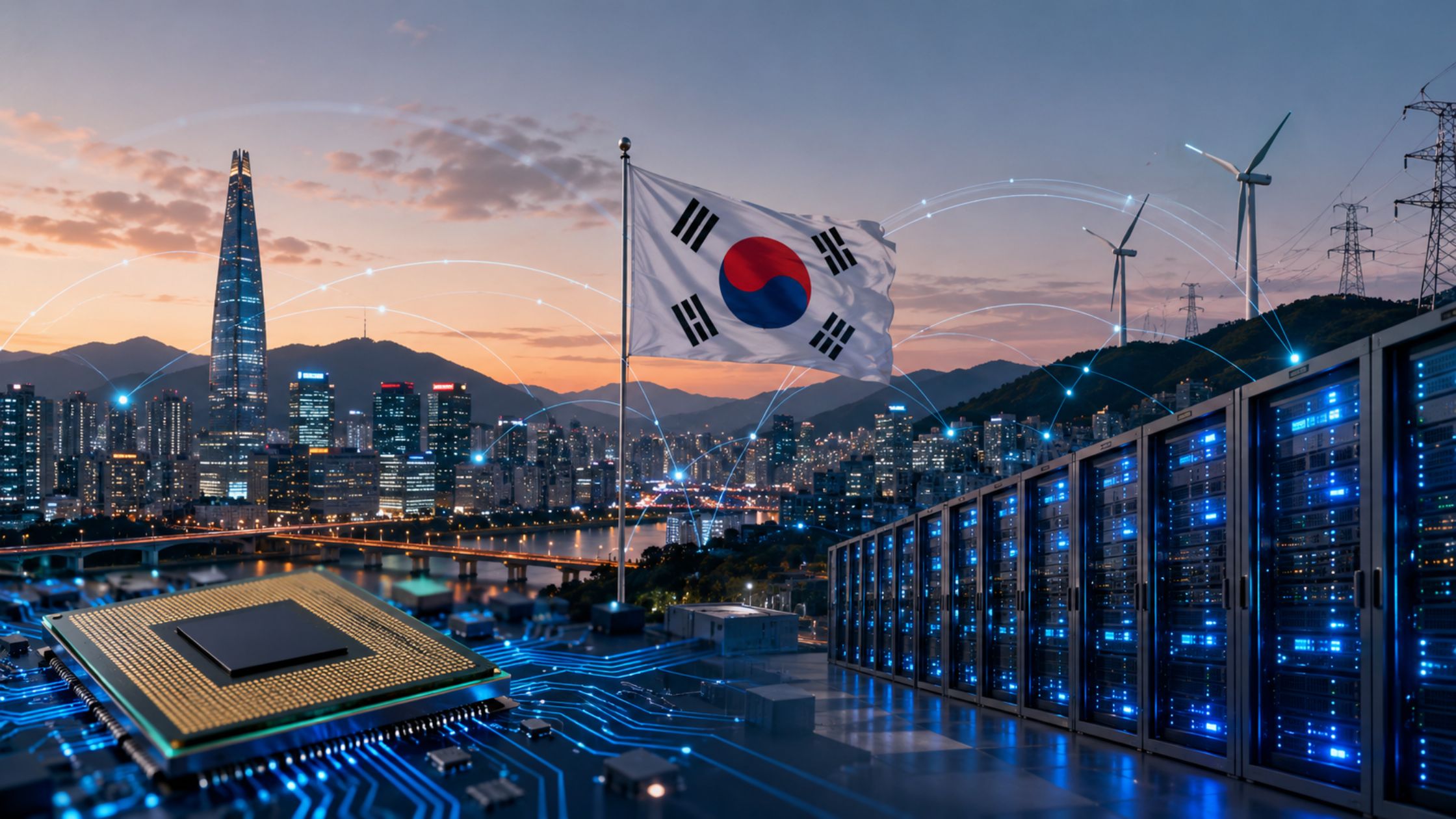
As Seoul accelerates investments in sovereign AI and next-generation semiconductor infrastructure, industry experts argue that compute accessibility, energy resilience, and digital infrastructure could become the country’s next competitive frontier.
South Korea has firmly established itself as one of the world’s leading AI hardware powerhouses. Home to semiconductor giants Samsung Electronics and SK hynix, the country sits at the center of the global supply chain for high-bandwidth memory (HBM), a critical component powering today’s most advanced artificial intelligence systems. At the same time, the Lee Jae Myung administration has elevated AI to the heart of its industrial policy, unveiling an ambitious strategy to strengthen domestic AI infrastructure, expand sovereign AI capabilities, and reinforce South Korea’s leadership in advanced manufacturing.
The government’s latest plans include significant investments in AI computing infrastructure, public AI services, semiconductor innovation, and the National AI Computing Center. Working alongside domestic technology companies and global partners such as NVIDIA, South Korea aims to secure large-scale GPU capacity while accelerating the development of homegrown large language models and AI applications across industries.
As countries compete to build larger AI clusters and acquire more advanced chips, a parallel debate is beginning to emerge across the technology industry. Is manufacturing cutting-edge hardware enough to secure long-term AI leadership, or will future competitiveness depend equally on the infrastructure required to operate AI at scale?
That question is becoming increasingly relevant for South Korea.While speaking with KoreaTechToday, Greg Osuri, Founder and CEO of decentralized cloud computing platform Akash, argued that the industry’s attention is gradually shifting from semiconductors alone toward the broader infrastructure ecosystem that enables AI development.
“Korea’s advanced semiconductor and manufacturing base gives it a real structural advantage,” Osuri said. “The key questions are: how long will it take, where will they do it, where will the power come from, and what is the interim stopgap? I think the countries that lead the AI race will be the ones that make compute easily accessible and reduce concentration risk that defines the current market structure.”
South Korea’s AI strategy is entering a new phase
For much of the past decade, South Korea’s AI competitiveness has been closely associated with its semiconductor industry. Samsung Electronics and SK hynix have played a pivotal role in supplying advanced memory used in AI accelerators developed by companies such as NVIDIA, AMD, and other global chipmakers. As demand for generative AI continues to grow, HBM has become one of the industry’s most strategically important technologies, placing Korean manufacturers at the center of the global AI supply chain.
However, AI leadership today extends well beyond producing chips. The rapid adoption of large language models and agentic AI systems has shifted attention toward an entirely different layer of the technology stack. AI infrastructure now encompasses hyperscale data centers, high-performance networking, cloud computing platforms, GPU clusters, power generation, cooling systems, and software orchestration capable of supporting increasingly complex AI workloads. Recognizing this shift, South Korea has expanded its national AI strategy to include investments across the full AI value chain.
Recent policy initiatives reflect several priorities:
- Expanding sovereign AI capabilities through domestic AI models and national computing infrastructure.
- Increasing GPU availability to support researchers, startups, enterprises, and public institutions.
- Accelerating AI adoption across manufacturing, healthcare, mobility, defense, and public administration.
- Strengthening collaboration between government, semiconductor companies, cloud providers, and research institutions.
The strategy reflects a broader recognition that future AI competitiveness will depend not only on hardware innovation but also on the country’s ability to deploy and scale AI efficiently. This evolution mirrors developments in other leading AI markets. The United States, Europe, Japan, and several Middle Eastern countries are investing heavily in AI infrastructure alongside semiconductor production, reflecting growing awareness that access to computing capacity is becoming as strategically important as chip manufacturing itself.
The next bottleneck may not be chips
Despite the continued importance of advanced semiconductors, many industry observers now believe the next major constraint on AI development may lie elsewhere. Large AI systems require enormous amounts of electricity, sophisticated cooling technologies, high-speed networking, and extensive physical infrastructure. Building these facilities has become increasingly challenging as electricity demand rises and suitable sites become more difficult to secure.
During his conversation with KoreaTechToday, Osuri argued that discussions around AI shortages often overlook the infrastructure supporting computing itself.
“Every GPU, LLM model, and AI agent ultimately depends on power, cooling, and grid capacity,” he said. “So when people talk about a compute shortage, they are often also talking about an energy and infrastructure shortage underneath it.”
He added that the industry’s current trajectory may not be sustainable as AI adoption accelerates.
“We can buy more chips, but if we cannot power them economically, cool them efficiently, or connect them to reliable infrastructure, they do not translate into usable AI capacity. AI demand is scaling faster than the physical infrastructure needed to support it.”
Those observations align with broader concerns emerging across global technology markets. The International Energy Agency and multiple industry studies have projected significant increases in electricity consumption from AI-driven data centers over the coming decade. At the same time, hyperscale facilities require substantial investments in transmission infrastructure, water resources for cooling, and specialized engineering expertise.
For South Korea, these issues carry particular significance. The country’s dense urban environment, limited land availability, and high industrial electricity demand present unique challenges for expanding large-scale AI infrastructure. Although Korea possesses one of the world’s most advanced digital economies, balancing AI growth with energy security, environmental sustainability, and infrastructure resilience will require increasingly sophisticated planning.
These considerations are already influencing how governments and technology companies evaluate future AI investments. Rather than measuring competitiveness solely through semiconductor output or GPU procurement, policymakers are beginning to assess how effectively AI infrastructure can be deployed, operated, and expanded over the long term.
Infrastructure resilience is becoming a strategic issue
Alongside energy, another issue is attracting growing attention across the AI industry: concentration risk. Today’s AI ecosystem depends heavily on a relatively small number of cloud providers, GPU manufacturers, and hyperscale infrastructure operators. While this model has enabled rapid AI deployment, it has also raised questions about resilience, pricing, and accessibility.
Recent service disruptions affecting major cloud platforms have highlighted how outages at a handful of providers can affect thousands of businesses simultaneously, reinforcing calls for greater infrastructure diversification.
For South Korea, this debate extends beyond operational resilience. As the country seeks to strengthen sovereign AI capabilities, policymakers are increasingly focused on reducing dependence on external infrastructure while ensuring domestic developers, startups, researchers, and enterprises have reliable access to advanced computing resources.
The discussion is no longer simply about building more AI capacity. It is increasingly about determining how that capacity is distributed, managed, and made accessible across the broader innovation ecosystem.
What resilient AI infrastructure means for South Korea
South Korea’s AI ambitions extend beyond building advanced semiconductor capabilities. The country also aims to cultivate a thriving ecosystem of AI startups, enterprise software developers, research institutions, and public-sector innovation. Achieving that vision will require broad and reliable access to computing resources.
For large technology companies, securing GPU capacity is often a matter of negotiating long-term contracts with hyperscale cloud providers. Smaller AI companies, university research labs, and early-stage startups, however, frequently face a different reality. Limited access to high-performance GPUs, rising cloud costs, and long procurement timelines can slow experimentation and product development.
This challenge is not unique to South Korea, but it has become increasingly relevant as the country’s startup ecosystem expands into generative AI, robotics, healthcare, semiconductor design, autonomous mobility, and industrial AI.
Osuri believes addressing compute accessibility will be essential if countries hope to broaden participation in the AI economy.
“Access to high-end GPUs is often gated behind enterprise contracts, long procurement cycles, and pricing structures that favor large companies,” he told KoreaTechToday. “That creates an uneven playing field, where smaller teams may have the talent and ideas to build AI products, but may not have access to the necessary infrastructure.”
He added that while South Korea possesses many of the ingredients required for AI leadership, wider access to computing resources will play an increasingly important role in determining how broadly innovation spreads.
“For Korea, alternative compute models could help turn existing technical strength into broader participation. While Korea has world-class developers, a strong hardware culture, and a thriving startup ecosystem, access to compute remains expensive, scarce, and concentrated. A more open model would give smaller teams and developers a better path to build and scale.”
Although Akash advocates decentralized compute marketplaces as one possible solution, the broader issue extends well beyond any single company or technology model. Governments, cloud providers, chip manufacturers, and AI developers are all exploring different approaches to expanding compute capacity while reducing costs and improving accessibility.
For South Korea, the policy question is likely to center on how public investments in AI infrastructure can support not only national champions but also the broader innovation ecosystem.
South Korea has already secured a central role in the global AI ecosystem through its leadership in advanced semiconductors. Its latest investments demonstrate an ambition to extend that leadership into sovereign AI, large-scale computing infrastructure, and next-generation digital industries.
Yet as artificial intelligence becomes increasingly integrated into every sector of the economy, the conversation is beginning to move beyond chip production alone. Reliable electricity, scalable data centers, accessible computing resources, resilient cloud infrastructure, and efficient deployment models are emerging as equally important components of national AI competitiveness.