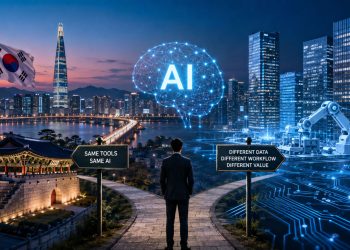


As AI makes candidate matching faster and resumes easier to generate, the harder problem may be understanding what a person’s experience actually means for a specific employer.
South Korea is already moving recruitment deeper into the age of AI. In March 2026, the Ministry of Employment and Labor upgraded Employment24’s AI talent recommendation service to analyze job roles, career history, salaries, qualifications and other factors, while also providing employers with a recommendation score, reasons for the recommendation and resume summaries. In June, the ministry introduced additional AI employment services that analyze job seekers’ capabilities and recommend training and employment opportunities, while helping companies write job descriptions, adjust hiring conditions and identify candidates.
The scale of the challenge explains why such systems are becoming important. The Bank of Korea estimated that South Korea had about 57,000 AI workers in 2024. Yet 69% of large companies and 68.7% of midsize companies said they planned to hire more AI workers, while employers continued to report difficulties finding experienced talent. Around 16% of Korea’s AI workforce, or approximately 11,000 people, were working overseas.
The next question for AI recruiting, therefore, may not be simply whether technology can find the right candidate. It may be whether it can understand the value of experience that does not fit neatly into familiar credentials, job titles or career paths.
From Matching Candidates to Understanding Capabilities
Traditional recruitment has largely depended on signals that are easy for employers to recognize: university, previous employer, job title, years of experience, certifications and language ability.
AI can make these signals easier to process at scale. Korea Employment Information Service, for example, analyzed 1.29 million WorkNet job postings using data analytics and AI modeling to identify factors associated with successful hiring. Its research is being used to develop machine-learning models that can forecast whether vacancies will be filled within 30 days.
But prediction is not necessarily the same as understanding. A job description describes what a company thinks it needs. A resume describes what a candidate says they have done. Between the two sits a more difficult question: what capabilities did that experience actually produce, and how relevant are those capabilities to the company’s business? That distinction becomes particularly important as skills increasingly move across traditional occupational boundaries.
When International Experience Becomes Difficult to Read
South Korea’s growing international talent population provides a useful example of the problem. The country reached roughly 300,000 international students in 2026, one year earlier than its original target. The Ministry of Education is now shifting its policy from simply increasing international student numbers toward developing talent, strengthening career planning and connecting education with employment and settlement.
Yet bringing people into Korea does not automatically make their previous experience legible to Korean employers. An international professional may have worked for an unfamiliar company, studied at an unfamiliar university or held a job title that has no direct Korean equivalent. The underlying skills may be highly relevant, but the signal can be harder for a recruiter to interpret.
That is what Casimir Agossou, founder and CEO of Acafo, describes as an “experience translation” problem.
“Yes, and I think ‘experience translation’ describes the problem very well. A Korean employer can quickly understand what five years at a well-known Korean company means. But when a candidate comes from a university, company or industry abroad that the recruiter does not know, the signal becomes weaker even when the actual experience is highly relevant.”
In a conversation with KoreaTechToday, Agossou argued that technology can help convert that unfamiliar experience into something more meaningful to employers.
“Technology can help by translating unfamiliar experiences into something employers can evaluate: What capability did this experience develop? What problems can this person solve? How does that capability create business value for this particular company?”
Acafo’s own platform reflects this approach. Its tools include skill discovery, a skills bank, Korean-standard resume creation and AI-powered translation designed to culturally adapt applications for Korean recruiters. Agossou recently said the company grew from his own 24-month search for employment in Korea and has since conducted hundreds of career consultations and analyzed thousands of job postings. Acafo was also named the K-Style Expo Q3 2026 winner.
The Next Layer of AI Recruiting Could Be Capability Mapping
This points toward a different model for recruitment technology. Instead of treating the resume as the primary representation of a candidate, AI could increasingly connect experience, demonstrated capabilities, market demand and potential business value.
That would change the question from “Does this candidate resemble the job description?” to “What can this candidate do, where have they demonstrated it, and where could those capabilities matter?”
Korea’s public employment infrastructure is already moving in this direction. Employment24’s newer AI services analyze job seekers’ capabilities and connect them with training and jobs, while employer-facing tools use company and job information to recommend talent and explain why candidates are suggested. But capability mapping also introduces a difficult question: whose definition of value is the system learning?
There is a risk that AI simply automates the same assumptions that shaped conventional recruitment. A system trained primarily on historical hiring patterns could reproduce familiar preferences for certain universities, employers, career paths or credentials. Korea’s own research on AI recruitment reflects this tension. A 2025 Ministry of Employment and Labor survey found that 86.7% of surveyed companies were using AI tools somewhere in HR, but only 21.7% had formally introduced AI into recruitment. Among companies using or planning to expand AI recruitment, concerns about fairness and objectivity remained significant.
Agossou makes the limitation explicit.
“But technology alone cannot solve everything. Companies also need to move toward evaluating demonstrated capabilities and potential rather than relying too heavily on familiar credentials. Technology can build the bridge, but employers ultimately have to be willing to cross it.”
That may be the most important distinction in the next phase of AI recruiting.
From Job Matching to Business-Value Matching
South Korea’s AI talent shortage, international talent strategy and expanding AI employment infrastructure are converging around the same problem: companies need capabilities that are not always easy to identify through conventional signals.
The Bank of Korea’s finding that Korea continues to experience overseas outflows of AI professionals makes the challenge even more significant. Attracting and retaining talent requires more than identifying candidates. It requires career pathways and labor-market systems capable of recognizing where their skills can create value.
AI can make experience more searchable, comparable and understandable. But its more consequential role may be to translate experience into context: the problems someone has solved, the capabilities they have demonstrated and the business situations in which those capabilities can matter. The next frontier of recruitment, then, may not be better resumes or faster matching. It may be teaching machines, and ultimately employers, to look beyond familiar credentials and understand what experience is actually worth.