

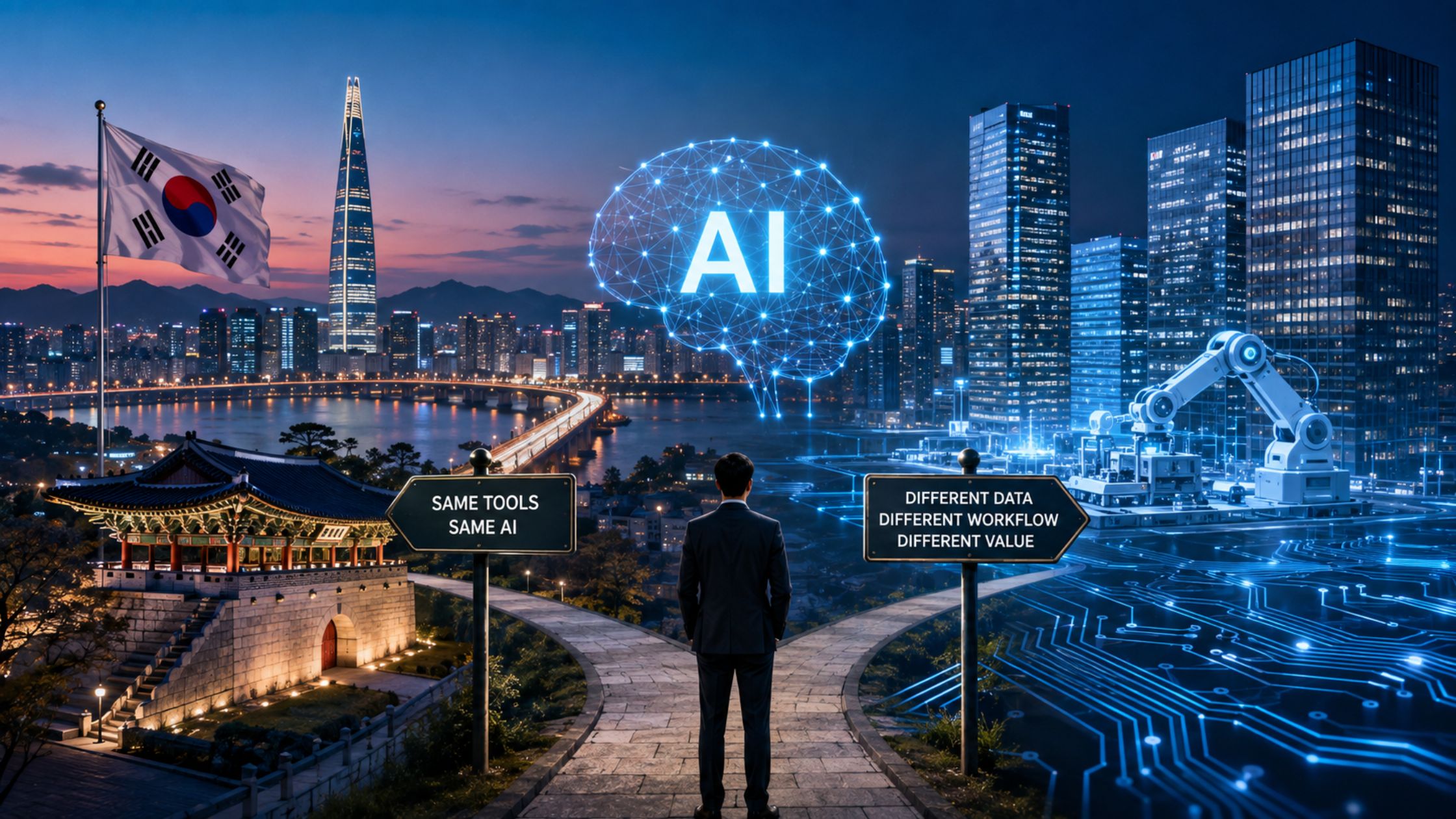
South Korean companies are rapidly moving beyond AI experimentation, but as foundation models and AI tools become increasingly accessible, the harder competitive question is emerging: what can a company build with AI that its competitors cannot simply buy or replicate?
South Korea has moved unusually quickly into enterprise AI. A 2026 Samsung SDS survey of 670 AI decision-makers found that 76% of Korean companies had already adopted generative AI, shifting the corporate conversation from whether to adopt the technology toward how to deploy it and which partners to work with.
Yet adoption alone is not translating automatically into productivity. Research from the Bank of Korea found that generative AI use reduced workers’ average working time by 3.8%, or about 1.5 hours a week, equivalent to an estimated 1% potential productivity gain. But the study found no corresponding increase in actual output. The central problem was a “productivity disconnect”: AI was improving individual tasks without sufficiently changing workflows, organizational structures or resource allocation.
That gap is becoming Korea’s next AI challenge. When businesses can increasingly access the same models and tools, AI adoption itself becomes less of a competitive advantage. The question becomes what companies build around it.
When Everyone Has Access to Similar AI
The first wave of enterprise AI was largely about access. Companies experimented with ChatGPT, image generators, coding assistants and other generative AI applications to understand what the technology could do. But the economics are changing quickly. AI capabilities that once appeared novel are becoming broadly available through commercial products. That creates a problem for companies whose AI strategy is essentially based on using the same tools as everyone else.
Vincent Chow, Founder and General Manager of SnappyFly, experienced this shift firsthand. While experimenting with generative AI, his team produced highly realistic images that initially appeared commercially promising. The problem emerged when a client pointed out that similar results could be generated using readily available tools.
Speaking with KoreaTechToday, Chow said that experience changed how his team thought about AI.
“When we first experimented with generative AI, we did exactly what many businesses are doing today. We tried the many tools that we come across every day. We used AI aggregation tools and generated impressive-looking images. It was exciting and fascinating, but we eventually realised it wasn’t really solving a commercial problem.”
The lesson was not that the technology was inadequate. It was that technological capability without commercial differentiation had limited value.
Korea’s Productivity Disconnect Shows Why Adoption Is Not Enough
The Bank of Korea’s findings reinforce that distinction. AI can make a task faster without necessarily making the organization more productive. An employee may spend less time writing, researching or analyzing information, but if the surrounding workflow remains unchanged, much of that time saving may simply disappear elsewhere.
The BOK found that AI’s benefits were more visible among self-employed workers, professionals and heavy AI users, groups with greater autonomy and stronger performance incentives. That suggests the impact of AI depends partly on how work is organized, not simply whether the technology is available.
This is an important distinction for Korean enterprises.
The next phase of AI adoption will require companies to move from adding AI to existing processes toward redesigning processes around what AI makes possible.
Deloitte’s 2026 enterprise AI research points in the same direction. Only 34% of surveyed organizations had begun fundamentally transforming products, processes or business models around AI, while another 30% were redesigning core processes. The remaining 37% were using AI with relatively limited changes to existing processes. In other words, widespread AI use does not mean widespread AI transformation.
The Moat Is Moving Beyond the Model
As foundation models become more accessible, the defensible layer may increasingly sit around the model rather than inside it. For Korean companies, that could mean proprietary customer data, industry-specific knowledge, unique workflows, distribution networks or years of accumulated operational information.
The distinction can be relatively simple. A generic AI system can generate a marketing image. A company that understands its customers, has proprietary product data and has integrated AI into its entire content-production workflow can potentially create something much harder to reproduce. That is increasingly the difference between AI usage and AI strategy.
Korea’s Massive AI Investment Raises the Stakes
The question is becoming more urgent because Korea is continuing to invest heavily in the AI ecosystem. The government has selected SK Telecom, Kakao and KT for a national project to build and operate a homegrown AI service. At the infrastructure level, SK Hynix has approved approximately KRW 54.3 trillion ($38.3 billion) in investments through 2031 for semiconductor facilities in Yongin and Cheongju, including capacity aimed at AI-related memory demand.
The proposed 2027 national budget also includes a major expansion of spending, with AI and semiconductor infrastructure among the government’s strategic priorities. This means access to AI capabilities is likely to become even broader. That makes differentiation more important, not less. If AI infrastructure becomes increasingly abundant, companies cannot depend on simply possessing AI capabilities as their competitive moat.
The Next AI Divide Will Be Organizational
Korea’s AI race is therefore entering a different phase. The first divide was between companies that experimented with AI and those that did not. That distinction is rapidly becoming less meaningful. The next divide could be between companies that use AI inside existing workflows and those that redesign their businesses around AI.
The latter requires difficult decisions about where proprietary investment is justified and where commercial AI tools are sufficient. It also requires organizations to reconsider how employees work, how information moves through the company and how AI-generated efficiencies translate into revenue, customer value or new products.
Chow captures the distinction succinctly:
“Experimentation demonstrates what AI can do. Meaningful deployment requires us to solve actual commercial problems clients face and add value to what they can’t already do.”
South Korea’s enterprise AI challenge is no longer primarily about getting companies to use the technology. With adoption already widespread and national investment accelerating, the harder problem is turning AI access into something competitors cannot easily reproduce. The Bank of Korea’s productivity findings offer a warning. AI can make individual tasks more efficient without automatically transforming the organization.
For Korean companies, the competitive advantage may therefore move away from the AI model itself and toward the data, workflows, expertise and customer relationships built around it. The companies that win the next phase of Korea’s AI race may not be those with the most AI tools. They may be those that ask the harder question first: What can AI help us do that customers actually value, and that our competitors cannot simply buy off the shelf?