

South Korea’s Ministry of Economy and Finance has unveiled plans to drive innovation and economic growth through the introduction of two initiatives. First, the country aims to launch cloud services utilizing quantum computers developed domestically. Additionally, test flights of urban air mobility (UAM) vehicles are set to commence in the greater Seoul region later this year, for better adoption of advanced technologies.
These initiatives form part of the government’s ambitious agenda to focus on the development of technologies and stimulate growth across various sectors.
The plans unveiled during the Emergency Ministerial Meeting on Economic Affairs are aligned with the New Growth 4.0 Strategy introduced in 2022. Finance Minister and Deputy Prime Minister Choi Sang-mok chaired the meeting. Alongside the quantum computing cloud service and UAM test flights, the ministry also outlined its strategy to support the growth of high-tech industrial clusters.
As part of this strategy, the government aims to launch cloud services powered by indigenous 20-qubit quantum computers for public use in the latter half of the year. Additionally, the Ministry of Economy and Finance revealed plans to commence the development of a more advanced 50-qubit computing system by 2026, for further growth in technological advancement.
The government’s annual plan for key projects in 2024 has identified five primary areas of focus in the technology sector: future mobility, space exploration, quantum technology, medicine and healthcare, and energy.
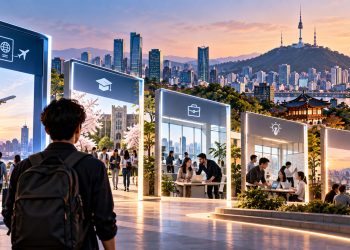
In the domain of next-generation mobility, particular attention is being given to the advancement of urban air mobility (UAM) vehicles, colloquially known as flying cars. To facilitate this, regulatory frameworks will be streamlined to commence performance verification for UAM vehicles in the greater Seoul region come August, with the aim of introducing the technology to the market by 2025.
Moreover, the government is laying the groundwork for the legal and safety aspects of self-driving cars, aiming to have self-driving passenger vehicles equipped with Level 4 autonomous driving technology operational on the roads by 2027. Concurrently, in the pursuit of next-generation mobility solutions, the government plans to conduct flight tests of UAM vehicles over the Gyeongin Ara waterway, connecting the Han River and the Yellow Sea, starting from August.
These tests will extend until June 2025, with commercial services slated to commence in the subsequent year. Additionally, the government announced supporting pivotal industries such as secondary batteries, semiconductors, displays, and shipbuilding to strengthen technological prowess in these sectors throughout the year.
Finance Minister Choi Sang-mok highlighted the significance of sectors such as mobility, quantum technology, and biotechnology in driving economic growth during an emergency meeting of economic ministers. He highlighted the government’s determination to achieve tangible outcomes in projects related to these fields, recognizing their potential to serve as new engines of economic expansion.
In line with this vision, Korea’s space agency, akin to the U.S. National Aeronautics and Space Administration, is slated for launch in May to spearhead government-led space initiatives. Additionally, the government aims to expedite the establishment of an AI chip-powered data center and inaugurate the nation’s first fully automated port in Busan in March, furthering efforts to enhance daily life innovation and accelerate technological advancements.
Also Read:
- Samsung, Vodafone, and AMD Achieve First AMD-driven Open RAN Call
- Regulatory Shake-Up: South Korea to Expel Inadequate Crypto Exchanges in 2024
- Korean Government Expands Overseas Presence to Drive Smart Farm Technology Exports
- Platform Act Delayed: South Korea Reconsiders Regulation of Tech Giants
- TSMC, SK Hynix Team Up to Counter Samsung in AI Semiconductor Market