

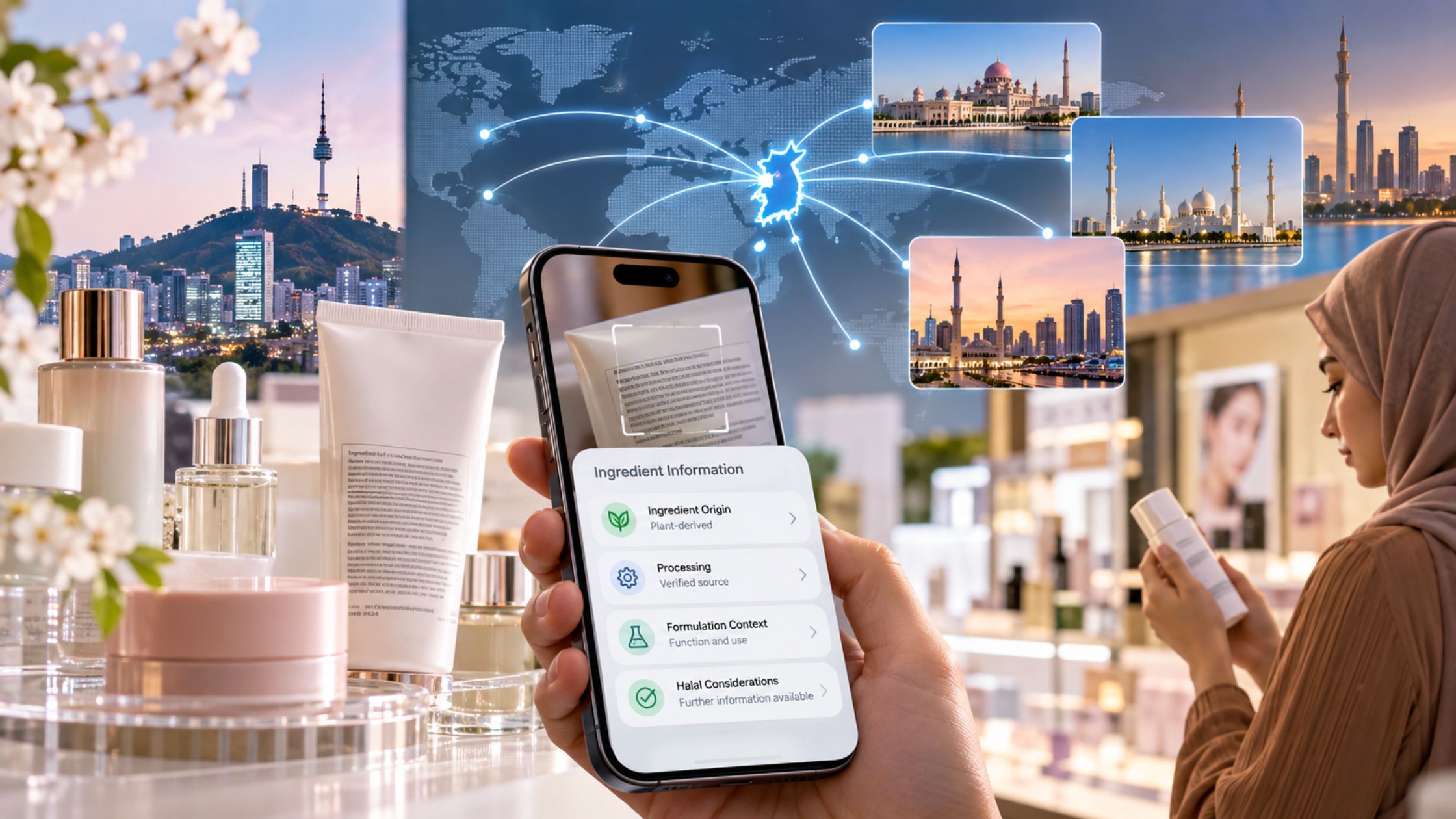
As Korean cosmetics reach more international markets, consumers are looking beyond product performance and marketing claims, increasing the importance of accessible information around ingredients, sourcing, formulation and certification.
South Korea’s cosmetics industry is entering another phase of global expansion. Korean cosmetics exports reached a record $11.43 billion in 2025, while the number of export destinations increased from 172 to 202. The momentum has continued into 2026, with cosmetics exports reaching $7 billion in the first half of the year, up 27.3% from the same period in 2025, according to South Korea’s Ministry of Food and Drug Safety (MFDS). The United States, China and Japan were the three largest markets during the first half of the year.
For K-beauty, that expansion means reaching consumers with increasingly different expectations around what they want to know about a product. The ingredient list remains fundamental, but consumers are also paying attention to the origin and processing of ingredients, animal-derived materials, environmental considerations, certification and the evidence behind product claims.
The result is a broader question for Korean beauty companies: how much context should consumers have around what goes into the products they use?
Transparency Is Becoming More Than an Ingredient List
Ingredient transparency does not represent one single consumer requirement. Different consumers may approach the same product through different lenses.
Some of the increasingly relevant dimensions include:
- Vegan: Whether a product or its ingredients contain animal-derived materials. South Korea’s cosmetics industry has developed guidance for vegan labeling and advertising to help companies communicate such claims more consistently.
- Cruelty-free: Whether the product or its development and supply chain involve animal testing. This is distinct from vegan status, meaning a product can meet one claim without necessarily meeting the other.
- Halal: Whether ingredients, processing and manufacturing meet applicable halal requirements. This is becoming particularly relevant as Korean cosmetics expand into Muslim-majority markets. Indonesia, for example, will require cosmetics to carry halal certification from October 18, 2026.
- Ingredient origin and sourcing: Consumers may want to understand where ingredients originate and, where relevant, how they are sourced.
- Processing and formulation context: The same ingredient name may not provide consumers with enough information about its source, processing or role within a formulation.
- Safety and allergens: Information about potentially relevant allergens and product safety can influence purchasing decisions, particularly for consumers with specific sensitivities.
- Environmental and packaging information: Sourcing, sustainability claims, packaging materials and recyclability increasingly form part of how consumers evaluate beauty products.
- Certification and claims: Consumers increasingly need to distinguish between regulated claims, third-party certifications and broader marketing language.
These factors do not represent one universal definition of a “transparent” beauty product. Instead, they illustrate how consumers can bring different priorities to the same formulation.
Research from NIQ points to this wider shift. Attributes including vegan, cruelty-free and sustainable packaging have been growing faster than the overall beauty category, while its 2026 beauty research identifies ingredient transparency and clear claims as important components of consumer trust.
Why This Matters for K-Beauty
The issue becomes more significant as Korean beauty enters markets with different regulatory systems and consumer expectations. Halal is one example. In September, South Korea’s MFDS and Indonesia’s Halal Product Assurance Organizing Agency signed an agreement to expand cooperation on halal certification and support Korean companies entering Indonesia. Indonesia is one of the world’s major halal markets, and cosmetics are among the products entering the country’s mandatory certification framework.
But the broader lesson extends beyond halal. A Korean brand selling in multiple markets may need to communicate vegan status to one consumer, animal-testing policies to another, ingredient sourcing to another and certification information to another.
That makes transparency less of a niche marketing feature and more of a cross-market communication challenge. This is where Ilham Lahreche, founder and CEO of Bare Halal, sees an important gap.
While conversing with KoreaTechToday, Lahreche argued that the challenge is not necessarily that consumers lack access to ingredient lists.
“The gap is not the absence of ingredient information. For instance, apps such as Hwahae already provide ingredient ratings and suitability guidance. What is still missing is deeper transparency around ingredient origin, processing, formulation context and halal-specific concerns,” Lahreche said.
Her observation highlights an important distinction between disclosing information and making that information meaningful.
A consumer can see an INCI ingredient name without necessarily knowing its origin, processing history or relevance to a particular purchasing criterion. Similarly, a product may carry a certification or marketing claim without providing consumers with much context about how that conclusion was reached.
“Even when major brands have internal halal expertise, that information is not always visible or accessible to consumers at ingredient level,” Lahreche added. “For Muslim consumers, a simple score, or even a general halal claim, may therefore not be enough to understand why a product is suitable, doubtful or requires further verification.”
The principle can extend beyond halal. Vegan, cruelty-free, sustainability and sourcing claims all raise questions about what sits behind the label and how easily consumers can verify or understand it.
Technology Could Become Part of the Transparency Layer
This is creating space for technology to act as an information layer between complex product data and consumers. Bare Halal describes its platform as an AI-assisted, human-reviewed ingredient intelligence application, designed to help users examine beauty and personal-care products and understand ingredient-related information. Lahreche’s approach emphasizes that technology can accelerate information processing while human review, transparency and accountability remain important to building trust.
South Korea’s own regulatory infrastructure is moving in a similar direction. The MFDS has launched a halal cosmetics certification support program that includes country-specific guidance, international cooperation, an ingredient information database and AI-based certification information.
This suggests that ingredient data is becoming relevant at multiple levels of the K-beauty ecosystem, from regulators and manufacturers to technology platforms and consumers.
A New Layer of Global K-Beauty
K-beauty’s international growth has traditionally been driven by formulation innovation, manufacturing capabilities, branding and the global popularity of Korean beauty culture. Its next phase will require companies to navigate an increasingly complex consumer information environment as well.
The objective is not necessarily to disclose every aspect of a proprietary formulation or replace existing certification systems. It is to make relevant information easier to access, interpret and verify.
As Lahreche put it, the opportunity is “not necessarily to replace what brands already do internally, but to translate that knowledge into consumer-facing transparency.”
For Korean beauty companies expanding globally, that translation could become increasingly important. As consumers bring different values and requirements to their beauty purchases, the ability to explain what is in a product, where relevant information comes from and what its claims actually mean may become an increasingly important part of how K-beauty builds trust beyond Korea.