
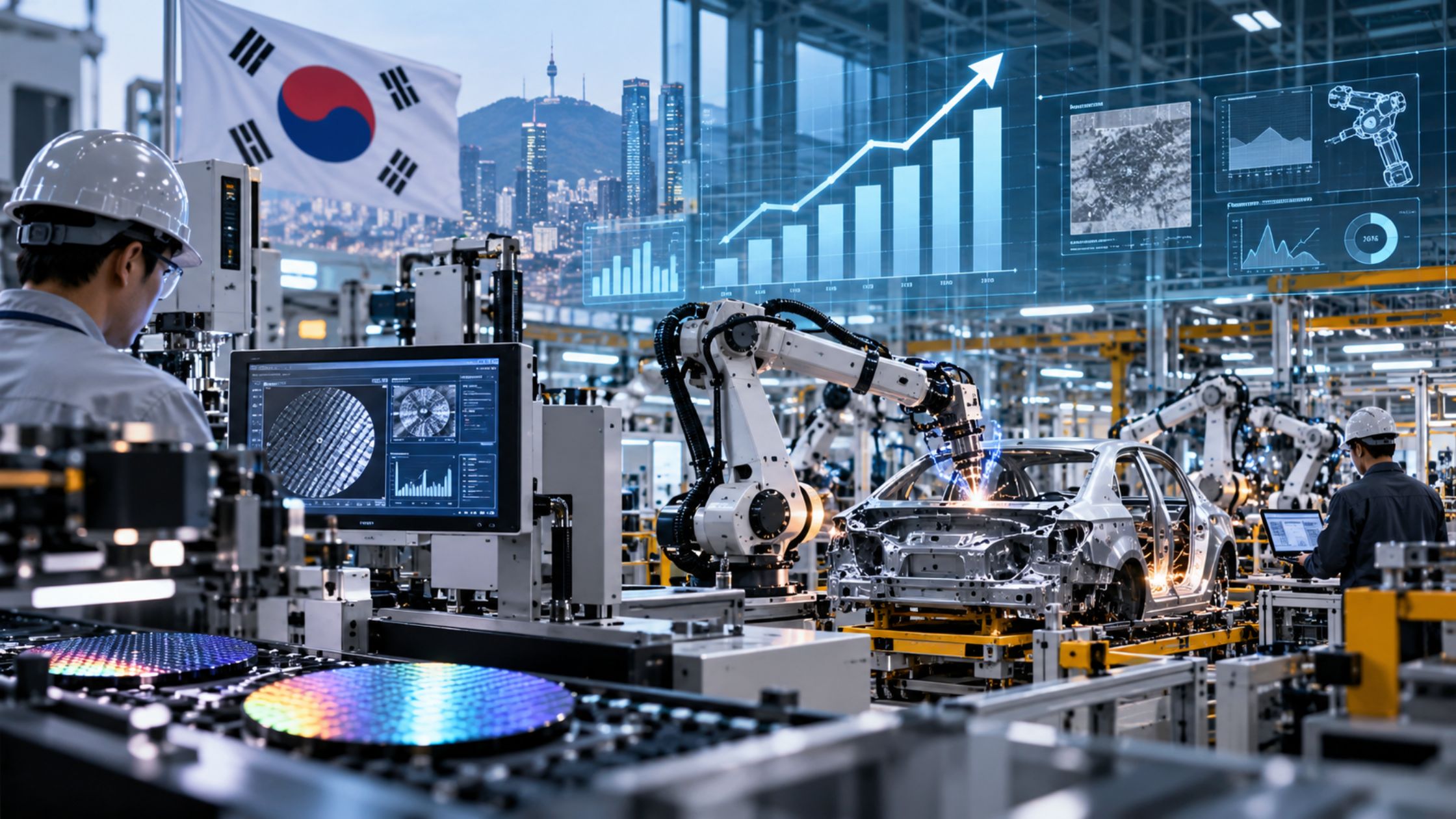
South Korea’s early manufacturing AI projects have reported productivity gains of 30.1% and a 15.5% reduction in defect rates. Scaling these results across an industry where AI adoption remains limited will require more than technology alone.
South Korea’s manufacturing AI transformation is beginning to produce measurable results, but replicating those gains across the wider industrial base remains a significant challenge. The government’s Manufacturing AI Transformation (M.AX) programme has supported AI adoption at more than 170 manufacturing sites. An assessment of 42 early participants that had begun generating measurable results found average productivity gains of 30.1% and a 15.5% reduction in defect rates, according to the Ministry of Trade, Industry and Resources in August 2026. These findings demonstrate the potential of industrial AI, but they do not establish that similar improvements can be achieved across the entire manufacturing sector.
For South Korea, whose industrial competitiveness depends heavily on semiconductors, automotive manufacturing and shipbuilding, the next test is whether successful AI deployments can become repeatable across factories with different production processes, infrastructure and technical capabilities.
From Semiconductor Inspection to Predictive Maintenance
The M.AX programme’s reported results illustrate how AI is being applied to specific manufacturing problems rather than introduced as a general-purpose technology. At semiconductor-related companies, Shinhan Diamond Industrial reduced quality-inspection time for chemical mechanical polishing (CMP) disks by 33% using an AI-based automated inspection system. SurplusGLOBAL, which dismantles semiconductor equipment and recovers reusable components, reported a 66.7% increase in productivity after applying AI to its equipment recovery process.
In automotive manufacturing, Asan Sungwoo Hitech reduced quality-inspection time for electric vehicle battery production by 90% through an autonomous manufacturing system. HWASHIN reported a 20% reduction in product defects after introducing predictive maintenance for battery-case production equipment. HD Hyundai Samho, meanwhile, reported a 50% productivity improvement in a targeted shipbuilding process using AI-based autonomous welding and inspection. These figures represent individual company outcomes reported by the ministry, rather than directly comparable measures of AI performance.
The significance lies in the range of applications. AI can help identify defects, anticipate equipment problems and improve the efficiency of complex production processes. Its value, however, depends on whether these improvements can be sustained and reproduced in other manufacturing environments.
The Adoption Gap Behind the Early Gains
Despite the reported successes, AI adoption across South Korean manufacturing remains limited. A Korea Energy Agency survey of 4,406 manufacturers, conducted between September and November 2025, found that only 6.9% had implemented AI in production processes. Among manufacturers that had not adopted AI, 49.1% cited insufficient capital for system upgrades, 46% identified compatibility problems with existing equipment and processes, and 45.5% pointed to a lack of in-house AI expertise. The findings were reported by the Seoul Economic Daily in February 2026.
These barriers help explain why successful deployments do not automatically translate into widespread adoption. Manufacturers may need to upgrade equipment, integrate disconnected systems and improve the quality of data collected from production lines before AI models can deliver reliable results. Smaller manufacturers face additional constraints when they lack specialist teams to develop, deploy and maintain these systems.
Research by the Korea Institute for Industrial Economics and Trade has similarly highlighted the need to strengthen manufacturing AI infrastructure, improve companies’ ability to identify suitable applications and develop a stronger ecosystem of smart-manufacturing suppliers. The challenge is therefore not simply to develop better AI models. It is to make implementation practical, affordable and repeatable across factories with different levels of digital maturity.
South Korea’s Strategy Moves Beyond Individual Factories
South Korea’s government is attempting to address this challenge by expanding M.AX beyond individual production processes. In June 2026, the Ministry of Trade, Industry and Resources launched initiatives intended to adapt verified industrial AI solutions for similar manufacturing processes and extend AI applications to production planning, supply-chain management, inventory control and worker safety. The government has also set a target of establishing 500 AI factories by 2030.
Another priority is improving access to manufacturing data. In October, the government outlined plans to standardise manufacturing data collection and quality management while developing a national manufacturing data library. The initiative is intended to support AI development while addressing concerns about the exposure of trade secrets and proprietary industrial information.
These measures address an important scaling problem: manufacturers should not have to rebuild every AI application from scratch. Standardised data, reusable solutions and stronger implementation support could help successful applications move across similar processes and industrial sites. Whether these initiatives can overcome differences in equipment, data quality and operational requirements will determine how effectively South Korea translates early results into broader productivity gains.
Can Automated Machine Learning Lower the Barriers?
The challenge also creates opportunities for platforms designed to simplify machine-learning development. Speaking with KoreaTechToday, Berkay Başeski, co-founder of Turkish AI startup MLVisor, identified South Korea’s manufacturing, electronics and automotive sectors as potential areas of interest for the company’s platform. He cautioned, however, that MLVisor has not operated in the Korean market.
“What makes it interesting to us is the combination you mention: strong manufacturing, electronics and automotive sectors produce large amounts of structured data from production lines, quality control, supply chains and sensors, and much of it is sensitive,” Başeski said.
He added that some companies may prefer to keep their data within their own infrastructure rather than transfer it to external cloud services.
“That fits our model. Many of these companies cannot or do not want to send their data to an external cloud service, and our technology can run inside their own infrastructure,” he said.
Başeski identified quality and defect analysis, demand and supply forecasting, and predictive maintenance as potential applications. He also emphasised the need to understand local requirements before determining which use cases matter most.
MLVisor is developing a platform intended to automate machine-learning workflows while allowing customers to retain control over their computing environments. Its commercial deployments are planned for 2027, so its relevance to South Korea remains prospective rather than demonstrated.
Nevertheless, the approach highlights two considerations for industrial AI adoption: reducing the technical work involved in developing models and accommodating manufacturers’ infrastructure and data-security requirements. Neither alone guarantees lower implementation costs or measurable productivity gains.
Scaling Results Will Be the Real Test
South Korea’s early AI factory results provide evidence that AI can improve manufacturing productivity and quality in specific applications. Yet the country’s relatively low adoption rate shows that successful deployments remain far from universal.
The next phase of M.AX will depend on whether manufacturers can overcome investment constraints, improve data infrastructure and develop the capabilities needed to integrate AI into daily operations. Government support and reusable solutions may help, but results will ultimately depend on how well individual applications fit real production environments.
South Korea’s manufacturing AI ambitions will not be measured by the number of factories that install AI alone. They will be measured by whether manufacturers across the industrial base can consistently translate the technology into better productivity, quality and operational performance.