
As Samsung, LG, POSCO and LS accelerate AI strategies, Korea’s next industrial competition is moving beyond software adoption toward physical AI, robotics and increasingly autonomous manufacturing.
South Korea’s AI adoption is accelerating, but its next challenge is turning that adoption into measurable industrial output. According to an AWS report released September 14, 58% of Korean companies were continuously using AI in 2026, up from 48% a year earlier, after about 624,000 companies adopted AI over the previous year. Yet only 18% had launched a new AI-based product or service. Physical AI remains earlier in its development, with only 6% of companies having fully deployed it, while 22% were running pilots and 39% planning future adoption.
That gap helps explain why South Korea’s major industrial groups are now pushing AI deeper into factories, production systems and physical machinery.
The messages coming from Korea’s conglomerates in September were unusually aligned. LG Chairman Koo Kwang-mo told affiliate CEOs on September 16 that AI would be a core determinant of future competitiveness. LG identified four priorities: AI factories, physical AI, semiconductor materials and substrates, and AI transformation. POSCO also reviewed autonomous manufacturing based on physical AI, while LS Chairman Koo Ja-eun urged the group to move faster on AI and use it to improve productivity in offices and manufacturing.
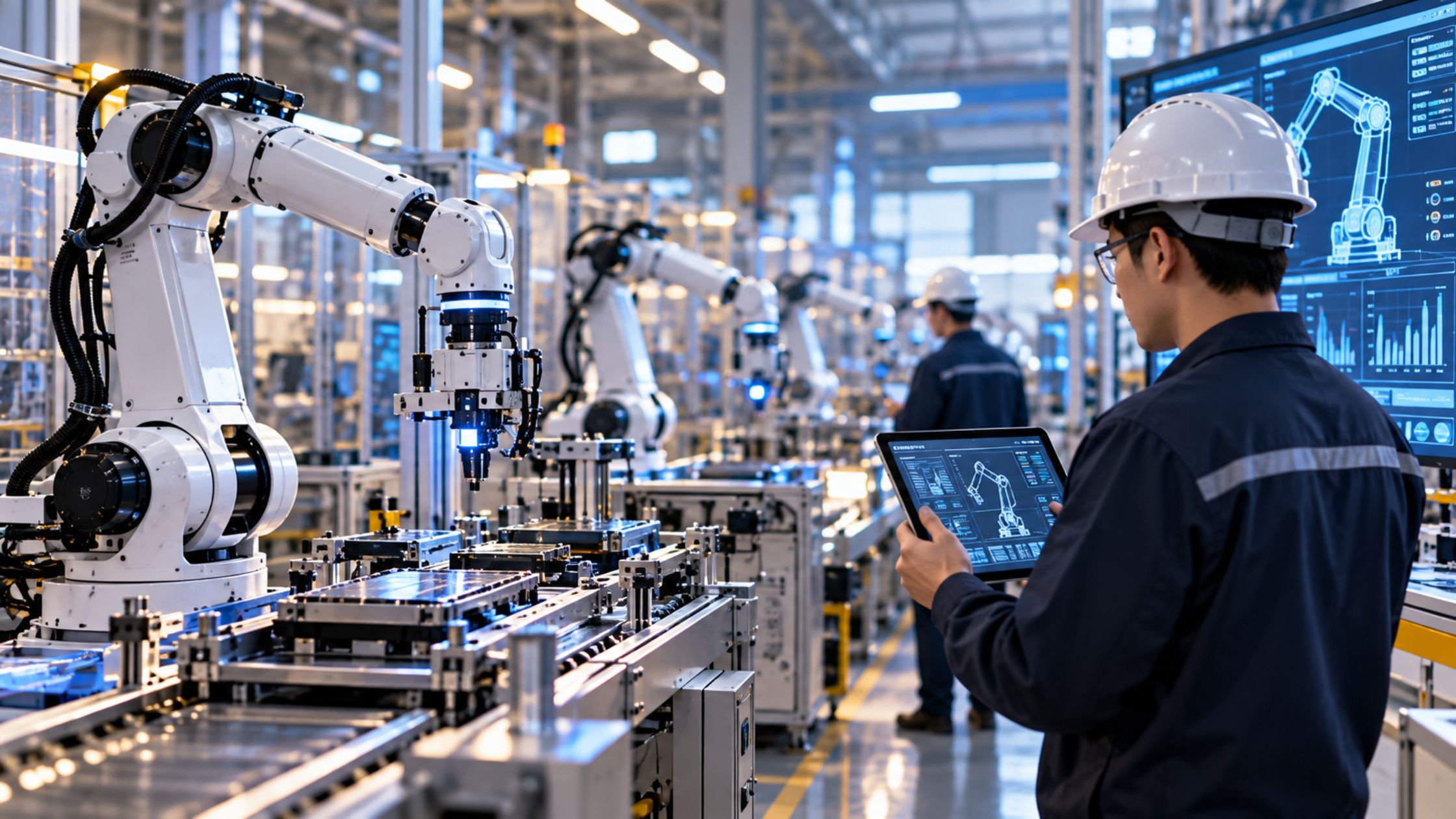
The shift reflects a broader change in what industrial AI is expected to accomplish. Traditional AI transformation has largely focused on software, data analysis and knowledge work. Physical AI brings intelligence into environments where machines must perceive their surroundings, make decisions and act.
For Korea, that transition is particularly significant because the country already has major strengths in manufacturing, semiconductors and robotics. The International Federation of Robotics ranked South Korea first globally in industrial robot density, with 1,220 robots per 10,000 manufacturing employees. The question is therefore no longer whether Korean factories can be automated. It is whether those automated systems can become increasingly autonomous.
Samsung Is Building the Infrastructure for Robot Learning
Samsung Electronics is approaching this transition through both robotics and manufacturing data. In July, Samsung established a dedicated Robotics eXperience Business Development Office under Device eXperience CEO Roh Tae-moon. The company is also planning a robot data factory at its Gumi manufacturing site, using real production environments to generate data for robotics development. Samsung has said its broader objective is to move toward AI autonomous factories by 2030.
Samsung SDS is pursuing a complementary strategy. In September, it formed Team REX, a 10-company robotics alliance spanning hardware, robot intelligence, behavioral data and simulation. The goal is to combine specialized technologies and develop robot configurations suited to individual manufacturing processes rather than relying on a single universal machine.
This points to an important characteristic of physical AI: the competitive advantage may not come from the robot alone. It can come from the entire system connecting data, models, simulation, hardware and factory operations.
LG Is Linking Robots With AI Factories
LG is taking a similarly integrated approach. In August, LG and NVIDIA announced cooperation spanning robots, AI factories and mobility. LG is developing a humanoid reference robot using NVIDIA’s robotics platform, while also preparing to deploy an LG CLOi robot on a washing-machine production line in the United States for real-world validation. The data generated from factory operations is expected to contribute to LG’s robotics development.
The partnership illustrates why AI factories are becoming part of the physical AI discussion. Robots require computing infrastructure, training data, simulation environments and continuous model improvement. Manufacturing facilities can therefore become both places where AI is deployed and environments where AI systems learn.
LG’s strategy also extends beyond robots. The group is combining manufacturing, components, energy, cooling, networking and AI infrastructure capabilities to develop AI factories that can support large-scale computing workloads.
POSCO and LS Show the Broader Industrial Opportunity
The move toward physical AI is not limited to electronics. POSCO DX announced in August that it was transforming into an “AI Native Company,” with physical AI for industrial sites and agentic AI for office environments as its two main pillars. Its physical AI strategy involves robotizing industrial equipment and creating environments where humans, AI and machinery can work together.
LS is taking a similar productivity-focused approach across its industrial businesses. At its September 18 Future Day, the group showcased AI projects including an AI-based cable manufacturing master system and a high-reliability power protection platform for AI data centers. The event focused explicitly on moving from AI experimentation to business results. Together, these examples suggest that Korea’s physical AI race is extending across electronics, steel, energy, logistics and heavy industry.
The Hard Part Is Making Autonomy Work
The enthusiasm around physical AI should not obscure how early the market remains. AWS found that only 6% of Korean companies had fully deployed physical AI as of 2026. The biggest opportunity areas identified included autonomous robots and predictive maintenance, but companies still face barriers around data, infrastructure, skills and proving return on investment.
That makes the current corporate investment significant. Korea is effectively trying to build the conditions for physical AI before adoption becomes widespread.
While conversing with AsiaTechDaily, angel investor Sunay Kumat said,
“There are very, very big opportunities with the AI boom in every sector. So it’s all about identifying those opportunities and addressing them.”
In manufacturing, that opportunity is increasingly about converting existing industrial assets into intelligent systems. Korea already has factories, robots, semiconductor capabilities and extensive manufacturing data. The strategic question is whether companies can combine those assets into systems capable of operating with less human intervention while maintaining reliability, safety and economic efficiency.
Korea’s Next AI Advantage May Be Industrial
The South Korean government is reinforcing this corporate push. In August, it announced plans to invest KRW 2.3 trillion through 2030 in full-stack humanoid development, including support for mass production and plans to purchase 1,080 domestically developed humanoid robots for universities and state-funded research institutions by 2030.
The direction is clear: AI is increasingly being treated as manufacturing infrastructure rather than simply another software capability.
South Korea’s existing advantages in semiconductors, robotics and industrial manufacturing give it a substantial base from which to pursue that transition. But the next phase will depend less on how many companies announce AI initiatives and more on whether those initiatives produce autonomous systems that can work reliably on real factory floors. For Korea’s industrial giants, the AI speed race is therefore becoming a race to make machines not only intelligent, but increasingly capable of acting on that intelligence.