
As South Korea tightens transparency requirements for AI-generated content and virtual endorsers, brands may need new systems to identify, verify and govern synthetic advertising before it reaches consumers.
South Korea’s artificial intelligence policy is entering a new phase. The country’s AI Basic Act now requires providers of generative AI and certain AI-generated outputs to disclose their synthetic nature, while advertising-specific rules introduced in June require AI-generated virtual figures used in recommendation and endorsement advertising to be clearly identified as virtual figures.
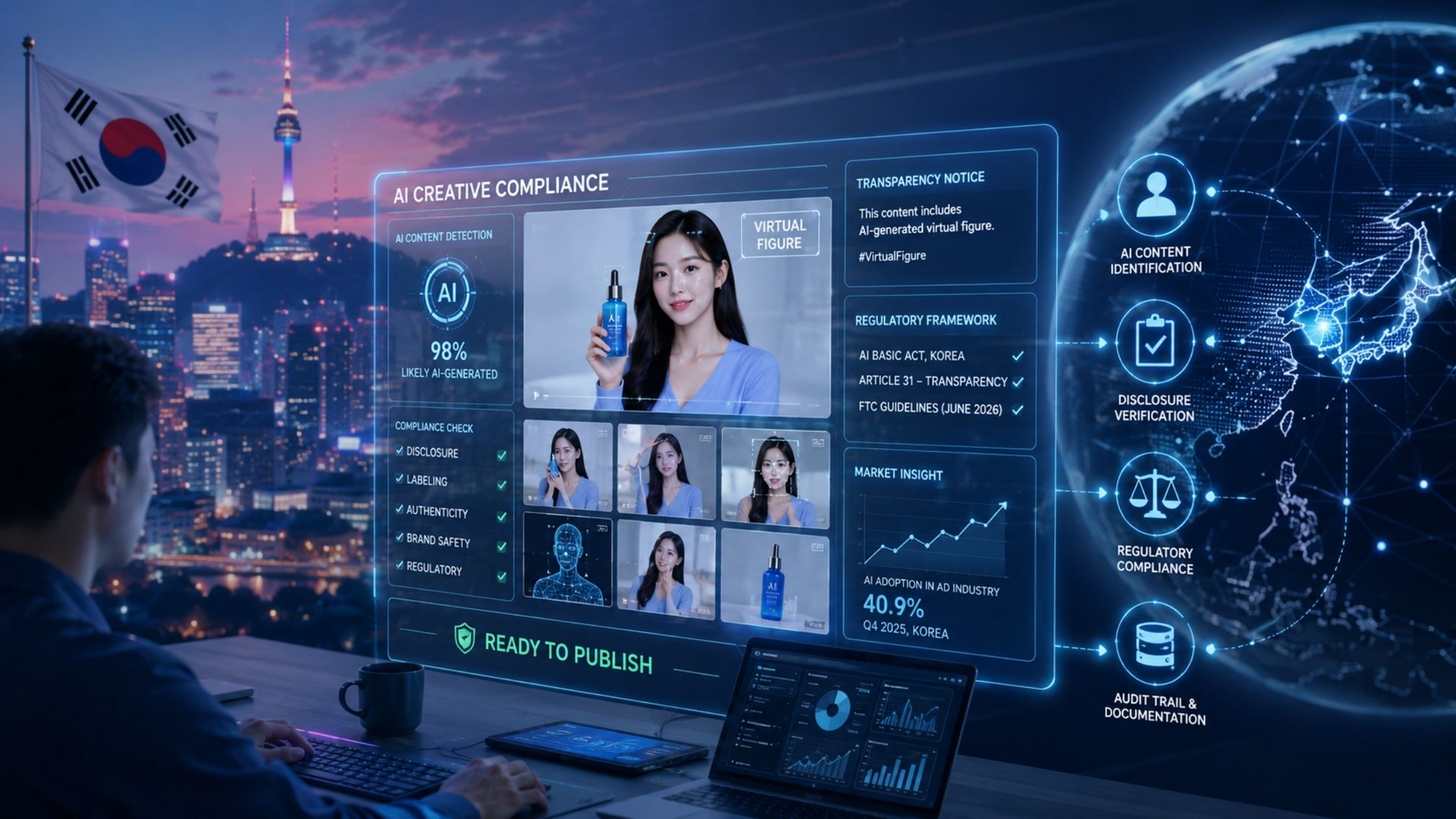
The timing is significant for an advertising industry that is rapidly adopting generative AI. Korea’s content industry reported a 32.1% generative AI adoption rate among businesses in the fourth quarter of 2025, with adoption reaching 40.9% among advertising businesses. Generative AI was being used across production, planning and content creation.
That creates a new problem for advertisers. AI can help produce more campaigns, images, videos and localized variations at lower cost, but each additional piece of synthetic creative can create another question around disclosure, authenticity, brand safety and regulatory compliance.
The result could be a new layer of advertising technology focused not on creating more content, but on determining what can safely and transparently be published.
Atique Bandukwala, founder and CEO of advertising technology company Vidopix, sees South Korea as an especially interesting market because several trends are converging. “The government is putting serious money into AI infrastructure, the consumer base is one of the most digitally engaged anywhere in the world, and the advertising industry there is technically very sharp,” he told KoreaTechToday.
For Korean companies with global ambitions, that combination could make creative compliance an increasingly important technology problem.
Korea is moving from AI adoption to AI accountability
South Korea’s AI Basic Act, which took effect in 2026, establishes specific transparency obligations for generative AI. Article 31 requires AI business operators providing generative AI or products and services using it to indicate that outputs were generated by generative AI. It also requires providers of realistic synthetic audio, images and video that are difficult to distinguish from reality to notify or label users in a way that makes the AI-generated nature clear. The implementing rules provide additional detail on how such notices can be delivered, including through human-readable or machine-readable methods.
For advertising, this matters because the boundary between synthetic media and conventional creative is becoming increasingly difficult to manage manually.
An advertisement can contain an AI-generated person, AI-generated background, synthetic voice, altered product image or an entirely generated video. The regulatory question is not necessarily whether AI was involved somewhere in the production process. It is whether the resulting material falls within a category that requires disclosure and whether the disclosure is sufficiently clear.
That turns AI transparency from a policy principle into an operational task.
Virtual influencers bring the issue into advertising
Korea’s revised Recommendation and Endorsement Advertising Review Guidelines, effective June 1, 2026, provide a concrete example. The guidelines establish rules for AI-generated virtual figures used as recommendation or endorsement subjects and require advertisers to clearly identify them as virtual figures. They also provide examples of disclosure language and placement depending on the advertising medium.
The significance goes beyond virtual influencers. A synthetic person can be designed to look like a doctor, professor, customer or celebrity. If consumers interpret that figure as a real person, the technology can change the meaning of the endorsement itself. That is why advertising regulation is beginning to focus not simply on whether content is technically accurate, but on whether consumers can understand the nature of what they are seeing.
South Korea is not alone in confronting this problem. AI-generated influencers and synthetic endorsements are becoming a global advertising issue as brands use generative systems to create content that can resemble authentic user-generated material. Korea’s difference is that the regulatory framework is moving relatively quickly toward explicit disclosure requirements.
The compliance problem grows as AI scales creative production
For advertisers, the challenge is scale. A traditional campaign might involve a limited number of television commercials, digital assets, social posts and localized versions. Generative AI can dramatically increase the number of possible variations. One campaign can become dozens of versions across markets, languages, platforms and audiences.
Korean global brands face this problem particularly acutely. Companies such as Samsung, Hyundai, Kia and LG operate across markets where creative content has to adapt to different languages, cultural expectations and advertising environments.
Bandukwala argues that this is precisely why Korea is becoming interesting to companies working on creative intelligence.
“The complexity of managing that much content across that many cultural contexts is exactly the kind of problem that pre publish creative intelligence was built to solve,” he said.
The challenge is therefore moving from content production to content governance. A marketing team may need to know not only whether a video is likely to perform well, but whether the creative contains synthetic elements, whether required disclosures are present, whether the content meets local requirements and whether the final version remains compliant after localization. At large creative volumes, relying entirely on manual review becomes increasingly difficult.
From disclosure labels to creative compliance
This is where a potentially new category of advertising technology emerges. A disclosure label is only the visible result of a compliance decision. Behind it is a workflow that may involve identifying AI-generated elements, determining applicable rules, checking the creative and documenting the decision. In an increasingly AI-driven advertising environment, that workflow could eventually look something like:
Create → detect → assess → disclose → verify → document → publish
The important shift is that compliance could move closer to the pre-publish stage. That is different from traditional advertising analytics, where brands often learn whether a campaign worked only after it has already consumed production and media budgets. Vidopix positions its platform around pre-publish creative intelligence, using AI to analyze video frame by frame for signals including attention, emotion and potential drop-off before an advertisement goes live.
Bandukwala believes Korea’s emerging transparency requirements could add another reason for brands to adopt such systems.
“A lot of people look at that as a regulatory burden, but I see it as an accelerant,” he said. “Once you tell brands that they have to be transparent about what is synthetic and what is not, they immediately need tools that can flag, verify, and document all of that before the content goes live.”
His argument points to a broader opportunity, although regulation itself does not mandate the use of creative-compliance software. The potential market is created by the operational complexity that regulation introduces.
Korea’s advertising market is already deeply digital. One industry estimate puts the country’s digital advertising revenue at about $7 billion in 2025, with video identified as the fastest-growing format through 2033. At the same time, Korean content businesses are rapidly incorporating generative AI. Advertising was among the sectors with the highest adoption in the latest KOCCA data, with 40.9% of advertising businesses reporting generative AI use in the fourth quarter of 2025.
The combination matters because AI-generated advertising is not developing in isolation. Korean companies are using AI while simultaneously expanding their international campaigns. That creates a complicated compliance environment. A campaign designed in Seoul may be adapted for consumers in the United States, Europe, Japan, Southeast Asia and other markets, each with different approaches to AI disclosure, endorsements, consumer protection and advertising standards.
A Korean advertising technology ecosystem therefore has an opportunity to develop around a problem that is both domestic and international. Bandukwala believes this global dimension is one reason Korea deserves attention.
“South Korea is fascinating to watch right now because you have so many things converging at once,” he said.
But AI cannot automatically become the compliance officer
There is an important limit to the creative-compliance thesis. Detecting that an image or video was generated by AI is not the same as determining whether an advertisement is legally compliant. Nor is an AI prediction of attention or emotion equivalent to a legal assessment. The regulatory environment is also not uniform. A disclosure that satisfies Korean requirements may not necessarily satisfy rules in another market. Advertising claims, influencer disclosures, privacy requirements and consumer-protection standards can vary significantly between jurisdictions.
This means AI tools are more likely to become compliance infrastructure that supports human decision-making than a replacement for legal and regulatory teams.
There is also a technical challenge. As generative models improve, distinguishing synthetic from human-created material can become harder. An automated system that incorrectly flags legitimate content could slow creative workflows, while one that misses synthetic content could create compliance risk. For that reason, the value of creative intelligence will depend not only on detection accuracy, but on how well the technology integrates with existing review processes.
Regulation could reshape the advertising workflow
The deeper implication of Korea’s AI rules is that compliance may increasingly have to happen throughout the creative process rather than at the very end. Consider a campaign that begins with an AI-generated virtual spokesperson. The agency then creates multiple language versions, changes the background, generates new product demonstrations and adapts the video for different social platforms.
Each modification creates another potential review point. That makes a centralized system for identifying synthetic elements and maintaining an audit trail potentially valuable. It also creates a new question for advertising agencies: who owns AI compliance? It could sit with legal teams, creative teams, brand-safety teams, marketing operations or a combination of all four. The companies that solve this organizational problem could have an advantage over those that treat AI disclosure as simply another label added before publication.
Korea could become an early market for creative governance
South Korea’s appeal lies in the convergence of several forces. Its government is building a national AI ecosystem while imposing greater transparency around AI-generated outputs. Its advertising industry is adopting generative AI at significant rates. Its consumers are highly digital, and its largest brands operate across global markets.
That creates a useful test case for what happens when AI-generated advertising meets regulation at scale.
The opportunity is not necessarily limited to identifying AI-generated content. Creative intelligence could eventually combine several functions: performance testing, cultural and linguistic review, brand-safety checks, disclosure verification and documentation.
Vidopix is approaching the problem from the pre-publish side, but the larger market question extends beyond any single company.
If AI makes it possible for brands to produce thousands of creative variations, the next challenge may be making sure those thousands of variations can be governed. The first phase of AI in advertising was largely about generation. Generate the image. Write the copy. Produce the video. Create another version for another market. The next phase could be about control.
As South Korea’s AI Basic Act establishes broader transparency requirements and advertising rules begin explicitly addressing AI-generated virtual figures, brands will have to think more carefully about what they publish and how they disclose it.
That does not mean regulation will automatically create a new software market. But it does create a problem that becomes increasingly difficult to solve manually as AI-generated creative scales. For Korean brands, the challenge is particularly significant. They are not only experimenting with AI. Many are producing advertising for global audiences, where creative decisions must survive differences in language, culture, platform rules and regulation.
As Bandukwala told KoreaTechToday, “The need for intelligence that works across languages and cultural contexts” is likely to grow as Korean brands expand globally. The bigger question is whether that intelligence will remain a collection of manual checks or become a formal layer of the advertising technology stack. If AI is going to make advertising easier to generate, Korea’s emerging regulatory framework may help make creative governance just as important as creative generation