
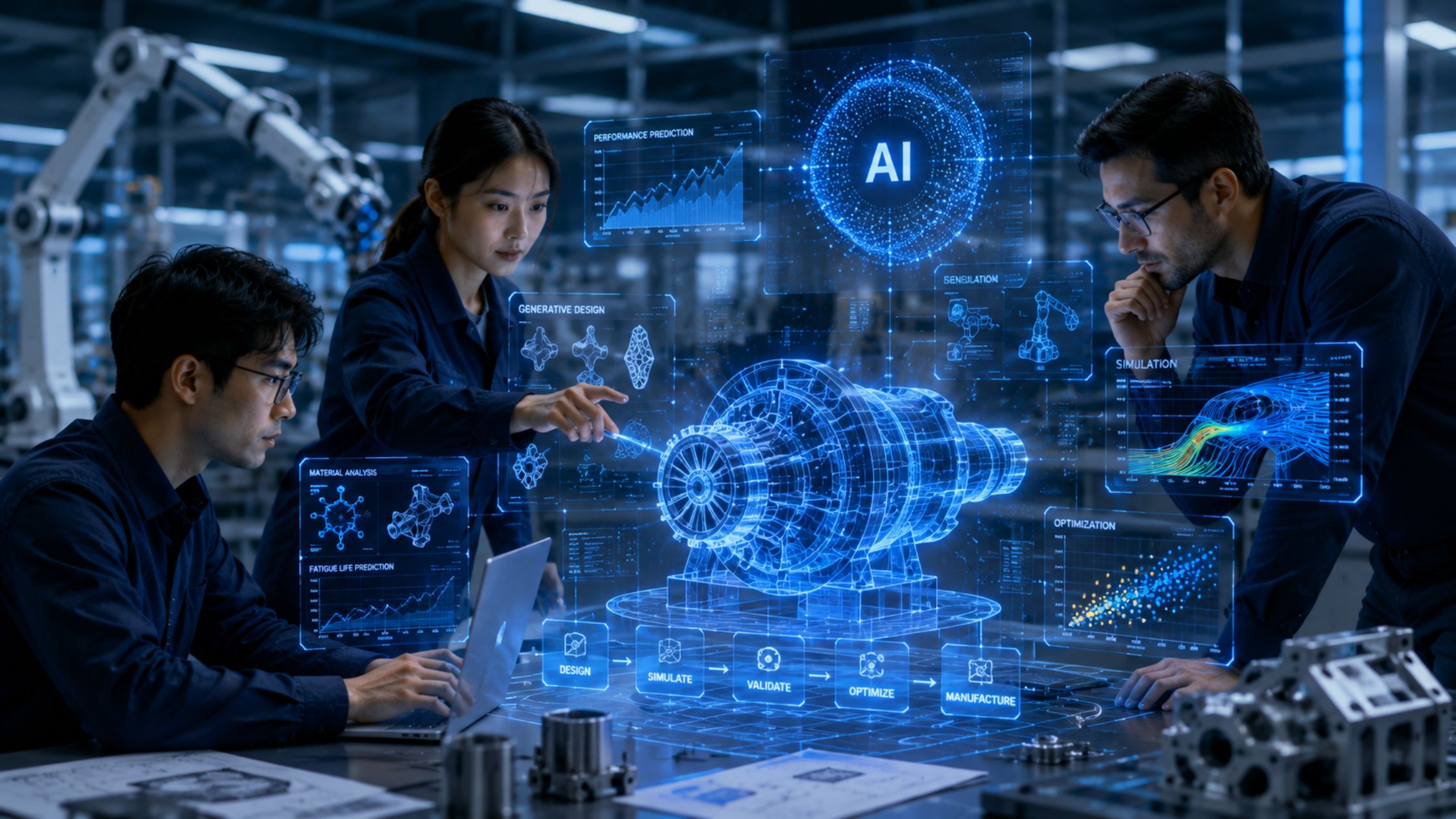
As manufacturers move beyond isolated AI pilots, engineering intelligence is emerging as the next frontier of industrial transformation, positioning South Korea’s automotive, shipbuilding, semiconductor, and advanced manufacturing sectors for a new phase of AI-driven innovation.
Artificial intelligence has become a strategic priority across South Korea’s industrial economy. From the government’s multibillion-dollar AI investment plans to growing adoption across manufacturing, semiconductors, mobility, and robotics, the country is positioning itself to lead the next generation of industrial innovation. Much of the public conversation, however, has focused on generative AI applications such as chatbots, coding assistants, and enterprise productivity tools. Inside engineering departments, a quieter but potentially more transformative shift is already underway.
Manufacturers are increasingly embedding AI directly into product development, allowing engineers to accelerate simulation, optimize complex designs, and shorten development cycles before physical prototypes are ever built. This represents an important evolution in enterprise AI. Rather than functioning as a standalone software application, AI is becoming part of the engineering process itself, continuously supporting design decisions throughout a product’s lifecycle.
For South Korea, the implications are particularly significant. The country’s global competitiveness rests on industries where engineering excellence determines commercial success. Automotive manufacturers are developing software-defined vehicles, shipbuilders are adopting digital shipyard technologies, semiconductor companies are designing increasingly complex AI chips, and industrial manufacturers are integrating digital twins into production. Across these sectors, engineering has become one of the most valuable sources of competitive advantage. As AI becomes embedded within engineering workflows, it could reshape not only how products are designed, but also how Korea maintains its leadership in advanced manufacturing.
Manufacturing is entering the era of intelligent engineering
Industrial companies have spent decades digitizing engineering operations. Computer-aided design, simulation software, product lifecycle management platforms, and digital engineering systems have transformed how products are conceived and validated. Yet despite this digital foundation, many engineering processes have remained sequential. Design teams create concepts, simulation specialists validate them, engineers refine the designs, and testing continues through multiple iterations before production begins.
Artificial intelligence is beginning to change that workflow. Instead of simply digitizing engineering information, AI is helping organizations interpret engineering data, predict performance outcomes, recommend design improvements, and significantly reduce the number of development iterations required to reach an optimized product.
Industry analysts increasingly describe this as one of the next major phases of enterprise AI adoption. While the first wave of generative AI focused on knowledge work and software development, industrial AI is moving much closer to the products companies manufacture. Engineering intelligence is becoming an operational capability rather than an experimental technology.
South Korea’s industrial strengths make it well positioned
Few countries possess the industrial profile that South Korea brings to this transition. The country’s leading industries generate enormous volumes of engineering data through product design, simulation, testing, manufacturing, and lifecycle management.
Automotive companies such as Hyundai Motor Group and Kia continue investing heavily in software-defined vehicles, battery technologies, and virtual engineering environments. Shipbuilders including Hanwha Ocean, HD Hyundai, and Samsung Heavy Industries are expanding digital shipyard initiatives while integrating AI into vessel design and operational efficiency. Semiconductor leaders Samsung Electronics and SK hynix increasingly rely on AI-assisted design tools as chip architectures become more complex.
These industries share one characteristic: engineering decisions directly influence product quality, manufacturing costs, safety, sustainability, and time-to-market. Unlike office productivity software, where AI primarily improves administrative efficiency, engineering AI has the potential to influence the physical products themselves. That distinction explains why manufacturers are beginning to move beyond isolated AI experiments.
AI is becoming an engineering capability
During a conversation with KoreaTechToday, Pierre Baqué, CEO and Co-Founder of Neural Concept, said manufacturers are entering a fundamentally different stage of AI adoption.
“The shift we’re seeing is from digital engineering to intelligent engineering. Companies spent the last 30 years digitizing their processes, CAD, simulation, PLM, but those tools remained fragmented. Design, simulation, and validation stayed sequential, siloed, slow. Now, AI makes those loops continuous.
What also unlocked production-scale deployment is that AI finally solved a problem that killed automation for decades: adaptiveness. Every time a product changed, rigid automation broke. AI learns from the product as it evolves, and that’s what makes scaling viable beyond the pilot. The question has shifted from ‘should we try AI?’ to ‘how do we own this capability across the enterprise?'”
His observations highlight an important transition taking place across industrial AI. For years, manufacturers approached AI through limited pilot projects designed to test isolated use cases. Today, many organizations are instead exploring how AI can become part of core engineering operations, supporting continuous decision-making throughout product development rather than functioning as a standalone automation tool.
This distinction is particularly relevant for sectors where every design iteration carries significant cost implications. Reducing simulation time, minimizing late-stage redesigns, and accelerating engineering validation can have measurable effects on product competitiveness.
Engineering workflows matter more than standalone AI tools
Successful industrial AI deployment depends not only on the sophistication of AI models but also on how seamlessly they integrate into existing engineering environments. Large manufacturers have spent decades investing in specialized engineering ecosystems built around CAD platforms, computer-aided engineering, simulation software, product lifecycle management systems, and manufacturing execution platforms. Replacing those environments would be both operationally disruptive and economically impractical.
Instead, companies increasingly seek AI technologies that complement existing workflows rather than requiring entirely new ones. That is particularly relevant in South Korea, where engineering organizations often operate across highly interconnected ecosystems involving original equipment manufacturers, Tier 1 suppliers, component manufacturers, research organizations, and production partners.
Embedding intelligence into those existing workflows allows AI to strengthen engineering capability without disrupting established development processes. As AI adoption matures, competitive advantage is likely to depend less on deploying individual AI applications and more on integrating intelligence across the entire engineering lifecycle.
Korea’s next AI advantage may be built inside engineering
South Korea’s leadership in manufacturing has traditionally been driven by engineering expertise, production quality, and continuous innovation. Artificial intelligence has the potential to amplify those strengths rather than replace them.
Several trends are beginning to converge:
- AI is accelerating simulation, validation, and product optimization.
- Engineering organizations are shifting from isolated AI pilots to enterprise-wide deployment.
- Digital twins and virtual engineering environments are becoming standard across industrial sectors.
- AI is increasingly integrated into existing engineering infrastructure instead of operating as separate software.
- Competitive advantage is shifting toward organizations capable of continuously improving engineering decisions through AI.
For Korean manufacturers, these developments represent more than another technology upgrade. They point toward a new operating model where engineering itself becomes increasingly intelligent.
The next industrial transformation will begin long before production
Much of the global AI conversation continues to focus on how artificial intelligence improves productivity inside offices or automates routine business processes. Manufacturing tells a different story. The greatest impact of AI may occur long before products reach the factory floor. It begins when engineers evaluate thousands of design possibilities, simulate complex physical behavior, optimize performance, and make decisions that ultimately determine product quality, safety, sustainability, and cost.
South Korea enters this transition from a position of considerable strength. Its globally competitive automotive, semiconductor, shipbuilding, electronics, and advanced manufacturing industries already possess the engineering depth, industrial data, and digital infrastructure necessary to support intelligent engineering at scale.
As manufacturers move beyond experimental AI projects toward enterprise-wide deployment, the question is no longer whether artificial intelligence belongs inside engineering organizations. Increasingly, it is becoming part of the engineering team itself. For South Korea, that evolution could strengthen one of the country’s most enduring competitive advantages: its ability to transform engineering excellence into global industrial leadership.