
By raising subsidy limits for regional investments, Seoul is trying to offset higher infrastructure costs and ease concentration in the capital. The shift signals a recalibration of industrial policy as advanced manufacturing becomes more capital- and resource-intensive.
The South Korean government is preparing to significantly increase state support for high-tech companies that invest outside the Seoul metropolitan area, as part of a broader effort to rebalance industrial growth and ease structural constraints around the capital. The plan was outlined by the Ministry of Economy and Finance during a joint policy meeting with the Ministry of Trade, Industry and Energy, attended by representatives from sectors such as semiconductors, batteries, robotics, and biotechnology.
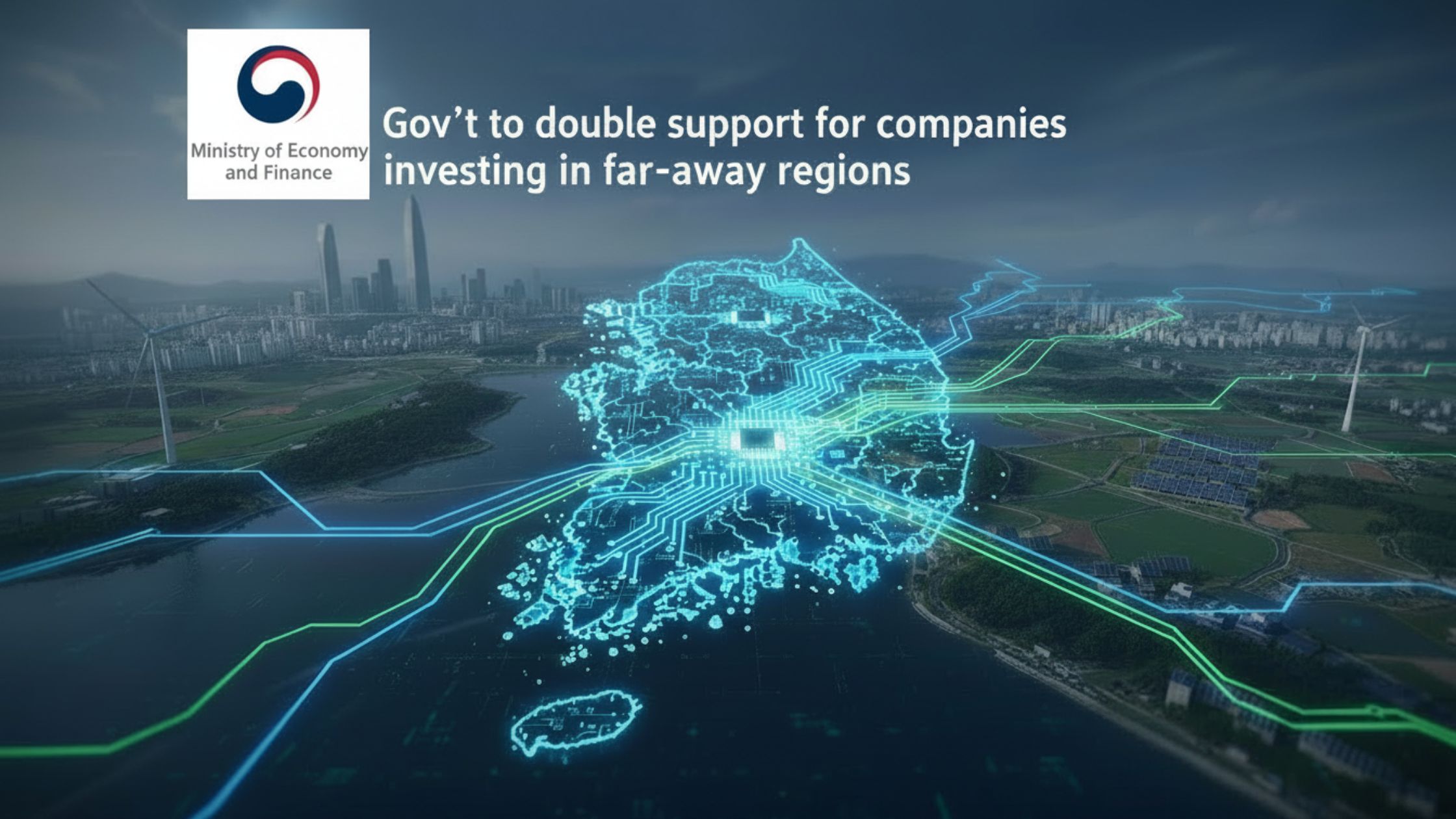
At the centre of the proposal is a revised subsidy framework that increases government support the farther an investment is located from Seoul. Speaking at a fiscal support roundtable in Seoul, Cho Yong-beom, budget director at the finance ministry, said the government is reviewing a plan to double the current ceiling on infrastructure funding for companies operating in National Advanced Strategic Industry Specialized Complexes. The cap could be raised from 100 billion won ($70 million) to 200 billion won, covering up to 30–50% of total project costs for eligible regional investments.
Officials say the policy is designed to offset the higher upfront costs companies face when building advanced manufacturing facilities outside the capital region. While Seoul and its surrounding areas offer established infrastructure and dense supply chains, provincial regions often require companies to invest heavily in basic facilities before operations can begin.
Under the revised plan, government support would cover core infrastructure such as roads, water facilities, and on-site power substations. By reducing these early-stage expenses, policymakers aim to narrow the economic gap between capital and regional locations and make non-capital investments more financially viable for high-tech firms.
Why the government is acting now
There remains a growing concern within the government that excessive concentration around Seoul has become a constraint rather than an advantage. Advanced industries such as semiconductors, secondary batteries, and biotechnology are capital-intensive and require large sites, stable power supply, and long-term planning—conditions that are increasingly difficult to meet in and around the capital due to rising land prices, energy constraints, and regulatory limits.
At the same time, global competition for strategic industries has intensified. Countries such as the United States, Japan, and members of the European Union have expanded state support for high-tech manufacturing through large-scale subsidy programmes. Korean policymakers see stronger domestic incentives as necessary to retain future investments while steering them toward regional locations.
Approval process and implementation
Final decisions on eligible investment 규모 and subsidy limits will be determined by the National Advanced Strategic Industry Committee, led by the prime minister. The review process is scheduled to conclude in the first half of the year, after which approved projects will qualify for infrastructure support under the expanded funding cap.
Officials noted that subsidies will not be automatic and will depend on factors such as project size, strategic importance, and location, signalling an effort to balance fiscal discipline with stronger regional incentives.
The proposal also aligns with recent legislative changes. Following the passage of the Semiconductor Special Act earlier this year, the government plans to introduce follow-up measures, including the creation of a dedicated semiconductor special account to support long-term investment in the sector.
During the same meeting, the finance ministry presented its four major fiscal investment directions for 2027. These include full-cycle support for advanced industries, expansion of regional growth bases by attracting anchor companies, and development of specialized local industrial clusters.
Beyond subsidies: building sustainable regional clusters
Officials stressed that infrastructure support is intended as a foundation rather than a standalone incentive. The government also plans to promote manufacturing AI transformation and develop renewable energy-based industrial complexes to attract companies committed to operating on 100% renewable energy.
“Fiscal policy is a key instrument supporting both global competitiveness and region-led growth,” Cho said, adding that sector-specific consultations will continue to refine support measures based on industry feedback.
The roundtable brought together officials from the industry ministry, representatives from 13 industry associations spanning semiconductors to shipbuilding, and researchers from the Korea Institute for Industrial Economics & Trade. The finance ministry said it will continue on-site consultations as part of efforts to reflect field-level input in future budget planning.
What this could mean for regional economies
If implemented as planned, the expanded subsidy framework could have a material impact on how and where high-tech investments are distributed across South Korea. Regions such as Gyeongsangnam-do, Chungcheongbuk-do, and parts of Jeollanam-do—which have been designated for advanced industrial complexes but lag behind the capital in infrastructure readiness—are likely to be among the primary beneficiaries.
These areas already host or plan to host semiconductor materials suppliers, battery component manufacturers, and biotechnology facilities, but have struggled to attract large anchor investments due to higher upfront development costs. By absorbing a larger share of infrastructure spending, the government is effectively lowering the barrier for companies to commit to these regions at scale.