
The ATHENA white paper outlines how automation, cloud and zero-trust security could reshape next-generation telecom infrastructure.
South Korean carrier SK Telecom has published its third annual 6G white paper, titled “ATHENA,” laying out a mid- to long-term strategy for future network evolution beyond 2030. The framework is designed to guide the transformation of communication infrastructure for the emerging AI era, where networks are expected to support not just connectivity but intelligent services at scale. SK Telecom plans to highlight select technologies aligned with this vision at MWC26 in Barcelona.
Unlike earlier editions that focused on standardisation requirements and early AI impacts, the ATHENA paper consolidates a broad architectural vision that positions AI at the core of both network operations and the services the network will support. It reflects a broader shift among telecom operators from traditional connectivity provision toward AI-centric infrastructure design.
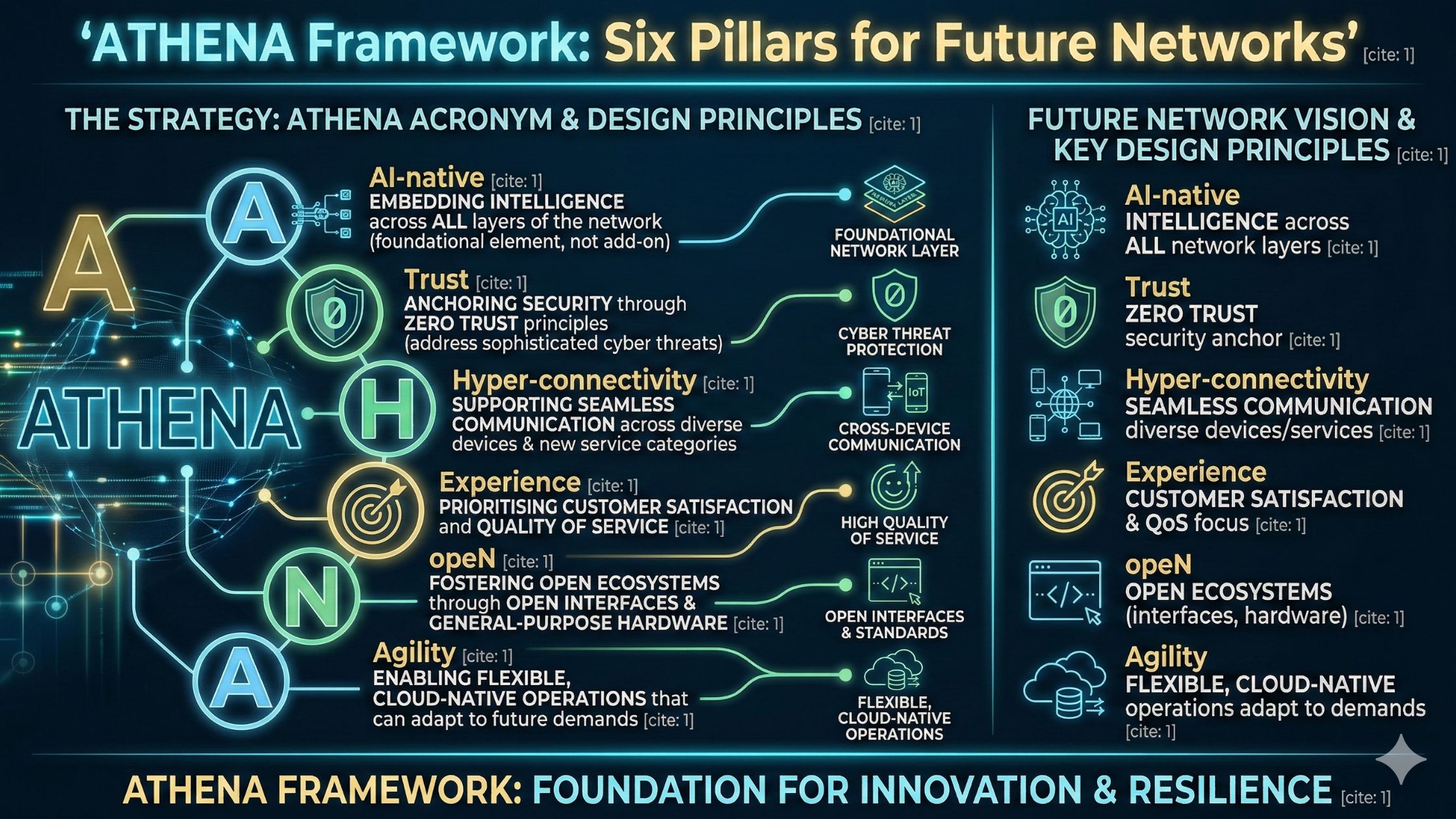
ATHENA Framework: Six Pillars for Future Networks
At the heart of the strategy is the ATHENA acronym, representing six core pillars: AI-native, Trust, Hyper-connectivity, Experience, opeN, and Agility. These concepts define key design principles for the carrier’s future network vision:
- AI-native: Embedding intelligence across all layers of the network, not as an add-on but as a foundational element.
- Trust: Anchoring security through Zero Trust principles to address increasingly sophisticated cyber threats.
- Hyper-connectivity: Supporting seamless communication across diverse devices and new service categories.
- Experience: Prioritising customer satisfaction and quality of service.
- opeN: Fostering open ecosystems through open interfaces and general-purpose hardware.
- Agility: Enabling flexible, cloud-native operations that can adapt to future demands.
Together, these pillars reflect a holistic network philosophy — one that goes beyond incremental upgrades and extends to autonomous, flexible and secure network operations.
Dual AI Strategy: “AI for Networks” and “Networks for AI”
A central analytical insight of SK Telecom’s vision is its two-fold view of AI:
- AI for Networks: Using AI to analyse data in real time, make decisions and autonomously optimise network performance. Examples include predictive traffic management and self-healing functions.
- Networks for AI: Adapting network architecture to efficiently support AI-heavy services, such as immersive applications, robotics and satellite connectivity, which require new levels of bandwidth, latency and reliability.
This dual approach signals a strategic pivot from simply applying AI to network operations toward designing networks that inherently support AI-driven services — a distinction that may define leadership in the 6G era.
Architectural Evolution Across Domains
The ATHENA paper outlines structural evolution across key network domains:
- Radio Access Network (RAN): Evolving toward AI-driven autonomous optimisation, enabled by virtualisation and open interfaces. This moves RAN from static, hardware-centric implementation toward a more adaptive, intelligent layer.
- Core and Transport Networks: Transitioning to cloud-native platforms where AI manages traffic flows, detects anomalies and supports efficient control mechanisms.
- Network Data Platform: Positioned as a central hub that aggregates telecommunications data to fuel personalised AI services and analytics.
This domain-by-domain breakdown illustrates SK Telecom’s belief that the next generation network will be defined by its ability to self-regulate, self-optimise and self-secure in real time.
Security features prominently in ATHENA’s strategy. SK Telecom emphasises a Zero Trust model, where every access request and data flow is continuously verified rather than implicitly trusted — an approach considered necessary as networks become more open and distributed.
The white paper also stresses infrastructure convergence: moving away from siloed generation-specific networks toward a unified platform capable of supporting 5G, future 6G and non-terrestrial networks such as satellite systems. Openness is further highlighted through commitments to general-purpose hardware and open-source technologies, which are expected to lower barriers for ecosystem partners.
Aligning with Global Standards
SK Telecom is not only publishing its strategic vision but also working to ensure it influences international standards. The company participates actively in major bodies such as the 3rd Generation Partnership Project (3GPP), the International Telecommunication Union (ITU) and the O-RAN Alliance — organisations that play central roles in setting global telecom standards.
Notably, SK Telecom has been elected to the board of the AI-RAN Alliance, reinforcing its participation in shaping how AI and wireless access technologies converge in next-generation networks.
MWC26: Showcasing Future Technologies
At MWC26, SK Telecom plans to demonstrate technologies that reflect its ATHENA vision, including AI agents for network operations, AI-RAN technologies that combine communication and intelligence, on-device AI antenna optimisation, and integrated communication and sensing systems. These demonstrations signal early, tangible steps toward the long-term goals outlined in the white paper.
Looking Ahead: Strategy Anchored in Innovation
SK Telecom’s ATHENA strategy reveals a carrier seeking to redefine its role in future connectivity landscapes. By strategically aligning AI, security and openness with customer value, the operator is betting on networks that are autonomous, adaptive and capable of supporting services beyond today’s imagination. As Yu Takki, Head of Network Technology Office at SK Telecom, put it: “Despite uncertainties in the 6G era, we will continue to create new growth opportunities by leading the evolution of future communication infrastructure over the next decade, prioritising customer value and combining AI, virtualisation, openness and Zero Trust security.”