
The investment highlights how AI demand and geopolitics are reshaping global semiconductor strategies
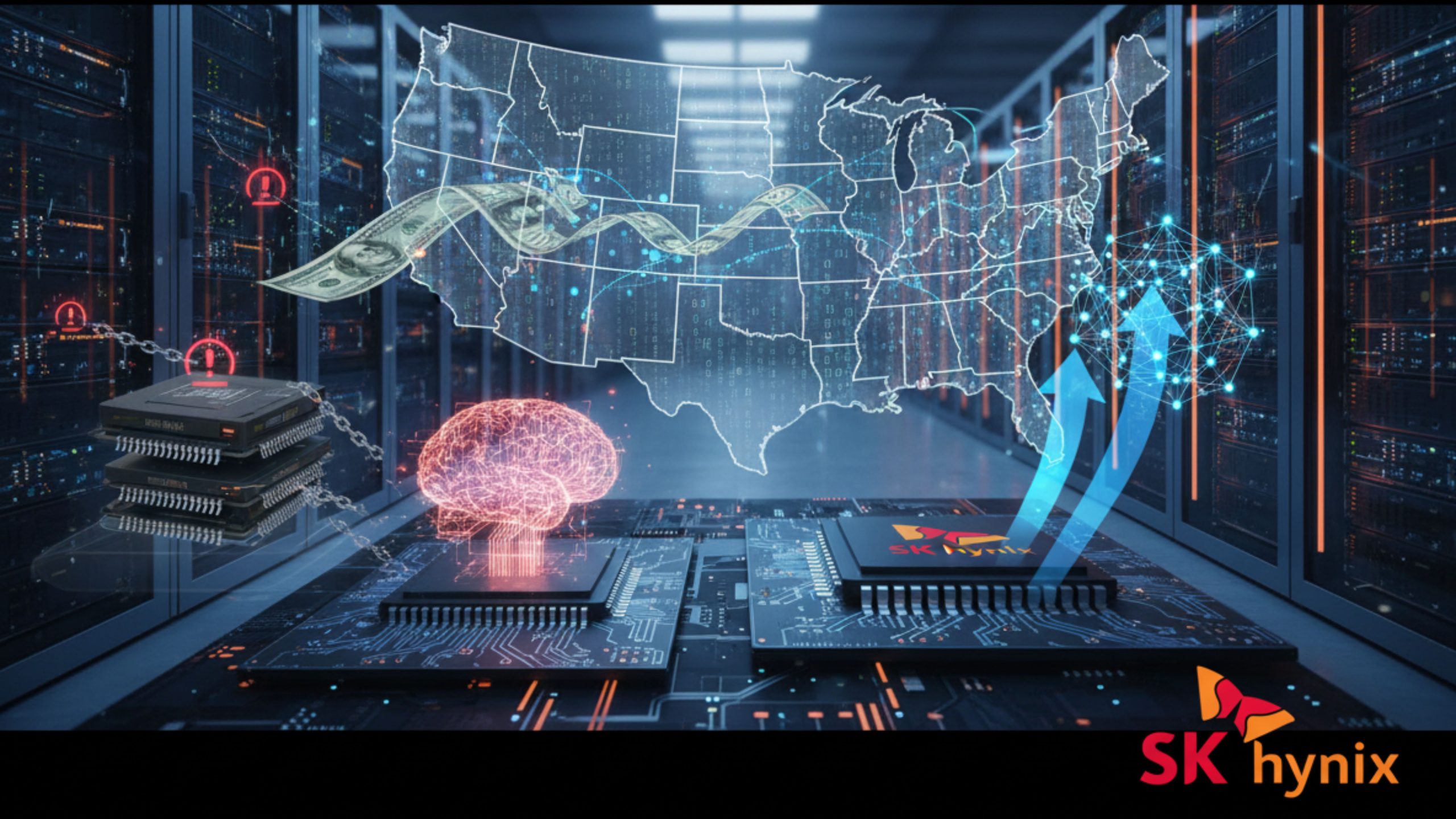
SK Hynix said on Wednesday that it will establish a new U.S.-based company dedicated to artificial intelligence solutions, committing at least $10 billion to the effort. It takes the company’s traditional role as a memory chip supplier, as it seeks to capture new growth opportunities tied to the rapid expansion of AI infrastructure.
The new entity, tentatively named “AI Co.,” will serve as a central hub for SK Group’s AI strategy, coordinating development and deployment of AI-related technologies in global markets. The company said the decision reflects both rising demand for AI-related memory and the strategic importance of the United States, where supply constraints, pricing pressure, and trade policy are increasingly shaping the semiconductor industry.
SK Hynix’s rising profile in artificial intelligence is largely built on its strength in high-bandwidth memory (HBM), a specialised memory technology required for large-scale AI training and inference. Because HBM is closely coupled with advanced AI processors, including chips from Nvidia, limited supply has emerged as a key constraint as cloud operators and AI developers rapidly scale their systems.
As AI investment accelerates, shortages across the memory supply chain have intensified. This has shifted pricing power toward leading producers, elevating the strategic value of companies that can deliver advanced memory at scale.
Earnings reflect pressure in the memory supply chain
The impact of these supply constraints was reflected in SK Hynix’s latest earnings. On the same day it announced the U.S. AI investment, the company reported fourth-quarter results that beat market expectations, supported by higher memory prices amid limited supply.
The results underscored how the current AI-driven cycle differs from past semiconductor booms, which were often tied to consumer electronics. This time, growth is being led by data centres and AI workloads, reinforcing the importance of advanced memory and packaging technologies.
Solidigm restructuring underpins new AI entity
As part of the plan, SK Hynix will reorganise Solidigm, its California-based enterprise SSD unit established in 2021. The existing storage business will be moved into a newly formed entity, Solidigm Inc., while the new U.S. AI company takes shape as a separate platform focused on AI-related activities.
By separating the two operations, SK Hynix aims to give the AI entity greater operational independence, making it easier to pursue AI-focused development and investment without being constrained by its legacy storage business. The company said the $10 billion commitment will be deployed in stages through a capital-call structure, with spending increasing as projects progress. It also plans to seek strategic investments in U.S.-based AI companies alongside internal development.
Trade policy adds urgency to U.S. expansion
The decision to anchor the AI strategy in the United States also reflects political and trade considerations. The administration of U.S. President Donald Trump has warned that foreign semiconductor makers could face tariffs unless they expand manufacturing and research activities on U.S. soil.
For companies like SK Hynix, large-scale U.S. investment has become both a commercial and strategic necessity, helping to secure market access while reducing exposure to trade-related risks.
Building capacity at home and abroad
SK Hynix already has a major U.S. project underway. The company is building a $3.87 billion advanced chip packaging and research facility in Indiana, announced in 2024, with operations expected to begin in 2028. The site will produce high-bandwidth memory for AI applications.
At the same time, SK Hynix has committed nearly $13 billion to advanced chip packaging facilities in South Korea. Together, these investments reflect a dual-track strategy that strengthens domestic manufacturing while expanding its footprint in the United States.
A response to converging pressures
Taken together, the U.S. AI investment highlights how SK Hynix is responding to a convergence of forces: surging AI demand, persistent memory shortages, and shifting trade dynamics. By establishing a dedicated AI hub in the United States, the company is positioning itself closer to key customers and policymakers, while seeking to move further up the value chain.
As competition intensifies among memory makers and AI infrastructure providers, SK Hynix’s strategy suggests an ambition to evolve from a critical component supplier into a broader strategic partner in the global AI ecosystem.