
AI-based monitoring and real-time data sharing form the core of a new public-private anti-fraud framework.
Naver announced on 24 February that it has signed a memorandum of understanding (MOU) with the Korean National Police Agency to strengthen preventative efforts against telecommunication-based financial fraud. The agreement focuses on coordinated action against increasingly complex scam tactics — including voice phishing and fraudulent investment chat rooms — that are spreading across online platforms in South Korea.
The agreement was formalised at the Seoul Metropolitan Police Agency’s Integrated Response Unit, where Naver Chief Risk Officer Yoo Bong-seok and Shin Hyo-seop, who leads the police task force on telecommunication financial fraud, were present along with other officials. The partnership reflects a broader effort to strengthen coordination between major online platforms and law enforcement in addressing digital financial crimes.
Rising Threat of Online Financial Scams
Voice phishing and investment scam chat rooms have rapidly evolved beyond traditional phone-based fraud, increasingly exploiting online communities, messaging services and digital platforms to deceive users. This trend has prompted authorities and tech firms to explore technical and organisational responses, rather than conventional public awareness campaigns alone.
As crime methods change in sophistication and scope, law enforcement sees platform operators as essential partners for pre-emptive detection and disruption. Naver’s cooperation with the Police Agency is part of broader national efforts to adapt anti-fraud strategies to the realities of a connected digital economy.
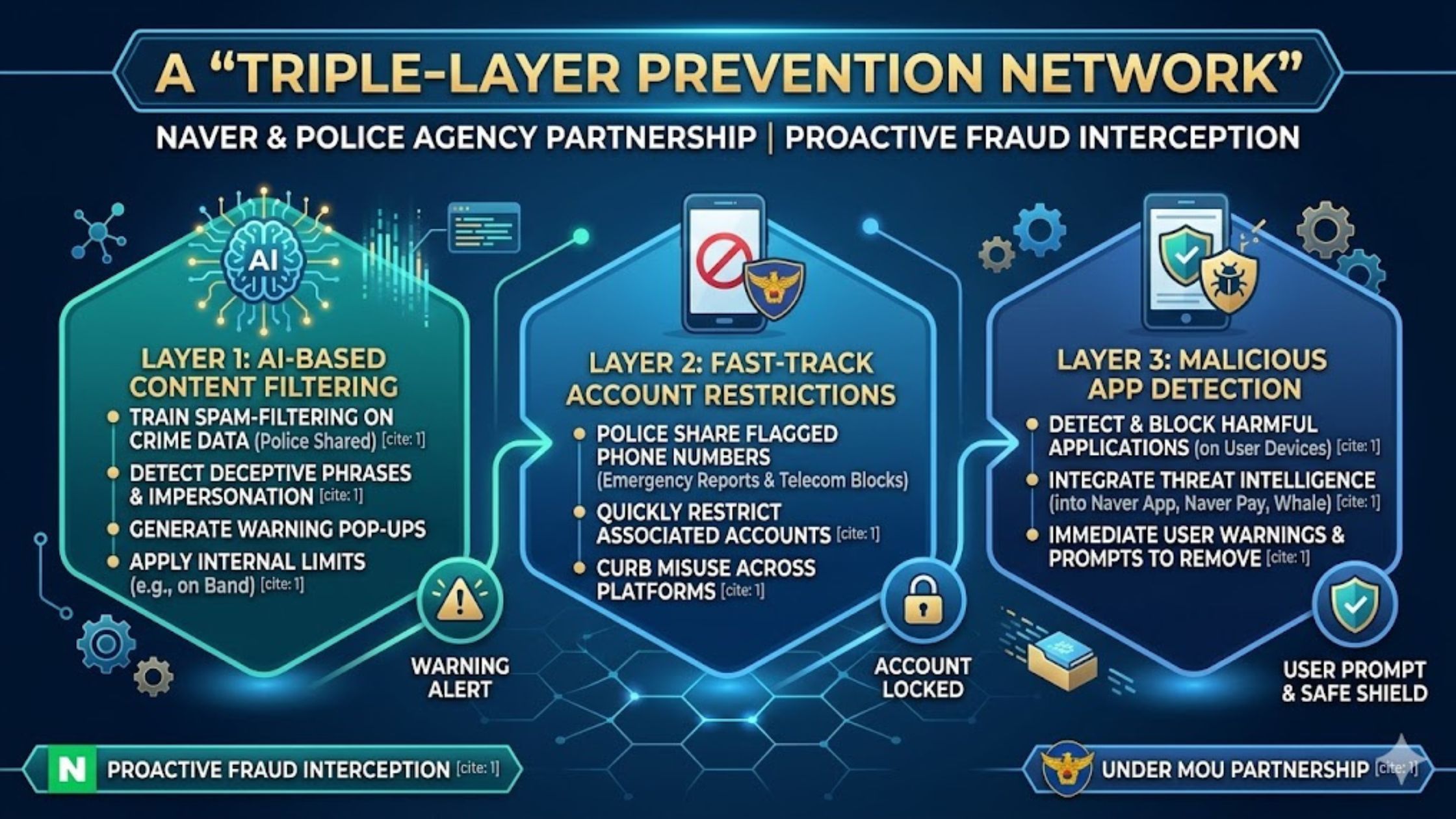
A “Triple-Layer Prevention Network”
Under the MOU, Naver will put in place a three-layer prevention system leveraging artificial intelligence and security technologies to proactively intercept fraud attempts across its platforms:
- AI-based Content Filtering: Naver will train its spam-filtering algorithms on crime data shared by the police, including deceptive phrases and impersonation keywords. When suspicious posts are detected on services such as Band, the system will generate warning pop-ups or apply internal limits to prevent harm.
- Fast-Track Account Restrictions: When the police share lists of phone numbers flagged through emergency reports and telecom operator blocks, Naver will quickly restrict accounts associated with those numbers to curb misuse.
- Malicious App Detection: Naver and the Police Agency will build systems to detect and block harmful applications on user devices. Shared threat intelligence on malicious apps linked to scams will be integrated into core services such as the Naver app, Naver Pay and Whale browser. Users running such apps will receive immediate warnings and prompts to remove them.
This layered approach combines proactive filtering, rapid blocking of harmful actors, and device-level security measures — a departure from reactive approaches that focus solely on post-incident investigation.
Naver’s Role in Safer Digital Spaces
Shin Hyo-seop, head of the Police Agency’s Integrated Response Unit for telecommunication financial fraud, described the MOU as both “practical and symbolic” in raising barriers for criminals using online platforms. He stressed that broader security cooperation with private firms is essential to safeguard citizens’ assets in a digital economy where scams continually adapt.
Shin said the agreement represents both a concrete and meaningful step toward making it harder for criminals to exploit online platforms. He added that the police plan to deepen cooperation with private companies to better protect citizens from financial fraud.
Naver’s Chief Risk Officer, Yoo Bong-seok, noted that the company has been enhancing its internal pattern-detection tools to identify phishing and harmful behaviour, including efforts to block lures to external scam sites. Through the partnership, he said, Naver aims to build “a faster and more advanced response system” and continuously improve its capabilities to protect users.
“Going forward, by working with the Police Agency, we plan to establish a faster and more sophisticated response system and continuously enhance our capabilities to protect users,” Yoo said, highlighting the company’s commitment to safer internet environments.
Beyond Technical Measures
The MOU reflects a broader shift in how telecommunication financial fraud is being addressed in South Korea. Recent government data shows voice phishing incident numbers and associated financial losses have begun to decline after a pan-government crackdown, but authorities recognise that online platforms and evolving scam techniques require new kinds of partnerships and tools.
By incorporating real-time police intelligence into AI-based filters, sanctions and device-level protection, the agreement seeks not only to disrupt individual harmful acts but also to raise the cost and complexity for would-be fraudsters. This may set a model for how digital platforms and public agencies collaborate on cyber fraud prevention in an era of rapid digital transformation.
In this context, the Naver–Police Agency partnership illustrates how fraud prevention is shifting from reactive investigation to preventive infrastructure. Rather than relying solely on post-crime enforcement, authorities and platforms are attempting to embed safeguards directly into digital ecosystems. If effective, this approach could redefine how online financial crime is managed in South Korea — making prevention an integrated function of major platforms instead of a separate law enforcement task. The success of this model may influence future collaborations between technology firms and regulators as digital fraud continues to evolve.