
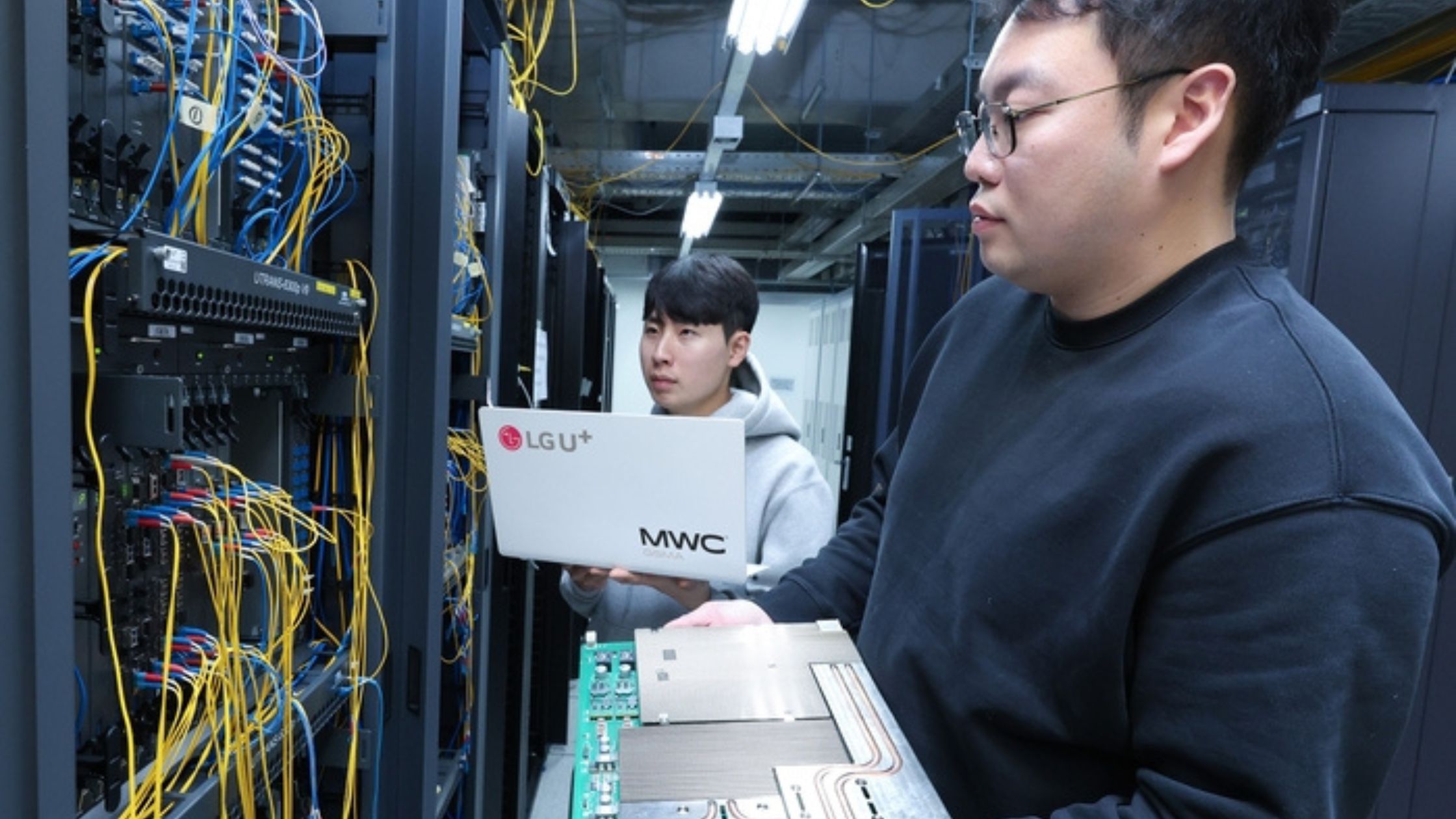
Company positions prevention-focused architecture as response to AI-driven cyber threats.
LG Uplus said it will debut its integrated security platform, U+SASE, at Mobile World Congress (MWC) 2026 in Barcelona next month. The move comes as enterprises face increasingly complex cyber threats driven by the rapid expansion of artificial intelligence (AI) and cloud technologies. The platform aims to consolidate diverse security functions across corporate IT environments — including endpoints, networks, clouds and servers — into a unified model to prevent gaps in protection.
U+SASE, currently under development, is a broader shift in enterprise cybersecurity: moving from fragmented, device-by-device defenses toward a network-centric approach that monitors and secures all access points in real time. LG Uplus said the platform will help organisations reduce operational burdens and maintain consistent security across increasingly distributed environments.
Traditional enterprise security systems often require separate tools for PCs, servers and network elements, which can increase complexity and cost while leaving gaps in coverage. By integrating security processes at the network level, U+SASE aims to deliver unified visibility and control across all segments of IT infrastructure.
“Through comprehensive monitoring and control of distributed IT resources, we can minimise security blind spots,” a company spokesperson said, underlining U+SASE’s emphasis on network-wide protection rather than isolated solutions.
AI-Driven Threat Detection with AlphaKey
At MWC26, LG Uplus will also showcase AlphaKey, an AI-powered cloud-based account management solution designed to identify abnormal access patterns early. The system learns normal user and administrator behaviours — such as login location, device type and access history — and flags deviations in real time.
For example, if a user logs in outside of regular business hours and performs unusually high-volume data queries or downloads, AlphaKey can restrict access and notify administrators automatically. By detecting anomalies at the sign-of-suspicion stage, LG Uplus says it can mitigate threats before they escalate into breaches.
Data Protection Through Homomorphic Encryption
Another significant technology in the company’s showcase is homomorphic encryption, planned for future use in its AI calling application, ixi-O. Unlike conventional encryption — which must be decrypted for data processing, potentially exposing plaintext — homomorphic encryption allows computation directly on encrypted data without revealing its contents.
This means that even if encrypted data is intercepted or a device is hacked, the attacker cannot interpret the data’s original content. LG Uplus said this approach could fundamentally reduce risk in high-value data environments.
Preparing for Quantum-Era Threats with PQC
In addition to encryption, LG Uplus will present optical transmission equipment based on post-quantum cryptography (PQC) — cryptographic methods designed to remain secure even against attacks by quantum computers. These algorithms are built on mathematical problems that current and future quantum machines cannot easily solve.
LG Uplus said its system supports a range of latest PQC algorithms proposed by global bodies such as the U.S. National Institute of Standards and Technology (NIST) and Korea’s Post-Quantum Cryptography Research Group, enabling organisations to adopt quantum-resistant protections as needed.
U+SASE: Unified Security for an AI Era
U+SASE itself is presented as a Security Access Service Edge (SASE) platform that unifies networking and security into a single service, simplifying management and improving responsiveness compared with traditional siloed security solutions. Unlike piecemeal approaches, the platform delivers integrated real-time monitoring and threat mitigation across an organisation’s digital footprint.
The platform also incorporates features tailored to the generative AI age, such as automatic filtering of risky prompts, masking of sensitive information and AI-based data loss prevention, designed to block internal data leaks through AI-assisted channels.
LG Uplus executives said the suite of technologies on display at MWC26 reflects a wider security strategy prioritising prevention over reaction — a response to the increasing sophistication of AI-related threats. Ju Eom-gae, head of LG Uplus’ wireline business, said the company aims to provide security technologies that instill confidence in customers amid rising AI-based hacking threats.
“Our goal is to deliver security solutions that customers can trust,” Ju said, adding that LG Uplus will continue to refine and expand its offerings to stay ahead of evolving cyber risks.