
As artificial intelligence investment accelerates, Korea’s emerging AI startups are navigating a market dominated not by Silicon Valley, but by powerful domestic tech conglomerates.
South Korea’s digital economy is among the most platform-concentrated in the world. A small number of technology groups dominate search, messaging, payments, e-commerce and telecommunications — sectors that now form the foundation for AI deployment. Naver and Kakao control large-scale consumer data ecosystems, while Samsung Electronics and major telecom operators anchor hardware and network infrastructure.
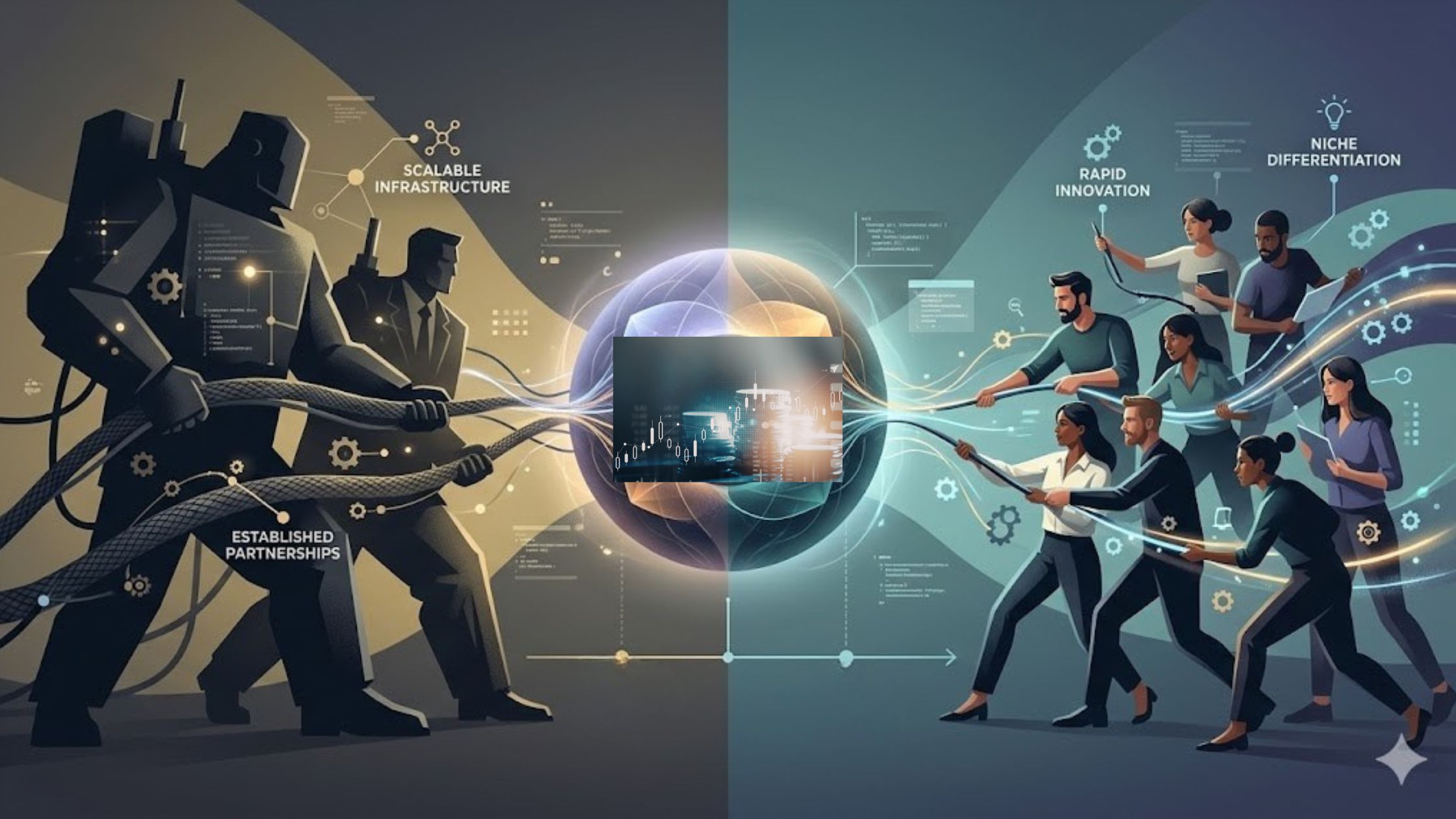
As artificial intelligence becomes embedded across these systems, Korea’s AI startups are entering a market where incumbents already command scale advantages in data, capital and enterprise relationships. The central competitive dynamic is not simply global rivalry, but the balance between entrepreneurial agility and corporate dominance within Korea’s own technology landscape.
The Structural Advantage of Korea’s Tech Giants
Major Korean technology companies have moved aggressively into AI development. Naver has invested heavily in its HyperCLOVA language model series, building large-scale infrastructure and positioning itself as a domestic alternative to foreign AI systems. Kakao, with its messaging, payments and content ecosystem, holds powerful distribution channels. Samsung Electronics maintains influence across hardware, semiconductors and device integration. Telecommunications operators such as SK Telecom and KT Corporation provide network infrastructure and cloud services increasingly tied to AI deployments.
These firms benefit from several structural advantages:
- Established enterprise clients and government contracts
- Direct access to large-scale user data
- In-house data centers and compute capacity
- Strong capital reserves for long-term AI investment
In contrast, startups often depend on rented cloud capacity and must negotiate access to enterprise customers.
What Startups Bring to the Table
Despite these structural asymmetries, Korea’s AI startups are not without advantages. Smaller firms tend to move faster, iterate more quickly and focus on specialized use cases rather than competing head-on in the foundation model race.
For example, Upstage has focused on document AI and enterprise-oriented large language model optimization rather than building a broad consumer platform. Wrtn Technologies has concentrated on generative AI applications tailored to Korean-language users, positioning itself in the consumer productivity segment. In education technology, Riiid applies AI to personalized learning and assessment, leveraging domain-specific datasets instead of attempting large-scale general-purpose model development.
Startups also face fewer legacy constraints. Large conglomerates must balance AI investments with existing business units, regulatory scrutiny and shareholder expectations. Startups, by contrast, can pivot more aggressively and test experimental approaches without affecting broader corporate operations.
This flexibility has enabled several Korean startups to develop competitive niche capabilities — particularly in Korean-language optimization, vertical AI services and applied enterprise tools. While they may not match the compute scale of domestic tech giants, their ability to specialize allows them to target segments where speed, customization and domain expertise matter more than model size alone.
The Compute and Capital Gap
However, the gap in infrastructure remains significant. Foundation model development requires large-scale GPU clusters, extensive storage and high electricity consumption. For startups, accessing such compute capacity often involves costly cloud contracts, while large corporations may operate proprietary data centers or secure preferred hardware allocations.
Funding disparities also influence scale. Conglomerates can allocate billions of won to AI R&D across multiple divisions. Startups, even those with venture backing, typically operate on far narrower budgets. As AI models grow more computationally intensive, the cost of training and fine-tuning systems becomes a major barrier.
This does not make competition impossible, but it shifts the nature of competition. Rather than racing on model size, startups may focus on efficiency, optimization and application-layer innovation.
Distribution and Market Access
Another structural challenge lies in distribution. Korea’s digital platforms are highly consolidated. Companies like Naver and Kakao already serve as gateways to search, messaging, payments and content. Integrating AI tools into these ecosystems provides immediate scale and user reach.
Startups, in contrast, must secure partnerships or carve out independent channels. Enterprise adoption can also be influenced by existing vendor relationships. Government procurement and large corporate contracts often favor established providers with proven track records.
As a result, even technically competitive startup solutions may face barriers in scaling beyond pilot projects.
The Global Layer of Competition
While domestic dynamics dominate the Korean landscape, global AI leaders add another layer of competitive pressure. Multinational firms such as OpenAI, Google and Microsoft provide widely adopted APIs, cloud infrastructure and foundation models that Korean companies — both startups and conglomerates — increasingly integrate into their services.
For instance, many Korean startups rely on OpenAI’s GPT models or Google’s AI services for backend language processing rather than training their own large-scale models from scratch. Even larger firms, including SK Telecom and KT Corporation, have formed partnerships with global AI companies to accelerate deployment of generative AI services. Meanwhile, cloud providers such as Amazon Web Services and Microsoft Azure supply much of the GPU infrastructure used by Korean developers.
This creates a three-tier competitive structure:
- Global AI platform providers controlling foundational models and cloud compute
- Korean tech giants building localized ecosystems and proprietary models
- Local startups pursuing niche differentiation at the application layer
For startups, competing directly with both global and domestic platform players may be less viable than embedding within larger ecosystems or exporting specialized AI solutions abroad. In practice, this often means focusing on vertical services — such as document processing, education AI or industry-specific automation — while relying on global foundation models as underlying infrastructure rather than attempting to replace them.
Where Startups May Find Opportunity
Despite structural constraints, opportunities remain. Korea’s strengths in manufacturing, robotics and advanced hardware integration create demand for AI solutions tailored to industrial environments. Startups that align with these sectors may find openings less contested by consumer-focused platform giants.
Additionally, Korean-language optimization and region-specific data models remain areas where local expertise matters. While global models continue to improve multilingual capabilities, domestic firms often emphasize cultural nuance, regulatory alignment and localized enterprise needs.
Export-oriented SaaS models may also allow startups to bypass domestic distribution bottlenecks by targeting overseas markets.
A Market at a Strategic Crossroads
Korea’s AI ecosystem is entering a consolidation phase. Large corporations are expanding vertically across infrastructure, data and applications, while startups experiment with specialization. Some startups may ultimately become acquisition targets for larger groups seeking innovation pipelines. Others may survive by defining clear technological niches.
The competitive question is therefore less about whether Korean startups can “beat” their domestic tech giants. Instead, it centers on how they position themselves within an ecosystem where capital, compute and distribution are unevenly distributed.
As government policy increasingly supports AI development through procurement and industrial initiatives, the balance between entrepreneurial agility and corporate scale will shape the trajectory of Korea’s AI industry over the coming years.