

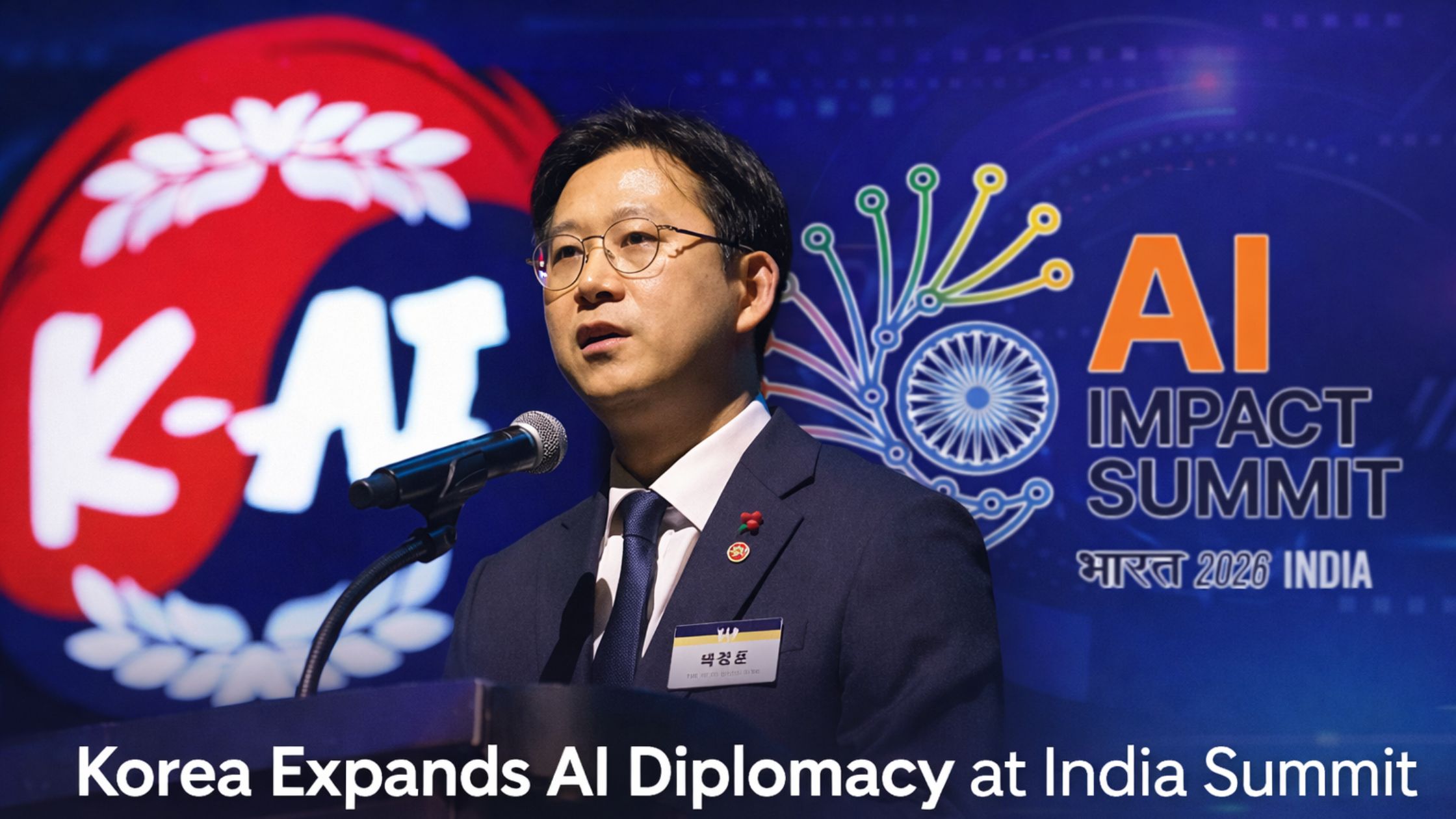
Science minister positions Seoul as a policy and innovation partner beyond traditional AI power blocs
South Korea used the India AI Impact Summit in New Delhi this week not merely as a showcase for its technology credentials, but as a strategic platform to expand its influence across the Global South through what officials describe as “AI diplomacy.”
Led by Science and ICT Minister Bae Kyung-hoon, the Korean delegation framed the country’s participation around cooperation frameworks, regulatory experience and industry partnerships. The emphasis, according to Seoul, was on building practical collaboration mechanisms rather than securing headline visibility.
The India AI Impact Summit marked the first time the global AI summit series was hosted in a Global South nation. India’s growing role in digital public infrastructure and AI deployment made it a significant venue for countries seeking to shape emerging governance norms beyond the United States, Europe and China.
For South Korea, the summit offered an opportunity to position itself as a middle-power technology partner — neither an AI superpower nor a peripheral player, but a country with operational experience in deploying AI across healthcare, manufacturing and public services.
Officials from the Ministry of Science and ICT said the goal was to expand cross-regional AI cooperation frameworks that connect policy, infrastructure and industry collaboration.
Exporting a Governance Model
A central element of Korea’s pitch was its recently enacted AI Basic Act, a regulatory framework designed to balance innovation with accountability. Rather than presenting AI solely as a growth engine, Minister Bae highlighted Korea’s experience in creating guardrails for high-risk applications while supporting private-sector development.
“Korea aims to share not only technology but also our policy experience in responsible AI governance,” Bae said during summit sessions.
By presenting its AI regulatory model as exportable, Seoul is attempting to fill a gap faced by many emerging economies: how to adopt AI quickly without lacking institutional safeguards.
Analysts say governance export can be as strategically valuable as hardware exports. Countries seeking to build AI ecosystems often require regulatory templates, data protection standards and risk classification systems. Korea’s policy framework — shaped by both innovation priorities and consumer protection debates — offers a tested middle-ground model.
Industry Diplomacy in Action
Beyond policy discussions, Korea used the summit to cultivate industry-level relationships. Minister Bae held bilateral talks with global AI firms, including executives from Anthropic, to explore cooperation in research and deployment.
Such engagements reflect a broader strategy: pairing government-led diplomacy with private-sector follow-through. By facilitating high-level meetings during multilateral events, Seoul can accelerate potential joint pilots, regulatory sandbox arrangements and co-development projects.
Industry observers note that summits of this kind often serve as incubators for practical agreements that materialize months later — including memorandums of understanding, talent exchange programs and cross-border research initiatives.
The question for policymakers is whether participation translates into measurable outcomes. Officials suggest several near-term areas of cooperation are under discussion:
- Joint AI pilot programs in healthcare and smart manufacturing
- Collaboration on AI training and talent development
- Policy dialogue platforms linking Korea and India’s regulatory agencies
- Exploration of AI applications for digital public infrastructure
If realized, these initiatives would extend beyond symbolic engagement and create tangible channels for Korean firms and institutions to participate in AI projects across emerging markets.
Strategic Benefits for Seoul: Why South Asia Matters
For South Korea, engagement at the India AI Impact Summit carries strategic weight because India sits at the center of South Asia’s digital expansion. The region is experiencing rapid growth in digital public infrastructure, AI adoption in public services and technology entrepreneurship. By deepening ties with India, Seoul is not only strengthening bilateral cooperation but positioning itself within a broader South Asian policy and innovation network.
India’s regulatory choices often influence neighboring economies that are building their own AI frameworks. If elements of Korea’s AI Basic Act — such as its risk-based classification system and emphasis on responsible deployment — resonate with Indian policymakers, that alignment could shape standards across the region. Regulatory convergence would reduce compliance uncertainty for Korean companies seeking to deploy AI solutions in healthcare, manufacturing or digital government systems throughout South Asia.
There is also a structural complementarity between the two countries. South Korea brings strengths in AI semiconductors, applied industrial AI and digital governance implementation. India offers scale — a large developer ecosystem, expanding cloud infrastructure and a vast domestic market. Cooperation therefore creates opportunities that go beyond policy exchange, potentially enabling joint pilot projects, research collaboration and cross-border technology partnerships.
More broadly, the summit reinforces Seoul’s middle-power strategy in the Indo-Pacific. Rather than aligning exclusively with major AI blocs, South Korea is cultivating relationships with emerging technology hubs. In doing so, it strengthens diplomatic flexibility while embedding itself in the institutional architecture of a region that will play a growing role in global AI deployment.
Ultimately, the value of AI diplomacy in South Asia lies in durability. If policy dialogue evolves into sustained regulatory cooperation and practical AI projects, Seoul’s influence will extend beyond hardware exports to shaping how AI is governed and implemented across the region.
Challenges and Credibility Tests
However, the diplomatic push carries risks. Exporting governance frameworks requires institutional capacity in partner countries. If local conditions limit implementation, policy alignment may remain largely symbolic.
Additionally, the commercial impact of summit engagements depends on sustained follow-up. Without concrete project announcements or pilot deployments, diplomatic momentum can dissipate.
Korea’s credibility also hinges on its domestic record. Effective enforcement of its own AI regulatory framework will influence whether other nations view its model as practical and trustworthy.
Post-Summit Developments to Watch
The true impact of South Korea’s participation at the India AI Impact Summit will not be measured by speeches or photo opportunities, but by what follows in the months ahead.
- Observers will look for formal bilateral agreements emerging from discussions held during the summit. These could take the form of memorandums of understanding on AI governance cooperation, joint research initiatives, or structured technology exchange frameworks between Seoul and New Delhi. Such agreements would signal that dialogue has moved beyond symbolic engagement into institutional alignment.
- The launch of joint pilot projects or applied research programs will serve as a tangible indicator of progress. If Korean firms or research institutes begin collaborating with Indian counterparts on AI deployment in areas such as healthcare, smart manufacturing, or digital public infrastructure, it would demonstrate that diplomatic engagement is translating into operational cooperation.
- Increased participation of Korean companies in AI-related projects across South Asia would reflect commercial follow-through. Regulatory dialogue and policy alignment often lower market entry barriers. If Korean startups or technology providers secure contracts, partnerships or pilot opportunities in the region, it would suggest that AI diplomacy is generating measurable economic pathways.
- Sustained policy dialogue mechanisms between Seoul and New Delhi will determine whether cooperation becomes durable. Regular working-level exchanges between regulatory agencies or joint forums on AI governance would indicate that the relationship is evolving into a structured partnership rather than a one-off summit interaction.
In this sense, the summit represents a strategic pivot. South Korea is attempting not only to compete in AI technology — an arena dominated by larger powers — but also to influence the governance and collaboration frameworks through which AI is deployed globally. For middle powers like Korea, shaping norms and building partnerships can be as important as technological scale.
However, this strategy carries an implicit test: influence must be institutionalized. If summit discussions fail to produce sustained engagement, the diplomatic momentum may fade. If they lead to structured cooperation, Seoul’s outreach in South Asia could become a cornerstone of its broader AI diplomacy strategy in the Indo-Pacific.