
Expanded lineup highlights Seoul’s strategy to reduce reliance on foreign AI systems while fostering competitive domestic architectures.
South Korea’s Ministry of Science and ICT has selected a consortium led by Motif Technologies Inc. to join the state-backed “Independent AI Foundation Model” initiative, expanding the field of contenders developing a homegrown large AI model. The newly appointed team, which includes academic and industry partners such as the Korea Advanced Institute of Science and Technology (KAIST), will compete alongside three previously chosen teams as the government advances its strategy for national AI capability.
The addition comes after the ministry conducted an in-depth evaluation of the bids from Motif Technologies and a rival consortium led by Trillion Labs, ultimately selecting Motif’s proposal as the additional competitor. Kim Kyung-man, director general for AI policy at the ministry, said the consortium stood out for its experience designing AI systems from an independent architecture and its ability to achieve performance comparable with global models despite operating in relatively limited data conditions.
Background: Competitive Selection Process
In January, the ministry shortlisted three elite teams led by SK Telecom, LG AI Research and Upstage after eliminating two initial applicants — Naver Cloud and NC AI — from the state-funded program. Officials signalled at the time that an additional consortium would be added to restore a four-team lineup for the next evaluation stage.
An AI foundation model is a largescale machine learning system trained on broad, diverse datasets that can be adapted for a wide range of applications, from natural language tasks to image and multimodal comprehension. The ministry has described the project as central to South Korea’s ambition to become one of the world’s top three AI powerhouses, reducing reliance on foreign-developed systems and fostering domestic innovation.
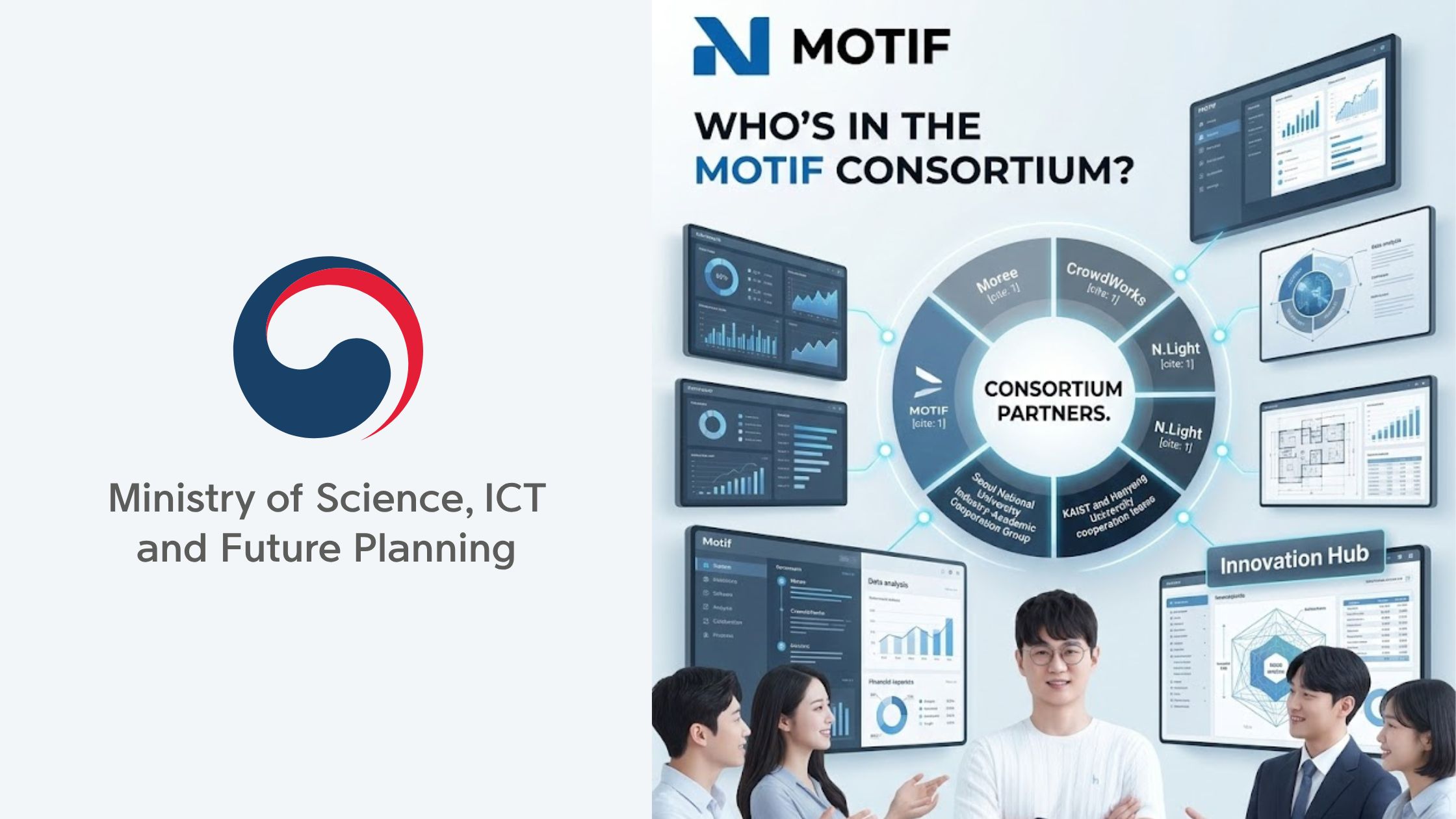
Who’s in the Motif Consortium?
Motif’s expanded team includes a mix of technology firms, research institutes and universities, such as:
- Moree, CrowdWorks and N.Light
- Seoul National University Industry-Academic Cooperation Group
- KAIST and Hanyang University cooperation teams
- Samil Accounting Corporation and other specialised partners
The breadth of the consortium reflects a push to incorporate diverse expertise across AI, data infrastructure and real-world applications.
According to the ministry’s briefing, evaluators praised the consortium not just for text-based model development but for work on foundations in image and video processing, reinforcing its level of technological internalisation.
Model Goals and Development Support
Motif Technologies has previously developed Motif 12.7B, a 12.7-billion-parameter large language model that attracted attention on international benchmarking leaderboards. Under the government project, the team plans to build models in the 300-billion-parameter class, with subsequent expansion into multimodal systems that can handle visual and behavioural data.
All four elite teams will receive hardware and data support from the state, including access to 768 Nvidia B200 GPUs and funding for data construction and processing — resources intended to level the development environment across teams.
Timeline and Evaluation Structure
To ensure fairness, the ministry has adjusted the development timeline: the initial three teams began work in January and will continue through June, while Motif’s team will develop its models from February to July. After completion, a second evaluation is scheduled for early August.
From the four teams, three will be selected following the August assessment, and in a later round before year-end, two final teams will be chosen to receive continued state backing.
Industry Reactions and Debate
While the expanded competition restores the original number of contenders, some observers question whether Motif can compete equally with teams that have been building their models since January. Critics argue that Motif’s later start — developing from scratch rather than iterating on earlier progress — could put it at a disadvantage in performance.
However, ministry officials and supporters say that including Motif enhances diversity in approaches and contributes to a more dynamic national AI ecosystem. Science Minister Bae Kyung-hoon emphasised that even leading global AI companies did not begin as large, established players, and that broad participation is crucial for innovation across the domestic tech landscape.
Why This Matters
South Korea’s sovereign AI project differs from typical government research funding in that it fosters competition among domestic teams while providing substantial infrastructure resources and public support. The emphasis on independent architecture and open innovation — including plans to open-source models and software broadly — reflects a strategic bet that local AI capabilities can underpin future industrial transformation and reduce dependency on major foreign technologies.