
Hyundai’s humanoid plan exposes a deeper debate over jobs, cost and how work gets redesigned.
Hyundai Motor’s labour union has issued a firm rejection of the carmaker’s plan to deploy humanoid robots across major assembly lines at home and abroad. The union said the move looked like an effort “aimed at cutting labor costs” and warned that “not a single robot can be deployed at worksites without an agreement between the union and management.” It added: “Under no circumstances will workers welcome the plan, as the robot deployment will bring a huge employment shock.”
Hyundai, which introduced the plan at CES and named Boston Dynamics’ Atlas as a central part of its “physical AI” strategy, says the robots will be used mainly for repetitive or dangerous tasks and will improve labour efficiency. The company has set a target to begin using Atlas-style humanoids at its U.S. Metaplant (HMGMA) by 2028. That timeline, and the blunt union response, set the stage for a debate that goes beyond one company: it asks how Korea will manage the social effects of advanced automation.
Hyundai frames the move as an efficiency and safety initiative. Its public explanation stresses three points:
- Humanoid robots can handle repetitive and hazardous tasks that are dangerous for humans;
- These machines are part of a broader “physical AI” push to expand robotics beyond fixed industrial arms;
- Robots are an investment in productivity that supports larger manufacturing plans, including capacity growth overseas.
Hyundai’s vision rests on the assumption that humanoid robots—because they can use human tools and move in human spaces—offer more flexible automation than traditional industrial robots. For management, that flexibility is a pathway to higher throughput, safer workplaces, and a new growth engine for the group.
Why unions see humanoids differently
The union response is not merely about this product or this plan. It reflects deeper concerns:
- Direct substitution: Humanoid robots look and move like humans. That visibility makes them feel like direct job replacements rather than complementary tools.
- Cost logic: Robots have predictable capital and maintenance costs; wages and long-term labour obligations do not. The union points out that an annual maintenance cost for an Atlas-type robot is estimated at about 14 million won (~$9,500), a figure the union contrasts with human labour costs.
- Production shifts: The plan to scale output at overseas plants such as HMGMA, combined with robot deployment, fuels fears that domestic production will be hollowed out.
The union’s rhetoric captures a broader political and social worry: that large-scale robot deployment could change the bargaining landscape and the social contract between companies and workers.

Government steps in as automation debate widens
The debate over humanoid robots is no longer limited to disputes between companies and labour unions. In South Korea, it is increasingly drawing in the government, reflecting concern that rapid advances in robotics and AI could reshape employment faster than existing labour systems can adapt.
Following growing public discussion around automation and job security—including reactions to Hyundai Motor’s humanoid robot plans—government agencies such as the Ministry of Employment and Labour have begun examining policy responses. Officials have pointed to the need for an “AI and job transition roadmap” that addresses how workers can move into new roles as technology changes the nature of work.
The government’s involvement has recognized that automation is not just a corporate efficiency issue, but a structural labour challenge. Policymakers are increasingly focused on questions such as how quickly jobs may change, which skills will be displaced or newly demanded, and whether current retraining systems are sufficient to support mid-career workers in manufacturing.
This approach mirrors broader policy discussions already underway in areas such as artificial intelligence regulation and workforce development. Rather than attempting to block automation, the government appears to be positioning itself as a mediator—seeking to balance industrial competitiveness with employment stability by encouraging reskilling, transition support, and dialogue between labour and management.
For now, concrete measures remain limited, but the shift in tone is notable. By acknowledging job transition risks early, the state is signalling that future disputes over robots in factories will likely be addressed not only at the bargaining table, but also through national labour and industrial policy frameworks.
Here’s an expanded, more explanatory version of that section, written to slow the reader down and clearly explain why humanoids change the labour debate. I’ve kept bullets where they help structure, but added depth and examples.
Humanoids vs traditional automation: what’s different?
Automation is not new to South Korea’s factories. Industrial robots have been used for decades in tasks such as welding, painting, and heavy lifting. These machines are usually fixed in place, designed for a single function, and kept behind safety barriers. Over time, workers and unions learned to see them as tools that support production rather than direct competitors for jobs.
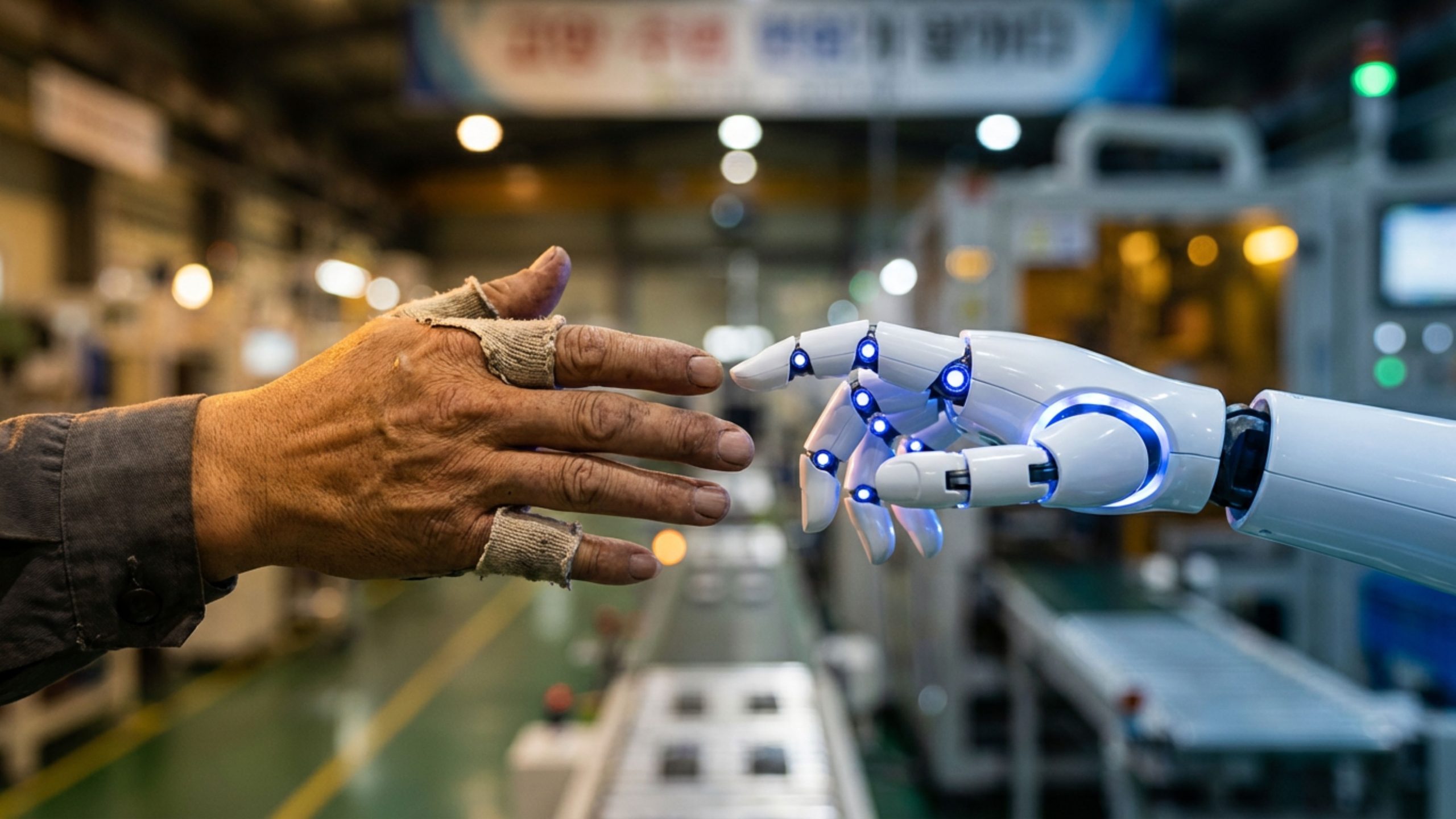
Humanoid robots represent a different category altogether. Designed to walk, lift, and operate in spaces built for humans, they are mobile, multi-purpose machines that can theoretically perform a wide range of factory tasks. This shift—from specialised equipment to general-purpose machines—changes how workers perceive risk and job security.
Several factors explain why humanoids trigger stronger resistance:
- Visibility and symbolism
A humanoid robot moving through a factory floor is highly visible and closely resembles a human worker in posture and movement. Unlike traditional robots that operate in restricted zones, humanoids share the same physical space as people. This makes them feel less like tools and more like substitutes, amplifying fears of direct job replacement even before large-scale deployment begins. - Functional flexibility
Traditional industrial robots are tied to specific production stages. Humanoid robots, by contrast, can potentially be reassigned across tasks such as assembly support, material handling, inspection, or logistics. This flexibility makes it harder for workers to predict which roles may be affected over time, increasing anxiety about long-term employment security. - Management and control implications
Deploying humanoid robots is not just a technical decision. It requires changes to workflow design, software systems, safety protocols, and supervision models. From a labour perspective, this raises concerns about how performance is monitored, who controls task allocation, and whether human roles may gradually shrink as robots take on more responsibilities. - Pace of change
Because humanoids can be updated through software rather than hardware alone, their capabilities may expand faster than traditional machines. Workers fear that even if robots are initially limited to narrow tasks, future upgrades could quickly extend their scope, outpacing negotiations or retraining efforts.
Together, these differences explain why unions view humanoid robots not as a continuation of past automation, but as a qualitative shift in how work is organised. The technology challenges not only specific jobs, but also the boundaries between human labour, machine assistance, and managerial control within the factory.
Is the dispute about jobs or job redesign?
At the heart of the conflict over humanoid robots is a deeper question: are companies planning to eliminate jobs, or to change what those jobs look like? The answer is not straightforward, because several outcomes can unfold at the same time, depending on how automation is introduced and governed.
One possibility is direct job displacement. In this scenario, robots permanently replace human workers, leading to a reduction in total headcount over time. From the union’s perspective, this is the most immediate and visible risk. Even if robots are initially limited to certain tasks, workers fear that gradual expansion and efficiency gains could make some roles redundant, especially in large-scale assembly operations where cost pressure is constant.
A second possibility is task substitution and job redesign. Here, robots take over physically demanding, repetitive, or hazardous tasks, while humans move into roles that require oversight, problem-solving, quality control, or coordination. Companies often highlight this model when defending automation plans. However, for workers, the promise of redesign raises practical concerns: whether enough new roles will exist, whether retraining will be funded, and whether older or less technical workers will realistically be able to transition into these positions.
The third and more subtle issue is a shift in power and bargaining dynamics. Even if robots do not immediately replace large numbers of workers, their presence can alter negotiations over wages, working conditions, and job security. When companies have a viable non-human alternative, the leverage of labour may weaken over time. This is why unions often react strongly at an early stage, before robots are widely deployed.
Which of these outcomes dominates will depend less on the technology itself and more on decisions made by companies, unions, and policymakers. Clear retraining commitments, transparent deployment plans, and enforceable labour agreements can steer automation toward job redesign rather than job loss. Without these safeguards, however, fears of displacement and weakened bargaining power are likely to intensify, even if the initial rollout appears limited.
What companies and unions should clarify:
To reduce mistrust and avoid escalation, the following items need clear answers:
- Scope of deployment: Where exactly will robots be used and which tasks will they perform?
- Workforce plans: What retraining, redeployment or job guarantees will the company offer?
- Timing and limits: Is there a phased plan with milestones tied to workforce protections?
- Cost and economics: Transparent accounting for expected savings and how gains are shared.
- Governance: A joint oversight mechanism (management + labour) for testing and scaling robots.
Clear, binding commitments on these points could shift the debate from confrontation to negotiation.
International comparisons and lessons
Other advanced manufacturing nations have handled automation disputes in different ways:
- Negotiated automation: In parts of Europe, firms, unions and governments have negotiated phased automation tied to retraining programs.
- State-led incentives: Some countries pair subsidies for automation with funds for worker reskilling.
- Firm-driven transitions: Where companies introduce rapid automation without labour buy-in, disputes and production disruptions are more likely.
South Korea’s strong union culture means that unilateral deployment is likely to provoke political as well as industrial backlash. That dynamic can slow adoption or force more comprehensive social measures.
Coexistence between robots and workers is possible, but it requires deliberate planning rather than simple assurances. Automation is more likely to gain acceptance when robot deployment is phased and negotiated, giving workers time to prepare for changes in how work is organised.
Clear retraining and redeployment pathways are equally important. Promises of new roles only reduce anxiety if companies explain what those roles are and who will be supported in moving into them. Without this clarity, automation is easily interpreted as a threat rather than a transition.
How productivity gains are shared also shapes worker response. If the benefits of automation flow only to companies, resistance is likely to grow. Governance mechanisms—such as joint oversight committees—and broader public programmes to support job transitions can help turn automation into a managed shift instead of a source of conflict.
When these elements are present, robots can improve efficiency while limiting social disruption. When they are not, automation risks becoming a flashpoint that slows both adoption and competitiveness.
A test for Korea’s industrial model
Hyundai’s humanoid plan is more than a corporate technology bet. It is a test of whether Korea can introduce advanced automation while preserving employment stability and social trust. The outcome will depend less on the robots’ technical capabilities than on how companies, unions and the state manage the transition.
If managed transparently and jointly, robot adoption could reshape work in ways that preserve jobs while changing their content. If managed as a unilateral cost-saving measure, it will deepen conflict and could slow the pace of productive automation. For Korea’s highly integrated manufacturing ecosystem, the stakes are national: the country must decide whether to treat robots as an industrial upgrade negotiated with labour, or as a replacement to be imposed from above. The choice will shape the future of factory work for years to come.