
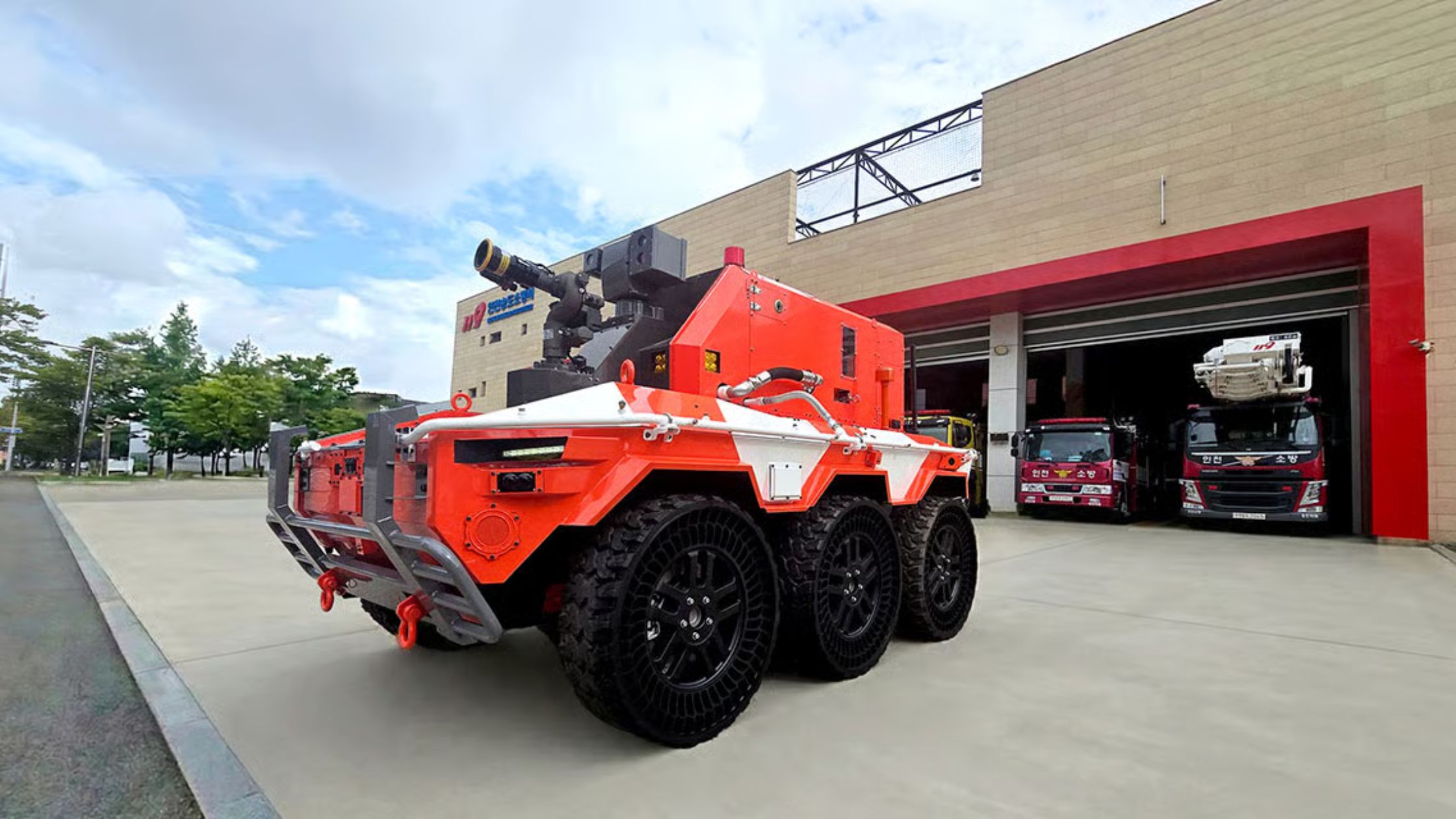
Developed with South Korea’s National Fire Agency, the unmanned vehicle is designed to operate in high-risk environments such as industrial fires and collapsed structures.
Hyundai Motor Group has released a campaign video titled “A Safer Way Home,” highlighting its newly developed unmanned firefighting robot, a remote-operated mobility platform designed to assist firefighters in hazardous environments.
The robot, unveiled and donated to South Korea’s National Fire Agency during a ceremony on February 24, represents the latest example of how robotics is being introduced into frontline emergency response. Developed through collaboration among Hyundai Motor Company, Kia, Hyundai Rotem and Hyundai Mobis in partnership with the fire agency, the platform is intended to enter dangerous fire scenes before human crews, helping assess conditions and suppress flames.
The video campaign combines real firefighting footage with interviews from frontline responders, illustrating how robotic systems could reduce risks faced by firefighters during high-temperature or structurally unstable emergencies.
Firefighters often operate in environments where conditions can deteriorate rapidly — including collapsing structures, toxic smoke, high heat and explosion risks. In such scenarios, even experienced responders may have limited visibility or access.
The unmanned firefighting robot is designed to be deployed ahead of personnel in these situations.
Operated remotely, the robot can enter high-risk zones to locate the fire source, relay real-time video to commanders and begin suppression operations. By performing initial reconnaissance and firefighting tasks, the system aims to reduce the need for firefighters to immediately enter hazardous spaces.
The campaign video features Im Pal Soon, a rescue team leader from the Central 119 Rescue Headquarters who operates the robot in the field. His narration provides first-hand insight into the risks firefighters encounter during emergency missions.
Footage in the video also shows the robot deployed at a factory fire in North Chungcheong Province on January 30, marking one of the first real-world uses of the system.
Adapted From Military Robotics Technology
The firefighting robot is based on HR-SHERPA, a multipurpose unmanned vehicle originally developed by Hyundai Rotem for military applications.
For disaster response use, the platform has been redesigned to incorporate electrified mobility systems, remote operation capabilities and thermal protection technologies that allow it to operate in extreme environments.
One of the key challenges in robotic firefighting systems is maintaining functionality under intense heat. To address this, the vehicle integrates a self-spraying water-cooling system and thermal insulation that allow the robot to withstand temperatures of up to 800 degrees Celsius, protecting its battery and electronic control systems.
The platform also includes sealed electrical modules designed to resist dust and water exposure, improving durability in fireground conditions.
Technologies That Enable the Robot
Several core technologies allow the robot to operate effectively in complex emergency environments.
Navigation and Terrain Handling
The robot is equipped with an advanced driving assistance system that detects surrounding terrain and obstacles. This allows operators to maneuver through narrow passages or debris-filled environments where conventional vehicles would struggle.
The vehicle can reach speeds of up to 50 kilometers per hour and climb steep slopes, enabling access to areas such as underground parking structures, warehouse ramps and industrial facilities.
Thermal Imaging and Vision Systems
Using infrared thermal imaging sensors, the robot can transmit real-time video even when visibility is reduced by dense smoke or darkness. These cameras help operators identify fire sources, locate potential hazards and monitor conditions inside structures.
Illuminated Fire Hose System
The robot carries a photoluminescent high-pressure hose reel designed to emit light in dark or smoke-filled environments. In traditional firefighting operations, hoses often serve as navigation guides for firefighters inside buildings.
By incorporating illumination into the hose, the system improves visibility and can help responders maintain escape routes during operations.
Six-Wheel Electric Drive
The robot uses a 6×6 in-wheel motor system developed by Hyundai Mobis, with an individual electric motor embedded in each wheel.
This configuration allows the vehicle to rotate in place and maneuver in tight spaces. The design also eliminates the need for a central drive shaft, improving mechanical efficiency and control.
Robotics Becoming Part of Modern Disaster Response
Hyundai’s firefighting robot reflects a broader trend toward the use of robotics in emergency and disaster response.
Around the world, research institutions and emergency agencies have been exploring robotic systems that can enter dangerous environments where human access is difficult or unsafe.
In the United States, for example, firefighting robots such as Thermite RS3, developed by Texas-based company Howe & Howe Technologies, have been used by fire departments to tackle large industrial fires and hazardous material incidents. The tracked robot can spray thousands of liters of water per minute and is often deployed in chemical plants or fuel storage facilities.
Japan has also invested heavily in robotic disaster response technologies following the 2011 Fukushima nuclear disaster. Japanese agencies have tested firefighting robots capable of operating in collapsed buildings and nuclear facilities where radiation or structural damage poses extreme risks to humans.
These systems vary widely in design — from large tracked suppression robots to smaller reconnaissance drones — but they share a common goal: keeping firefighters out of the most dangerous environments whenever possible.
Expanding Hyundai’s Robotics Ambitions
The unmanned firefighting robot also reflects Hyundai Motor Group’s growing investment in robotics beyond its traditional automotive business.
In recent years, the company has expanded into areas such as logistics robots, autonomous mobility platforms and industrial robotics through partnerships and acquisitions, including its investment in robotics company Boston Dynamics.
By adapting automotive technologies such as electric drivetrains, sensors and autonomous navigation systems, Hyundai aims to develop robotic platforms that can operate in sectors ranging from logistics to disaster response.
During the robot donation ceremony, Hyundai Motor Group Executive Chair Euisun Chung emphasized the safety motivation behind the project.
“Firefighters who rush into danger without hesitation to save lives remind us of the values our society must uphold,” Chung said. “The unmanned firefighting robot represents technology designed to protect those who protect others.”
Officials from the National Fire Agency described the project as an early step toward integrating advanced technologies into frontline disaster response.
“This initiative marks the beginning of a new approach to disaster response that incorporates robotics and advanced mobility technologies,” said Seung-ryong Kim, acting commissioner of the Korea National Fire Agency.
Early Deployment Across South Korea
Several units of the robot have already been deployed to specialized rescue teams across South Korea.
Two systems are currently assigned to 119 Special Rescue Teams, with additional units scheduled for deployment to provincial fire headquarters. The robots are expected to support operations such as early fire suppression, reconnaissance inside hazardous structures and response to incidents involving toxic gases or explosion risks.
While still in early stages of deployment, the technology highlights how robotics could gradually reshape disaster response operations — shifting some of the most dangerous tasks from human firefighters to machines designed to operate in extreme conditions.