
Private-sector alliance aims to reduce import dependence, strengthen local capabilities, and accelerate automotive chip development
Hyundai Mobis, the auto parts division of Hyundai Motor Group, has initiated Korea’s first private-sector alliance focused on automotive semiconductors. The collaboration brings together 23 companies and research institutions, including LX Semicon, DB HiTek, SK Key Foundry, Samsung Electronics, and the Korea Electrotechnology Research Institute, aiming to establish a unified domestic value chain for vehicle chips. The initiative seeks to reduce dependence on imported semiconductors and strengthen Korea’s position in the rapidly expanding global automotive chip market, valued at approximately 200 trillion won.
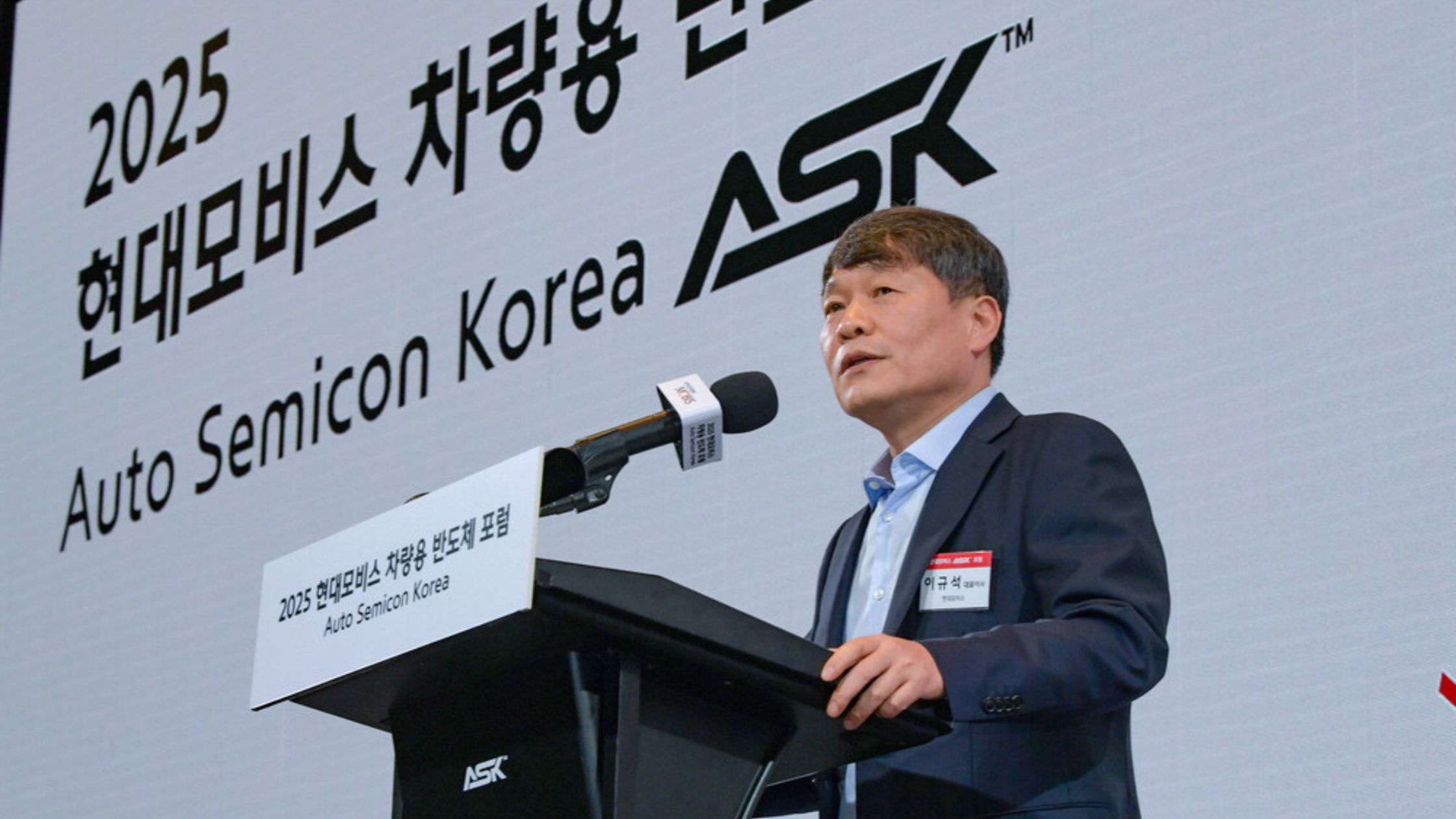
The alliance was formally introduced at the inaugural Auto Semicon Korea (ASK) forum on September 29, held at the DoubleTree by Hilton in Pangyo, Gyeonggi Province. Hyundai Mobis CEO Lee Gyu-suk, alongside senior executives from participating organizations, emphasized the strategic importance of localizing semiconductor production to secure supply stability and strengthen Korea’s position in global automotive technology.
Building a Self-Sustaining Domestic Semiconductor Ecosystem
The ASK forum gathered around 80 executives from 23 domestic companies and research institutes. It served as a platform to discuss collaboration opportunities, share technological insights, and coordinate efforts to develop a sustainable domestic automotive semiconductor ecosystem.
Hyundai Mobis aims to independently design and manufacture more than 10 types of automotive chips, including electronic control units (ECUs) and microcontroller units (MCUs), over the next two to three years. The company stressed that automotive semiconductors require stringent durability and reliability standards, which have historically limited domestic production and maintained heavy reliance on foreign suppliers.
The alliance intends to establish a self-sustaining value chain connecting automakers, chipmakers, and research institutions. Hyundai Mobis, as a Tier-1 supplier, leverages its in-house design expertise, production capabilities, and controller know-how to coordinate these efforts. Currently, the company produces 16 types of semiconductors through external foundries, reaching an annual output of around 20 million units.
Rising Demand and Strategic Importance
The demand for automotive semiconductors is increasing rapidly due to vehicle electrification and autonomous driving technologies.
- Internal combustion engine (ICE) vehicles require roughly 200 chips per car.
- Electric vehicles (EVs) need about 1,000 chips.
- Fully autonomous vehicles may require over 2,000 chips.
Despite the growing demand, Korean-made automotive chips currently account for only 3-4% of the global market, with Taiwan’s TSMC controlling about 70% of MCU supply. This supply imbalance has highlighted the need for Korea to develop a robust domestic semiconductor ecosystem to avoid production disruptions like those experienced during the COVID-19 pandemic.
Progress Through Strategic Partnerships
Hyundai Mobis is already seeing results from collaborative projects. Joint developments with GlobalFoundries and Dongwoon Anatech on next-generation automotive lamps and power drive semiconductors are nearing completion, with mass production expected as early as next year. By integrating the development of power semiconductors and key components, Hyundai Mobis anticipates reducing R&D timelines by up to two years compared to developing each component individually.
The company also plans to expand the application of automotive semiconductors into other sectors, such as robotics, where similar high-reliability components are required. Hyundai Mobis views this diversification as a natural extension of its semiconductor strategy, offering potential synergies across multiple mobility and technology markets.
Future Plans and Industry Impact
Hyundai Mobis intends to make the Auto Semicon Korea forum an annual event to foster continuous collaboration and expand participation to startups and technology providers. Standardizing and sharing automotive semiconductors with Hyundai Motor and Kia aims to:
- Increase production volumes per chip, making the market more attractive for domestic companies.
- Encourage broader participation of local players in the automotive semiconductor ecosystem.
- Gradually reduce Korea’s dependence on imported chips while strengthening its global competitiveness.
Through this initiative, Hyundai Mobis is positioning itself as a central player in Korea’s domestic automotive semiconductor industry, bridging the gap between automakers and chipmakers while driving innovation, securing supply chains, and preparing the country for a future dominated by EVs and autonomous vehicles.