
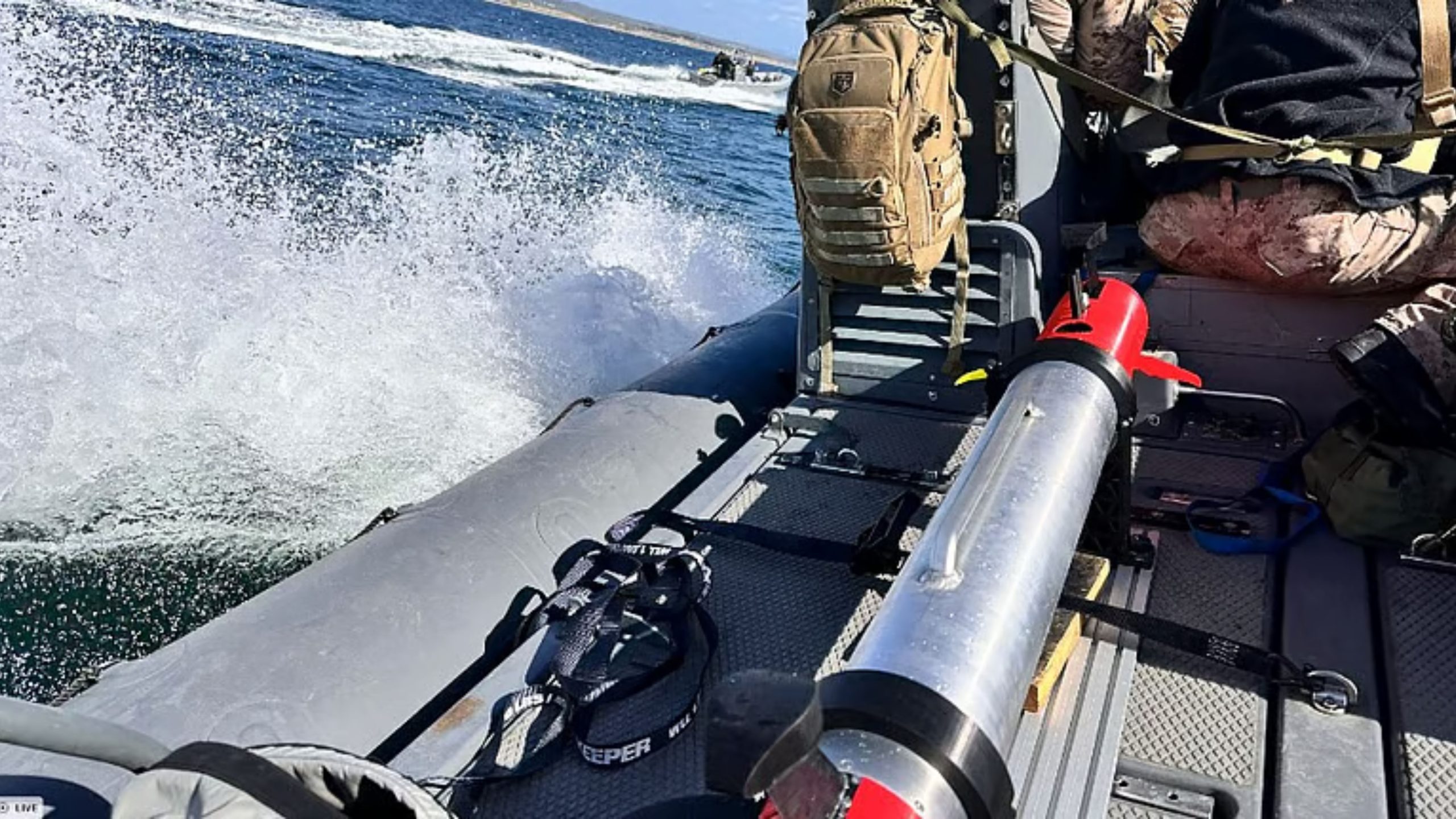
New bilateral defense project reflects growing urgency in Washington to expand autonomous naval capabilities amid China’s military rise
South Korea’s Hanwha Group has entered a new defense partnership with U.S. startup Vatn Systems to jointly develop autonomous underwater drones for the U.S. Navy. The agreement has shown deepening defense-technology cooperation between Seoul and Washington, driven by shared concerns over China’s expanding military presence in the Indo-Pacific region.
Hanwha joined an undisclosed $60 million funding round for Vatn in October, supporting the startup’s development of low-cost torpedo-shaped drones designed for surveillance and offensive missions. Priced at roughly $75,000 per unit, the drones aim to give the U.S. military a scalable and affordable underwater platform suited for modern naval operations.
Pentagon Push Accelerates Demand for Autonomous Systems
Hanwha’s investment comes as Washington accelerates efforts to strengthen the U.S. Navy’s capabilities with unmanned maritime systems. Both the Pentagon and the White House have stressed that autonomous surface and underwater platforms will be essential in potential conflict scenarios, particularly around Taiwan.
Michael Coulter, CEO of Hanwha Defense USA, underscored this shift:
“It’s going to mean unmanned aerial, unmanned surface, and unmanned underwater vehicles to win that fight,”
he told Reuters. He added that the collaboration with Vatn is well-aligned with military needs:
“We believe this partnership makes a lot of sense providing that solution to the Navy.”
Vatn Systems: A Young Company Positioned for Rapid Growth
Founded in 2023, Vatn Systems has quickly secured approximately $20 million in contracts, most of them from the U.S. Department of Defense. The startup aims to mass-produce compact underwater drones that can be deployed in large numbers, offering both affordability and tactical flexibility.
Vatn CEO Nelson Mills emphasized the strategic value of controlling the undersea domain:
“If we control undersea and control the surface, you control the lanes of commerce, you control the movement of ships, and you control the movements of troops.”
Lessons from Ukraine Inspire New Naval Concepts
The war in Ukraine has accelerated global interest in unmanned maritime platforms. Ukraine’s use of low-cost explosive speedboats against Russia’s Black Sea Fleet demonstrated how small autonomous systems can threaten large warships. These developments have fueled demand for similar systems elsewhere, despite the industry still being in its early stages.
The U.S. Navy, while an early proponent of autonomous vessels, has faced multiple setbacks — including technical challenges, slow procurement processes, and integration issues — that have delayed its deployment of a fully autonomous fleet.
Hanwha’s Expanding Footprint in U.S. Defense Technology
Hanwha brings extensive naval engineering experience, manufacturing submarines, surface vessels, and offshore platforms. Its expertise gives the partnership a significant industrial advantage as the two firms progress toward large-scale production.
However, Hanwha’s U.S. expansion has drawn geopolitical attention. China imposed sanctions on the company following its acquisition of Philly Shipyard in 2023, illustrating rising tensions over defense supply chains.
Still, Hanwha remains central to South Korea’s broader defense-tech push. The company was a prominent participant in South Korean firms’ pledge to invest $150 billion in U.S. industries this year, supporting bilateral cooperation in national security and advanced manufacturing.
Path Forward: From Prototype to Deployment
The next stage of the partnership will focus on refining prototypes and scaling production so the drones can be integrated into the U.S. Navy’s fleet. Analysts say the collaboration could accelerate development timelines by combining:
- Vatn’s agile engineering and autonomous systems expertise
- Hanwha’s manufacturing capacity and naval platform experience
If successful, the joint effort could become a model for future Korea–U.S. defense cooperation, particularly in unmanned maritime systems — a category increasingly central to naval strategy in the Indo-Pacific.