

New consultative body marks first structured channel between the government and KCTU, as policymakers confront the social impact of robotics and AI-driven industrial change.
South Korea has launched a new labor–government consultative body amid rising concern that artificial intelligence and automation could disrupt employment across key industries. The Korean Confederation of Trade Unions (KCTU), which represents more than one million workers, has partnered with the Ministry of Employment and Labor to establish a structured platform for regular dialogue.
The agreement marks the first time the ministry and the KCTU have created a formal, ongoing consultation mechanism. Under the new framework, working-level officials will meet monthly, while senior representatives — including the vice labor minister and KCTU vice leadership — will hold quarterly high-level discussions. The stated aim is to address major labor issues linked to industrial restructuring, robotics, and AI-powered production systems.
The ministry has also formed a similar consultative channel with the Federation of Korean Trade Unions and plans to launch another with the Korea Enterprises Federation, signaling a broader effort to manage technological transition through parallel dialogue tracks.
“Human-Centered” Transition vs. Market-Driven Automation
At the launch ceremony, KCTU Vice President Lee Yang-soo framed the moment as a turning point for labor policy.
“Korean workers are now confronting new challenges, not only from changes in the broader environment but also from industrial restructuring and the rise of AI, which are reshaping both employment and how work is organized,” Lee said.
“The government should take on institutional responsibilities that go beyond the level of individual enterprises.”
Lee emphasized that as employment structures evolve, the protection of basic labor rights — including the right to organize — must remain guaranteed. The union has repeatedly argued for a “human-centered” transition, warning that technological progress without adequate safeguards could increase inequality.
In response, Vice Labor Minister Kwon Chang-jun described the consultative body as a significant shift in engagement.
“Previously, we only met when conflicts arose or policy explanations were needed, but now we aim to regularly exchange opinions,” Kwon said.
He added that the government intends to gather on-the-ground input from workers and incorporate it into future policies related to AI, industrial transformation and workplace restructuring.
AI’s Real Impact on Jobs: What the Data Shows
Understanding how AI is changing work in South Korea requires more than headlines about robots and legislation — it requires looking at how technology is actually affecting jobs and skills on the ground.
According to an Organisation for Economic Co-operation and Development (OECD) survey, more than half of Korean firms that have adopted AI report that the technology has replaced specific tasks within existing jobs rather than eliminating whole jobs outright. Around 57% said AI had taken over specific tasks — and about a third said it increased the level of skills required in current roles. This suggests that in many cases AI may be reshaping how work gets done rather than simply removing positions.
However, the same report highlights structural challenges: Korean companies lag peers in AI adoption, especially in small and medium enterprises, where only about 31% use AI compared with over 50% in Germany. This gap matters because SMEs employ a large share of Korea’s workforce. Without broader upskilling and adoption support, a two-track economy could emerge: highly automated, high-skilled firms versus lagging, low-growth ones.
AI’s impact on jobs is complex — partly automating tasks, partly transforming required skills — and this nuance is critical for policy debates like the new consultative body aims to address.
Policy Responses Beyond Dialogue: Legislation and National Strategy
South Korea’s labor–government talks are not happening in a vacuum — they are part of a wider policy ecosystem aimed at managing AI’s socio-economic impact.
In early February, several lawmakers put forward draft legislation aimed at reducing the risk of job displacement caused by artificial intelligence. The proposal calls for employment protection measures to be formally incorporated into the national AI strategy, including policies to help workers retrain and move into new roles as industries evolve. Backers of the bill warn that without clear safeguards, rapid AI adoption could deepen job instability across multiple sectors.
In parallel, the government has established a National Artificial Intelligence Committee, chaired by top political leadership, to set overarching AI policy and investment directions. This committee, backed by a multi-trillion-won AI semiconductor and innovation strategy, aims to balance competitiveness with trust and governance. However, critics note that while the national strategy pushes innovation, specific guidance on workplace AI governance and worker protections is still scarce.
The government’s AI policy is multi-layered — from national strategy and innovation funding to job protection bills and tripartite consultations — but implementation details and worker protections remain central unresolved questions.
AI on the Factory Floor
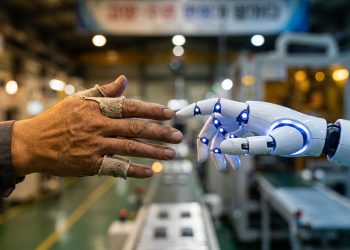
The consultations come as automation initiatives move beyond experimentation and into full-scale rollout. Hyundai Motor recently unveiled plans to manufacture its Atlas humanoid robots in large volumes at a US plant by 2028, with phased deployment across production lines. The company describes the effort as a key pillar of its “physical AI” roadmap, aiming to integrate AI-driven machines into manufacturing processes to handle routine and potentially dangerous work.
While companies argue that such systems improve safety and productivity, labor groups fear long-term displacement and a shift toward more precarious employment arrangements. The debate is no longer theoretical; it is increasingly tied to corporate investment roadmaps.
Employment Data Adds Urgency
Recent labor statistics have added weight to the debate. While overall employment in South Korea rose slightly compared with a year earlier, the internal breakdown presents a more complex picture. Jobs in professional and scientific technical services — including research, engineering, and IT-related roles — declined sharply. It marked the steepest drop since the current industry classification system was introduced in 2013.
This shift is notable because knowledge-intensive sectors are often expected to benefit from digital transformation. A slowdown in hiring within these fields raises questions about whether companies are adjusting workforce strategies as AI tools become more capable. A ministry official acknowledged that wider AI deployment could be one factor contributing to reduced recruitment in certain technical areas, though no direct causal link has been formally confirmed.
The data suggests that AI’s impact may be less about immediate mass layoffs and more about structural adjustment. Companies could be prioritizing automation investments and efficiency gains over workforce expansion, particularly in roles that involve data processing, analysis, or repetitive digital tasks.
For policymakers, this creates a dual and delicate challenge:
- Maintain global competitiveness in advanced manufacturing, semiconductors, and AI-driven industries
- Prevent structural displacement from widening income inequality or weakening mid-skill employment
Beyond these two objectives, the broader policy concern includes:
- Ensuring retraining and reskilling pathways keep pace with technological change
- Supporting small and medium-sized enterprises that may struggle to adapt
- Preserving job quality and labor protections as work becomes more technology-integrated
In short, the issue is not simply whether AI creates or destroys jobs. It is whether the transition can be managed in a way that distributes benefits broadly, rather than concentrating gains in capital-intensive sectors while compressing opportunities for workers.
A Shift in Korea’s Social Dialogue Model?
Beyond technology itself, the new consultative body may signal a broader institutional shift. Some observers note that creating separate one-on-one dialogue channels could reduce the role of the Economic, Social and Labor Council (ESLC), the country’s longstanding tripartite social dialogue forum.
The KCTU has not participated in the ESLC for over two decades, after withdrawing from its predecessor body in 1999. By establishing a direct channel with the union, the government appears to be pursuing a more flexible and bilateral approach to labor engagement during a period of rapid technological change.
In a statement, the KCTU warned that the outcome of the current transition will depend largely on policy direction.
“In this time of major transition, whether these developments become a disaster that forces insecurity and sacrifice onto workers or an opportunity to improve quality of life will largely depend on the government’s choices,” the organization said.
“At the center of this transition, people, not profit, have to come first.”
The formation of the consultative body does not resolve the tension between innovation and employment stability. However, it institutionalizes a space where that tension can be negotiated.
As AI moves deeper into South Korea’s factories and offices, the question is no longer whether automation will advance — but how its social costs and benefits will be distributed.